

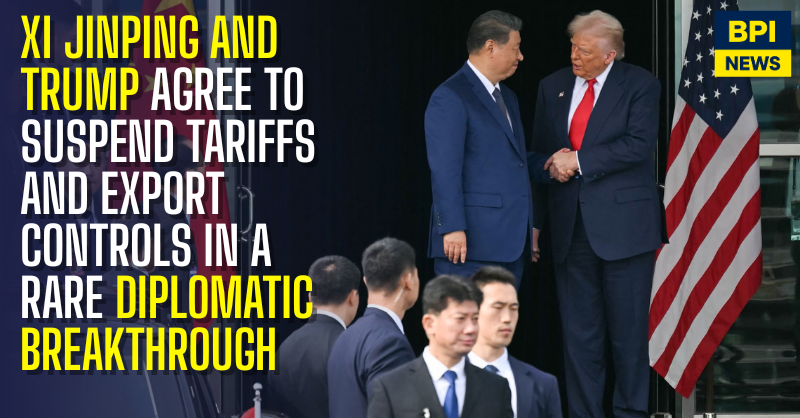
China and the United States have announced a series of mutual concessions following a high-level meeting between President Xi Jinping and President Donald Trump, marking a temporary easing in trade tensions between the world’s two largest economies.
China’s commerce ministry said on Wednesday that Beijing will suspend for one year its export control measures on rare earth elements and other materials critical to advanced technology manufacturing.
In return, Washington will also suspend for a year a rule targeting firms at least 50% owned by entities on the US sanctions list, the ministry added.
The statement said that both sides had agreed to a temporary freeze on reciprocal tariffs, with the US reducing duties on Chinese goods previously imposed in response to the flow of fentanyl-related chemicals into the country.
China will also suspend countermeasures against US industries for the same period, while Washington pauses restrictions on China’s maritime, logistics and shipbuilding sectors.
“These consultation results were hard-won,” Beijing’s ministry said. “China looks forward to working with the United States to implement them effectively.”
Trump hails ‘amazing’ talks
Speaking aboard Air Force One after leaving South Korea, Donald Trump described the meeting with Xi as “amazing” and said “a lot of decisions were made”.
“On a scale of 1 to 10, the meeting with Xi was 12,” Trump told reporters. “We agreed on tremendous things — including tariffs, fentanyl, and soybeans.”
The US president confirmed that tariffs on Chinese exports would be reduced, and that he plans to visit Beijing in April to build on the progress.
Trump also said that semiconductor production was discussed, but other “sensitive issues” were not on the agenda.
“We had an amazing discussion — very productive. China’s going to work hard to stop the flow of fentanyl into the US,” he added.
Rare earths and soybeans key to deal
Trade analysts say the agreement is not a full deal, but represents a significant de-escalation in tensions that have disrupted global supply chains.
Beijing’s decision to delay export restrictions on rare earth minerals — essential for semiconductors, electric vehicles, and defence technology — is seen as a major concession.
In return, the US has agreed to reduce tariffs and allow China to increase purchases of American soybeans, a crucial export for Trump’s rural voter base.
Trade deals of this magnitude typically take years to finalise, making the progress achieved during the meeting notable, despite the absence of a formal agreement.
Both sides have described the outcome as a temporary truce, with negotiations expected to continue in the coming months.