

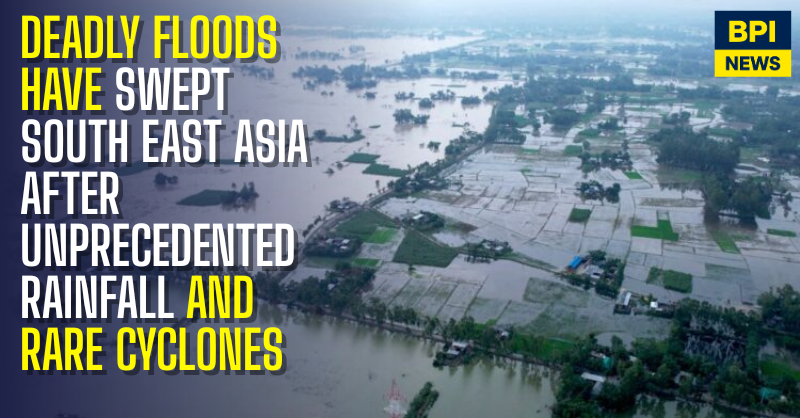
Hundreds of people are confirmed dead and many more remain missing after some of the heaviest rainfall in decades caused widespread flooding across South East Asia. Monsoon rains, intensified by tropical storms, have triggered catastrophic landslides and submerged entire communities, affecting millions in Indonesia, Thailand, Malaysia and Sri Lanka.
In Indonesia, the death toll on Sumatra island has surpassed 300, with dozens still missing. Torrential rain and flooding have swept away homes, damaged infrastructure and cut off transport routes. Evacuations are ongoing, but damaged roads and limited access to electricity and communications have hampered rescue operations. In Aceh Province, residents described fast-flowing floodwaters that engulfed streets in seconds, destroying houses and forcing survivors to cling to clotheslines for safety.
The impact has been worsened by Cyclone Senyar, a rare tropical cyclone in the Malacca Strait, which caused severe flooding and landslides in parts of Indonesia. Thousands of buildings have been submerged, and tens of thousands of residents are in temporary shelters. In Tapanuli, some residents reportedly ransacked shops for food due to shortages. Authorities in Jakarta are under pressure to declare a national disaster to improve coordination of relief efforts.
Thailand has also faced significant losses, with at least 160 deaths reported across 10 provinces. Songkhla province saw water levels rise up to three metres, leaving many stranded and destroying homes. Hat Yai recorded 335mm of rainfall in a single day, the heaviest in 300 years. Hospitals in the province were overwhelmed, with morgues forced to store bodies in refrigerated trucks. The government has announced relief measures, including compensation of up to two million baht for families who lost loved ones.
In Malaysia, flooding in the northern state of Perlis has left tens of thousands displaced. At least two deaths have been confirmed, with widespread property and agricultural damage. Civil Defence teams continue evacuations by boat as heavy rain persists.
Sri Lanka is also grappling with Cyclone Ditwah, which has killed over 130 people with around 170 missing. The government has declared a state of emergency as more than 15,000 homes have been destroyed and 78,000 people displaced. Around a third of the country remains without electricity or running water.
Meteorologists say the extreme weather is linked to Typhoon Koto near the Philippines and Cyclone Senyar in the Malacca Strait. Climate change has intensified the region’s monsoon patterns, resulting in stronger storms, heavier rainfall, and increased flooding risks.
Rescue and recovery operations continue, but authorities warn that further rain could worsen conditions in the coming days, putting more lives and communities at risk.