

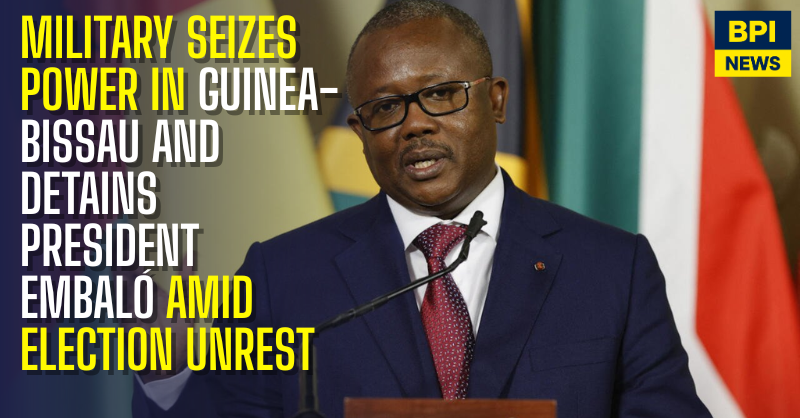
Military officers in Guinea-Bissau have seized control of the government, announcing they have detained President Umaro Sissoco Embaló and several senior political and military figures.
Gunfire erupted in the capital, Bissau, around 13:00 GMT on Wednesday, prompting chaos as hundreds fled the streets. Shortly after, a group of uniformed officers appeared on state television, declaring they had taken power and suspended the electoral process.
The announcement came just days after the country held a presidential election on Sunday, with both Embaló and his rival Fernando Dias claiming victory.
In their televised address, coup leaders said they had intervened to stop a plot by politicians “with the support of a well-known drug baron” to destabilise the country. They announced the closure of national borders and imposed a night-time curfew beginning at 19:00 GMT.
General Denis N’Canha, head of the presidential guard, read a statement declaring the formation of a “High Military Command for the Restoration of Order.” He urged citizens to “remain calm” and said checkpoints had been erected across the city.
Government sources told the BBC that alongside Embaló, Fernando Dias, former prime minister Domingos Pereira, and Interior Minister Botché Candé have also been detained. The army chief, General Biague Na Ntan, and his deputy, General Mamadou Touré, are also reported to be in custody.
Late on Wednesday, Embaló confirmed his removal in a phone call to France 24, saying: “I have been deposed.”
Portugal, the country’s former colonial power, called for a return to constitutional order, with its foreign ministry urging restraint and condemning any “act of institutional or civic violence.”
Guinea-Bissau, a nation of just over two million people, has experienced nine coups or attempted coups since gaining independence from Portugal in 1974.
The country has long been regarded as a major hub for drug trafficking, with the UN describing it as a “narco-state.” Its uninhabited coastline and islands have made it a key transit point for cocaine shipments from Latin America to Europe.
Embaló, 53, was seeking to become the first president in three decades to win a second consecutive term. However, opposition figures had questioned his legitimacy, saying his term should have ended in February 2025.
The streets of Bissau are now under heavy military control, with armed soldiers patrolling key intersections and enforcing the curfew as the population awaits clarity on the nation’s future leadership.