

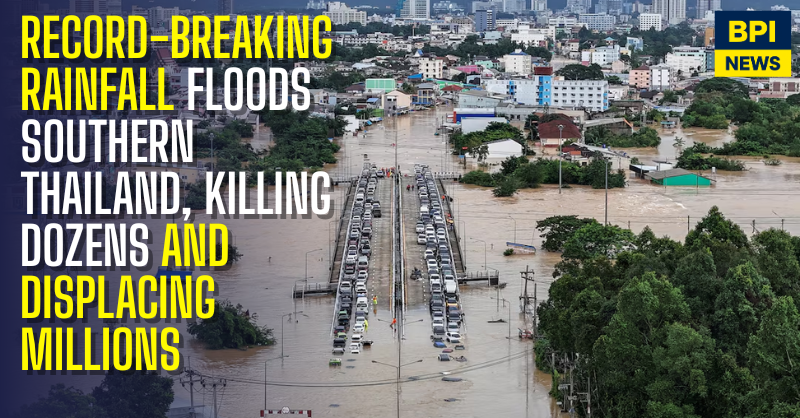
Severe flooding has devastated parts of southern Thailand, killing at least 33 people and affecting more than two million, as authorities deploy military ships and helicopters in large-scale relief efforts.
The city of Hat Yai, a major commercial hub near the Malaysian border, recorded 335mm of rain in a single day its heaviest downpour in 300 years. Streets and homes are submerged, with desperate residents stranded on rooftops awaiting rescue.
The deluge has hit ten provinces across Thailand’s south over the past week. The government declared Songkhla province, where Hat Yai is located, a disaster zone to release emergency funds. Military aircraft carriers, boats, and high-clearance trucks have been mobilised to deliver supplies and evacuate residents.
The Thai navy said its aircraft carrier could be converted into a “floating hospital” if needed, with field kitchens capable of preparing 3,000 meals per day. “We are doing everything possible to reach those who are still cut off,” said Songkhla’s governor.
Relief efforts have been complicated by widespread road closures and power outages. The volunteer-run Matchima Rescue Center said it had received thousands of evacuation requests in just three days, with many people still trapped.
Messages pleading for help flooded social media. One user wrote: “The water has reached the second floor, where there are children, the elderly, the sick, and the disabled!” Another added: “Every second is crucial now… we’ve been waiting three days for help.”
The extreme weather has also battered neighbouring countries. In Vietnam, officials confirmed 98 deaths over the past week, while Malaysia reported that more than 19,000 residents have been evacuated across the northern states of Kelantan and Perlis.
Rescue teams in Malaysia waded through knee-deep waters to reach stranded households, as 126 evacuation centres were opened across affected regions.
Meteorologists warn that more heavy rain is expected in the coming days due to a stalled monsoon system, raising fears of further flooding across South East Asia.