
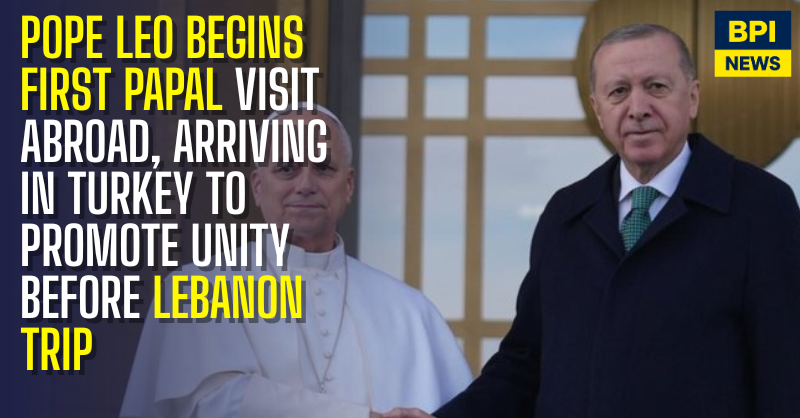
Pope Leo XIV has arrived in Turkey at the start of his first foreign trip as head of the Catholic Church, a journey focused on religious unity and interfaith dialogue at a time of heightened regional tensions.
Landing in Ankara, the Pope said his message was that “all men and women can truly be brothers and sisters, in spite of differences, in spite of different religions, in spite of different beliefs.”
The visit, originally planned by the late Pope Francis, includes stops in Iznik the site of ancient Nicaea, where bishops gathered 1,700 years ago to affirm the core tenets of Christianity, including the belief in Jesus as the Son of God. The council’s declaration later became known as the Nicene Creed, a cornerstone of Christian faith.
Pope Leo will join leaders from multiple Christian traditions in Iznik to commemorate the anniversary, in what the Vatican has described as a “moment of unity and reconciliation” between Eastern and Western churches.
During his time in Turkey, the pontiff will also visit Istanbul’s Blue Mosque, following in the footsteps of Popes Francis and Benedict XVI, and will hold meetings with Muslim, Orthodox, and Jewish leaders in a symbolic gesture of inter-religious cooperation.
The Pope will then fly to Lebanon, where his trip will continue despite Israeli airstrikes on Beirut earlier this week that killed Hezbollah’s chief of staff, Haytham Ali Tabtabai.
In Beirut, Pope Leo is expected to meet young people and faith leaders from across the Middle East, offering a message of peace and resilience to the country’s sizeable Christian community estimated to make up one-third of Lebanon’s population.
On the final day of his journey, he will celebrate Mass at Beirut’s waterfront, near the site of the 2020 port explosion, to honour the more than 200 people killed and 7,000 injured in one of the city’s darkest moments.
Vatican officials said the Pope’s visit is intended to “bridge divides and encourage dialogue”, both within Christianity and between religions.
Since his election in May, Pope Leo has earned a reputation for being measured and diplomatic, blending the progressive ideals of his predecessor with sensitivity to the views of traditionalists. He is expected to continue this balanced approach during his meetings with Turkish President Recep Tayyip Erdoğan and Lebanese civic leaders.
Unlike Pope Francis, known for his daily calls to conflict zones, Pope Leo has maintained a quieter diplomatic tone — though his consistent call for an end to war and his emphasis on human dignity have been clear hallmarks of his young papacy.
The Vatican confirmed that Pope Leo will speak primarily in English during his time in Turkey and French while in Lebanon, marking the first time the Chicago-born pontiff has used English as his main language during a public trip.