

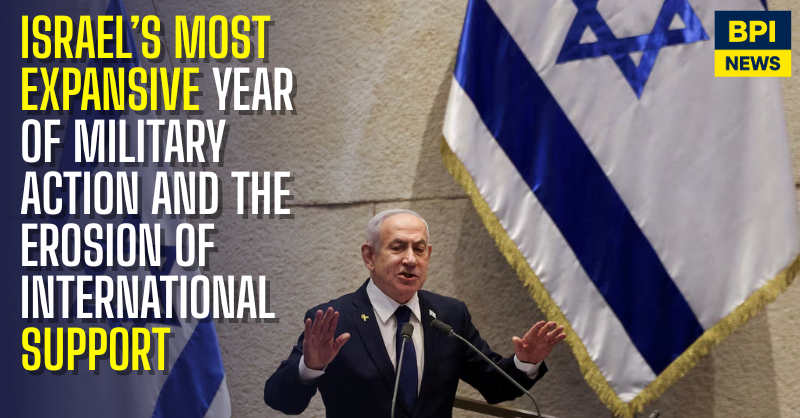
The scale of Israel’s military activity in 2025 has reshaped how the state is viewed internationally, not only by its critics but increasingly by governments that have long been among its most reliable supporters. According to data compiled by Armed Conflict Location and Event Data (ACLED), Israeli forces carried out more than 10,600 recorded attacks between January and early December, spanning at least six countries Palestine, Lebanon, Iran, Syria, Yemen and Qatar alongside strikes in Tunisian, Maltese and Greek territorial waters against aid flotillas bound for Gaza. The geographic breadth of this activity is without precedent for Israel in a single year.
The overwhelming majority of these attacks have taken place in Gaza and the occupied West Bank, where Israel has continued large-scale military operations despite multiple ceasefires announced and subsequently broken. Gaza has borne the heaviest toll, with widespread destruction, mass displacement, and repeated strikes even during periods nominally designated for humanitarian pauses. In the West Bank, Israeli forces have launched the most extensive operations in decades, targeting urban centres and refugee camps such as Jenin, Tulkarem and Nur Shams. Beyond Palestine, Israel has conducted hundreds of strikes in Lebanon, Iran and Syria, with additional actions in Yemen and the Gulf, signalling an increasingly permissive approach to cross-border and extraterritorial force.
This pattern has not gone unnoticed. While Israel continues to receive diplomatic cover from some quarters, the tone among even its closest allies has shifted. Public warnings, muted statements, and visible discomfort have replaced the near-automatic political backing of earlier years. Humanitarian agencies, including the UN’s Office for the Coordination of Humanitarian Affairs, have documented record levels of civilian harm, while international legal scrutiny has intensified. What is striking is not simply the criticism itself, but how mainstream it has become within Western political and media discourse.
Historical analogy helps explain why this shift is occurring. One of the more uncomfortable, yet instructive, comparisons lies in the behaviour of Nazi Germany during the late 1930s not in ideology, but in strategic logic. In that period, Germany justified successive military actions as defensive necessities, preventive measures, or responses to alleged provocations. Each step the Rhineland, Austria, Czechoslovakia was presented as limited and essential. Yet to external observers, the cumulative effect was unmistakable: a state increasingly willing to disregard borders, agreements, and international norms in pursuit of security defined solely on its own terms.
The relevance of this analogy lies not in moral equivalence, but in how international tolerance erodes when military action becomes habitual, expansive, and unbounded by credible restraint. In the 1930s, it was not a single act that altered global perception of Germany, but the pattern the sense that force had become the primary instrument of policy, and that pauses were tactical rather than genuine. By the time allies and neutrals alike reassessed their positions, reputational damage was already entrenched.
Applied to Israel in 2025, a similar dynamic is visible. The sheer volume of attacks, the repeated violation of ceasefires, and the extension of operations into multiple sovereign states and international waters have created an image of a country no longer acting as an embattled state responding to exceptional threats, but as one exercising military power with increasing normality. The devastation of Gaza, the displacement of its population, and the intensification of control in the West Bank have reinforced perceptions that Israel is pursuing outcomes that go beyond immediate security concerns.
The implications are significant. History shows that when a state’s use of force becomes constant rather than conditional, its diplomatic capital diminishes rapidly. Allies begin to hedge, language hardens, and legal and economic pressures follow. Even when strategic partnerships endure, they do so in a colder, more transactional form. What Israel is experiencing now is not isolation, but something more corrosive: the steady loss of moral and political credibility that once underpinned its exceptional status in international affairs.