


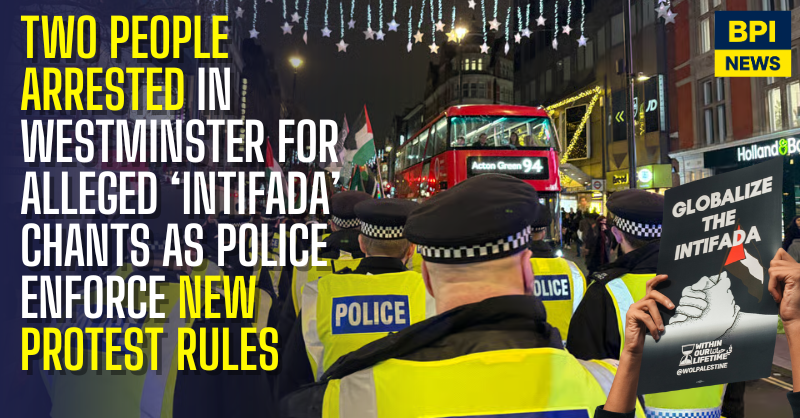
Two people have been arrested in central London after allegedly shouting slogans calling for an “intifada” (uprising) during a pro-Palestine demonstration, hours after the Metropolitan Police and Greater Manchester Police announced a new, more assertive approach to such chants.
Five arrests were made in total outside the Ministry of Justice in Westminster on Wednesday evening, with additional detentions linked to obstruction and public order offences. Officers moved in shortly after police chiefs issued a joint statement warning that chanting “globalise the intifada” or displaying the phrase on placards would lead to arrests.
The Met commissioner, Sir Mark Rowley, and the GMP chief constable, Sir Stephen Watson, said recent attacks targeting Jewish communities including two killings in Manchester and the mass shooting in Sydney had changed the threat context. They said the phrase carries “real-world consequences” and could no longer be treated as falling below prosecution thresholds.
Police said frontline officers had been briefed to apply public order powers more robustly, including around synagogues during services. The forces stressed that support for Palestinian rights could be expressed lawfully, but warned that chants interpreted as intimidating or threatening would prompt action.
The new approach has been criticised by the Palestine Solidarity Campaign, whose director Ben Jamal described it as “political repression of protest for Palestinian rights”. He said the word “intifada”, historically used by Palestinians to describe uprisings against Israeli occupation, did not inherently constitute a call for violence.
Jewish groups have argued that the chant is widely perceived as a call for further violence and that its use at demonstrations creates fear within their communities.
The Crown Prosecution Service has not confirmed whether the revised policing policy is likely to result in successful prosecutions. Senior Met figures have acknowledged privately that the force has faced sustained criticism for appearing inactive when controversial slogans are used, and that the updated guidance reflects concerns about public confidence.