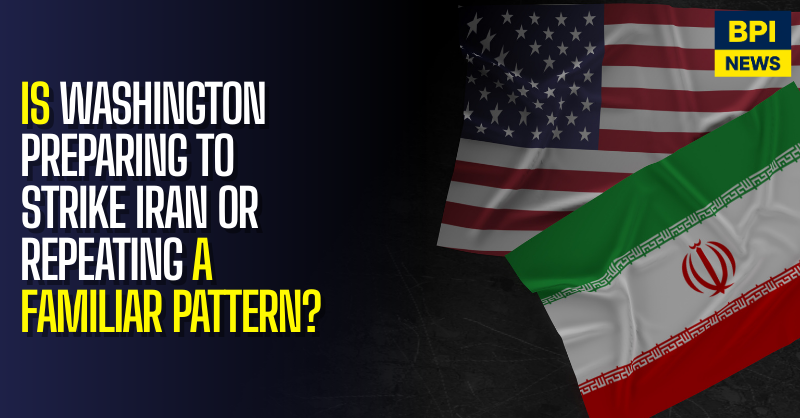
The steady build-up of American military power across the Middle East, combined with increasingly explicit warnings from Donald Trump, has reignited a question that has echoed through decades of US–Middle East relations: is this preparation for war, or preparation for leverage? The deployment of additional aircraft, missile defences, surveillance platforms and a carrier strike group has created an unmistakable atmosphere of escalation, even as Washington insists that diplomacy remains possible.
The scale of the current posture is difficult to ignore. With tens of thousands of US personnel already stationed across the Gulf, reinforced by advanced air assets and naval power, the United States now possesses the capability to strike deep inside Iran with little warning. Trump’s language, invoking past operations and warning that any future attack would be “far worse” reinforces the perception that military options are not merely theoretical. Yet capability alone does not confirm intent.
History offers useful perspective. The current moment bears resemblance to earlier episodes where force concentration was used as a tool of coercion rather than a prelude to invasion. In 1998, Operation Desert Fox saw the US and UK launch limited strikes against Iraq following months of military pressure and diplomatic deadlock. The objective was punitive and signalling, not regime change. Similarly, in 2012 and 2013, the US positioned forces against Syria amid chemical weapons concerns, only to ultimately pursue a negotiated outcome once sufficient pressure had been applied.
There is also a closer parallel in Trump’s own record. Last year’s strikes on Iranian nuclear facilities demonstrated Washington’s ability to execute long-range, high-precision operations without becoming entangled in sustained conflict. That operation was decisive but contained a characteristic of Trump’s approach to force, which favours shock and demonstration over occupation or open-ended warfare. The current military build-up mirrors that logic: overwhelming capability designed to make refusal costly, while keeping escalation technically optional.
Iran, however, is not Iraq in 1998 or Syria in 2013. It retains significant retaliatory capacity through missiles, drones and regional allies. The defensive preparations now visible at US bases in the Gulf suggest Washington is acutely aware that any strike would likely invite response, particularly against facilities in Qatar, Bahrain or the UAE. This defensive posture points as much to deterrence as to attack planning, reinforcing the ambiguity of American intent.
Another historical lesson lies in the recurring tension between signalling strength and achieving decisive outcomes. The United States has repeatedly demonstrated that it can strike almost anywhere, but history shows that translating military action into political resolution is far more elusive. Air power can damage infrastructure, degrade capabilities and kill senior figures, yet it rarely resolves the deeper strategic conflict particularly with regimes built to survive pressure.
Trump now appears caught between competing imperatives: the desire to be seen as decisive and uncompromising, and his long-stated reluctance to become trapped in another prolonged Middle Eastern war. Military pressure offers a way to reconcile both instincts, at least temporarily. It keeps the initiative in Washington’s hands while leaving the door open to negotiations framed as concessions extracted under duress.