

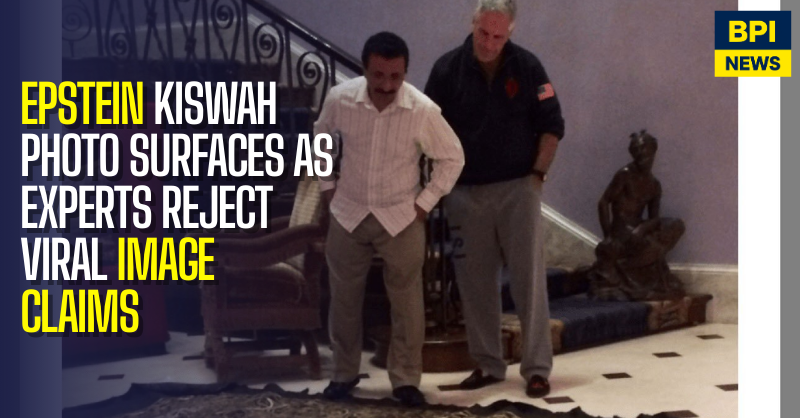
An authenticated photograph released by US authorities shows the Kaabah’s Kiswah laid on the floor inside the home of convicted sex offender Jeffrey Epstein, alongside UAE businessman Sultan Ahmed bin Sulayem.
The image forms part of material disclosed during investigations into Epstein’s contacts and activities. According to released information, the Kiswah panel was sent to Epstein by UAE-based businesswoman Aziza al Ahmadi.
The Kiswah is the cloth that covers the Kaaba, Islam’s holiest site, and is regarded as sacred by Muslims worldwide. Its presence in Jeffery Epstein’s residence has prompted strong reactions and renewed scrutiny.
At the same time, separate images circulating online have claimed to show the Kiswah laid on the ground in other settings. The Islamic media group Inside the Haramain said it conducted an internal review of one widely shared image with specialists who regularly study authenticated Kiswah material.
After detailed comparison, the group concluded that the textile in the viral image does not match an authentic Kiswah panel.
Findings From the Review
Size and scale
Reviewers said genuine Kiswah panels are wide and typically require seven to eight people to hold or move. In the viral image, the textile appeared narrow, closer to the width handled by three or four people, raising immediate doubts.
Material and structure
Experts noted that authentic Kiswah fabric is heavy and stiff because of dense embroidery and thick material. One reviewer said it would not “collapse into light creases” as seen in the circulated photo. The folds and texture were described as inconsistent with genuine Kiswah.
Outlining and contrast
Authentic Kiswah panels show strong black outlining and contrast around calligraphy and motifs. In the viral image, lighter tones dominated, with limited visible black framing where it would normally be present.
Borders and edge treatment
Specialists said the border framing and edge finishing in the viral image did not match verified Kiswah references, particularly in how border lines are formed and separated.
Pattern and motif alignment
Reviewers compared junction points, medallions and panel corners with authenticated examples and found consistent mismatches in motif placement and border flow. They said such discrepancies are a key sign of replicas.
Calls for Verification
Inside the Haramain said its assessment was based on visible, checkable features and stressed that it was not made lightly. The group also highlighted Islamic teachings that emphasise verification before sharing sensitive information linked to sacred objects.
Scholars and commentators have urged users to rely on verified sources and avoid spreading unconfirmed material, warning that misleading claims can cause unnecessary distress.
Saudi authorities have not commented on the Epstein image or on how the Kiswah panel came into private ownership.