

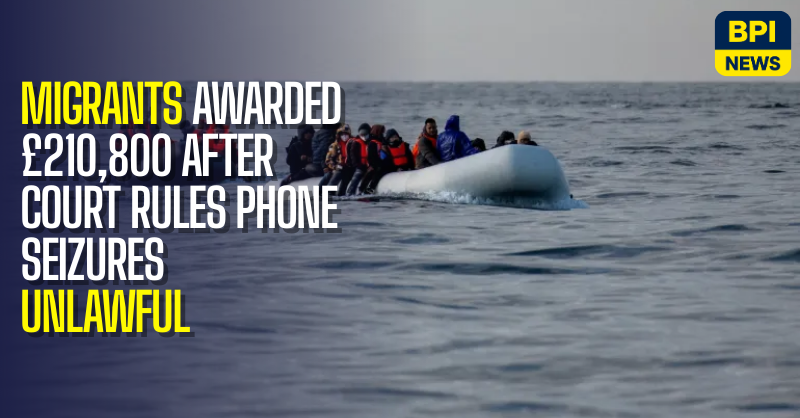
More than 70 migrants who arrived in the UK by small boat have received or are pursuing compensation after the High Court ruled that a Home Office policy to seize mobile phones on arrival was unlawful.
So far, 32 individuals have been awarded a total of £210,800, averaging £6,587 per person. A further 41 claims remain unresolved, which could increase the total to almost £480,000 if settled at similar levels.
The legal challenge arose from a policy introduced in 2020 during a surge in Channel crossings. Nearly 2,000 phones were seized between April and November that year under what the court described as a blanket approach. Until July 2020, devices and SIM cards were subjected to full data downloads. After that date, downloads were limited to cases involving a “person of interest”.
In 2022, the High Court found the policy breached Article 8 of the European Convention on Human Rights, which protects the right to private and family life. Judges ruled that phones and PIN codes were taken “without any lawful authority” and that the policy was unlawful because it had not been published.
Lord Justice Edis noted that then home secretary Priti Patel accepted the blanket seizure policy was not in accordance with the law.
The case was brought by three asylum seekers identified only as HM, MA and KH. Evidence heard in court included claims that some individuals were pressured into handing over passcodes, enabling personal data to be extracted and uploaded to an intelligence system known as Project Sunshine.
A Freedom of Information response revealed the Home Office has spent £735,000 defending the case. Of the £210,800 already paid, £163,900 was classified as direct compensation, with a further £46,900 paid through confidential settlement agreements.
Following the ruling, the court ordered the Home Office to contact affected individuals and advise them to seek legal advice.
Critics have criticised the compensation payments. Reform UK MP Robert Jenrick and campaign groups including Migration Watch UK and the TaxPayers’ Alliance said the payouts represented a misuse of public funds.
The Home Office had argued the policy was necessary to gather intelligence on people-smuggling gangs organising Channel crossings.
Since the ruling, Parliament has passed legislation making it lawful for authorities to seize electronic devices from migrants under certain conditions. Seizures have reportedly resumed at the Manston processing centre in Kent as part of efforts to disrupt smuggling networks.
Border Security and Asylum Minister Alex Norris said the government was implementing new measures aimed at tackling organised immigration crime.