

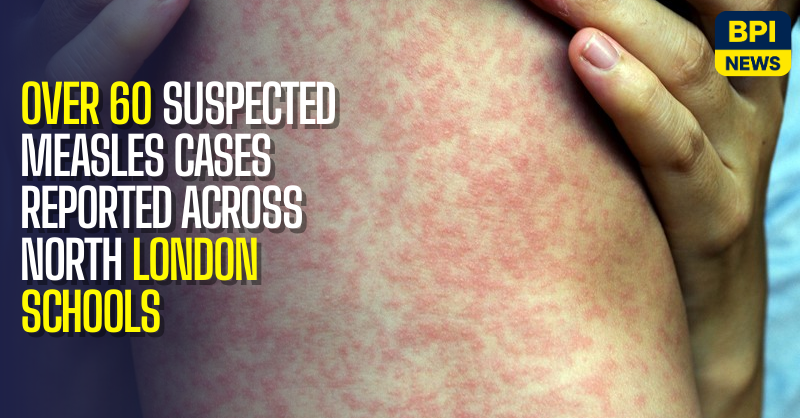
Health officials have confirmed a measles outbreak affecting several schools in north London, with more than 60 suspected cases reported.
According to the UK Health Security Agency, 34 cases were confirmed in Enfield between 1 January and 9 February. Reports indicate suspected infections across at least seven schools and one nursery in Enfield and neighbouring Haringey.
A GP practice in Enfield described the situation as a “fast spreading measles outbreak”, warning that infections had been confirmed across multiple schools and that transmission was continuing.
Officials said some children had required hospital treatment. During the current outbreak, around one in five infected children have reportedly been hospitalised, and all were not fully immunised.
Measles is a highly infectious viral illness that spreads easily among those who are not vaccinated. Symptoms include fever, cold-like illness, a distinctive rash and spots inside the mouth. While many recover, complications can include pneumonia and inflammation of the brain.
The UKHSA has previously warned that modelling of a large-scale outbreak in London could result in between 40,000 and 160,000 infections, depending on vaccination coverage. Hospitalisation rates in such a scenario were estimated to range between 20% and 40%, depending on age.
Falling immunisation rates have raised concerns among health authorities. The World Health Organization recently confirmed that the UK had lost its measles elimination status.
Dudu Sher-Arami, Enfield’s director of public health, said London has one of the lowest vaccination uptake rates in the country, making the capital particularly vulnerable to outbreaks.
Enfield Council said it is working with the UKHSA, the NHS and other local partners to manage the outbreak and limit further spread.
Councillor Alev Cazimoglu said the council was following national public health guidance to protect residents.
There is no specific treatment for measles, but two doses of the measles, mumps, rubella and varicella (MMRV) vaccine provide high levels of protection and are considered the most effective way to prevent infection and wider outbreaks.
Health officials are urging parents to ensure children are up to date with routine immunisations.