

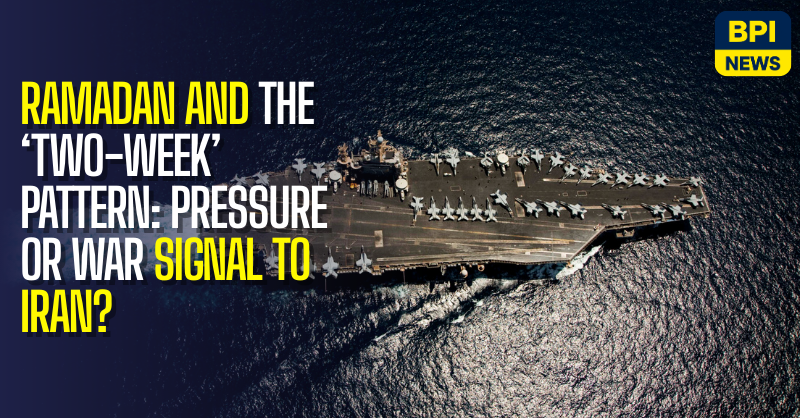
The United States latest military build-up across the Middle East has the unmistakable shape of strike preparation: carrier power moving into theatre, additional warships and aircraft deployments, visible strengthening of air defences, and heightened surveillance activity around Iranian airspace. Set against President Donald Trump’s public warnings and the memory of last year’s strike campaign against Iranian nuclear sites, the question is no longer whether Washington can hit Iran again, but whether it intends to or whether the build-up is designed to force Tehran into a deal under maximum psychological pressure.
The posture is substantial. Reuters reported that the USS Abraham Lincoln and accompanying destroyers entered the US Central Command area in late January, expanding Washington’s ability to defend forces or “potentially take military action against Iran”. Reuters also reported the dispatch of an additional warship days later as the build-up intensified. In mid-February, multiple outlets reported Trump ordering the USS Gerald R. Ford to head to the region, creating the prospect of a two-carrier posture at a moment of active brinkmanship. Satellite imagery distributed via Reuters also showed additional US aircraft at Muwaffaq Salti Air Base in Jordan a reminder that air power is being positioned not just for defence, but for sustained operations.
What has changed in this cycle is how visible the logistics have become through open-source tracking. Accounts such as @MenchOsint, who specialises in monitoring military aviation movements and satellite imagery, have highlighted the “plumbing” of an air campaign rather than the headline-grabbing platforms. In early February, he pointed to imagery from Al Udeid Air Base showing a marked concentration of aerial refuelling assets including a large park of KC-135R tankers alongside a parked RC-135V Rivet Joint reconnaissance aircraft, an indicator of intensified intelligence collection and target preparation.
The tanker story is particularly instructive. MenchOsint also noted subsequent movement of KC-135Rs out of Al Udeid, including multiple departures and indications that at least some aircraft were repositioning onward through Europe.
That sort of surge-and-shift pattern is consistent with two overlapping requirements: building the capacity for sustained operations, and reducing aircraft vulnerability to retaliation by dispersing assets across multiple fields.
He has also flagged the deployment of E-3G Sentry AWACS aircraft into the region first described as two airframes, then updated by OSINT circles to a larger number explicitly tying the presence of airborne command-and-control platforms to the kind of operational picture the US relied upon ahead of the June 2025 strikes. AWACS do not merely “watch”; they enable the choreography of a complex air campaign deconfliction, threat tracking, strike routing, and real-time adaptation in contested airspace.
Alongside these deployments, diplomacy has not stopped which is precisely what makes the moment ambiguous. US–Iran nuclear talks in Geneva have been described as making progress, with Iran agreeing to return within two weeks with detailed proposals to address remaining gaps. A US official’s assessment “Progress was made… but there are still a lot of details to discuss. The Iranians said they would come back in the next two weeks with detailed proposals…” reinforces the idea that negotiations remain live even as the military machine idles in the background. This is the classic dual-track: negotiations conducted under the shadow of force, with each side trying to convince the other it can endure escalation.
It is here that the calendar matters. Ramadan has begun, but not uniformly by date across every country due to moon-sighting differences. In practical terms, any dramatic US strike in the opening days of the month would land in a charged symbolic environment. Even if Washington framed action as purely strategic, Tehran could cast it domestically and regionally as an assault during a sacred time, widening the space for mobilisation language and “holy war” rhetoric. That does not mean an attack is impossible during Ramadan states have made war in sacred seasons throughout history but it does mean the informational and emotional terrain would tilt sharply in Iran’s favour if the US struck now.
History offers a revealing parallel: the recurring American habit of using a “two-week” deadline as a lever rather than a timetable. On June 19, 2025 the White House said Trump would decide “within two weeks” on diplomacy versus strike. Three days later, he ordered Operation “Midnight Hammer”. The episode has become a reference point because it suggests the “two weeks” language can function less as patience than as pressure and, to sceptics, as a diplomatic façade designed to legitimise force. That inevitably colours how today’s “two weeks” is heard in Tehran and across the region: not as reassurance, but as a warning that the window may be performative.
The 2025 episode also matters because it demonstrated both American reach and Iranian survivability. The strikes showed what the US can do when it chooses speed, surprise and depth. Iran’s response showed something else: a preference for calibrated retaliation enough to demonstrate capability, not enough to guarantee uncontrolled escalation. That balance US capacity to strike hard, Iran capacity to retaliate without tipping into full war is precisely what sustains this cycle of brinkmanship.
Where the analysis becomes sharper is in the nature of the threat Iran poses at sea. It does not need to “sink an aircraft carrier” to impose strategic cost. It merely needs to make carrier operations hazardous enough that commanders must disperse, manoeuvre evasively, or operate at less advantageous distances degrading tempo and creating political headlines, nothing would be more embarrassing to President Trump than one of Americas prized carriers out of action. The Red Sea experience with the Houthis offers an instructive analogue: harassment and the mere risk of attack forced high-value assets into defensive behaviour, with real operational friction and occasional costly incidents where jets were lost. Iran’s missile and drone inventory, paired with its ability to signal disruption around chokepoints, is designed for exactly this form of coercion: not annihilation, but disruption.
Against that backdrop, the talks in Geneva take on an additional meaning. If Tehran is returning with detailed proposals within two weeks, the diplomatic track is not a dead letter. Yet the military track is too advanced and too visible through OSINT to dismiss as mere signalling. The two can coexist and historically often do but they also raise the core question: is Washington genuinely negotiating, or using negotiations as cover to legitimise a strike it already prefers?
A cautious way to read the moment is this: the US is trying to recreate the conditions of June 2025 maximum pressure, maximum capability, minimum warning while keeping enough diplomatic motion to claim it exhausted alternatives. The risk is that this becomes a self-fulfilling choreography. If the military build-up is meant as leverage, it may still produce escalation by accident, misinterpretation, or domestic political logic on either side. And if a strike does come during Ramadan, Tehran’s ability to frame it as sacrilege and mobilisation could widen the conflict politically even if the military exchange remains “limited”.
What remains uncertain is whether Washington has decided that ambiguity itself is the weapon and whether, after the “two-week” precedent of 2025, anyone in Tehran will still treat it as an invitation to bargain rather than a countdown to impact.