

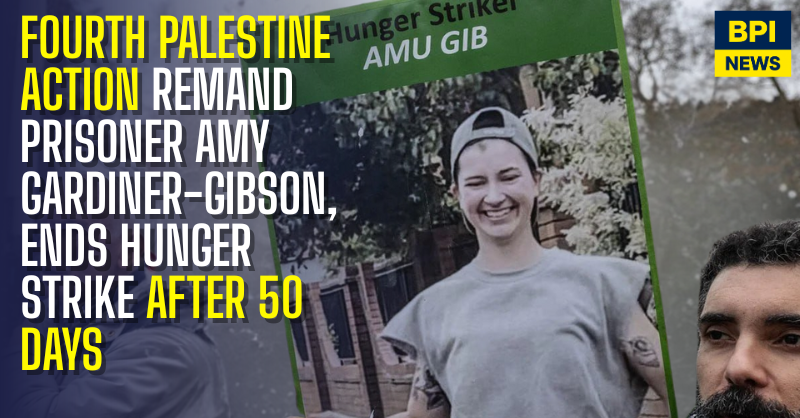
A fourth remand detainee awaiting trial for alleged offences linked to Palestine Action has ended her hunger strike after more than 50 days. Amy Gardiner-Gibson, also known as Amu Gib, joined fellow detainees Qesser Zuhrah, Jon Cink and Umer Khalid in halting the protest, which began on 2 November.
Gardiner-Gibson is believed to have been taken to hospital before ending the strike. Lawyers representing the group had set a deadline for the government to respond to a planned High Court challenge over the conditions and treatment of the detainees. It is understood that no formal response was issued before the deadline passed.
A Ministry of Justice spokesperson said the government would not introduce measures that risk encouraging similar protests but added that officials wanted the detainees to “accept support and get better”.
Four people have now withdrawn from the strike, while three others Heba Muraisi, Teuta Hoxha and Kamran Ahmad are said to have continued their refusal of food for 50, 44 and 43 days respectively. Officials have not disputed the reported timelines. A further detainee is described by supporters as intermittently striking due to an underlying health issue.
Prison guidance states that any medical treatment for hunger strikers must be overseen by clinicians and cannot be administered without consent unless capacity is lost.
Campaign groups have called for improved treatment of detainees held on remand and for the ban on Palestine Action to be lifted. The High Court is currently reviewing the Home Secretary’s decision to proscribe the organisation, with a ruling expected in the New Year.
Lord Timpson, Minister of State for Prisons, said hunger strikes were not unusual and that longstanding procedures were in place to protect prisoner welfare.