

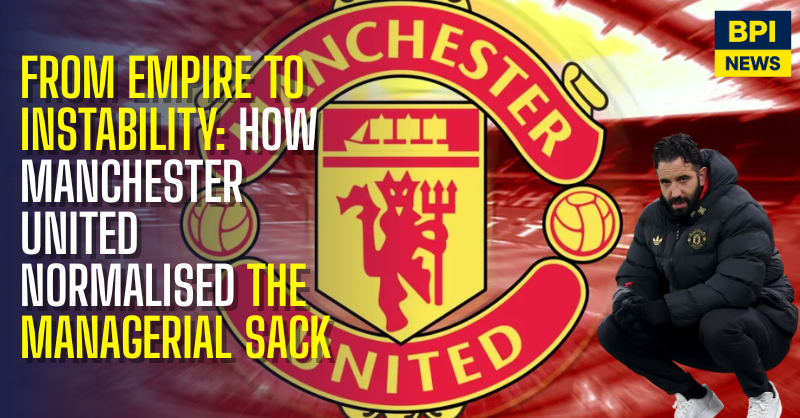
The dismissal of Ruben Amorim after just 14 months in charge is no longer shocking in itself. What is striking is how routine such moments have become at Manchester United, a club once defined by continuity, authority and institutional confidence. Amorim’s exit, framed by the club as a reluctant but necessary decision, fits seamlessly into a post-Ferguson era marked less by renewal than by repetition.
The circumstances of Amorim’s departure reflect familiar tensions. A strained relationship with senior figures, public suggestions of limited transfer backing, resistance to altering a preferred tactical system, followed by late adaptation and eventual removal. That United sit sixth in the Premier League only sharpens the point: managerial change is no longer reserved for collapse, but for perceived stagnation. The threshold for patience has narrowed dramatically.
To understand how far United have drifted, comparison with the club’s glory years under Sir Alex Ferguson is unavoidable. Ferguson’s reign established a model in which authority flowed decisively from the manager. Recruitment, culture and long-term planning were shaped around his vision. Poor seasons occurred, but they were absorbed within a broader project. Crucially, the manager outlasted cycles of players, executives and rivals.
That equilibrium ended abruptly after Ferguson’s retirement in 2013. The short-lived tenure of David Moyes did more than expose a failed succession plan; it shattered the club’s tolerance for transition. Since then, United have lurched between philosophies, each manager appointed as a corrective to the last rather than as part of a coherent strategy. Long-term planning has repeatedly given way to short-term course correction.
Amorim’s reign belongs squarely in this pattern. His commitment to a 3-4-3 system mirrored previous attempts by United managers to impose identity without full institutional alignment. His public insistence that he wanted to act as a manager rather than merely a coach echoed a recurring complaint at Old Trafford: responsibility without corresponding control. Tactical compromises late in his tenure suggested adaptation under pressure rather than organic evolution.
Statistically, Amorim’s record was among the poorest of any United manager in the Premier League era. Yet focusing solely on results risks missing the broader decay. United’s problems appear increasingly structural. Recruitment resets with each managerial change. Squads are assembled for one vision and inherited by another. Decision-making power is fragmented between executives and football staff, leaving managers exposed while remaining dispensable.
The appointment of Darren Fletcher as interim head coach reinforces this sense of institutional drift. Fletcher is respected, loyal to the club and deeply embedded in its recent history, but his lack of senior managerial experience underlines the provisional nature of the response. Familiarity offers comfort, but not direction. It recalls previous moments where symbolism substituted for strategy.
Perhaps the most telling aspect of Amorim’s sacking is its predictability. Once, managerial dismissals at Old Trafford carried weight and consequence. Now, they are absorbed into the rhythm of the season. The language used “reluctantly”, “best opportunity”, “change” has become formulaic. United no longer project patience or authority; they project uncertainty managed through repetition.
The decline, then, is not simply about league positions or trophies missed. It is about the erosion of a governing philosophy. Where United once represented stability amid chaos elsewhere, they now reflect the very volatility they once exploited. Amorim’s departure is not an aberration in this story. It is its latest, most familiar chapter.