

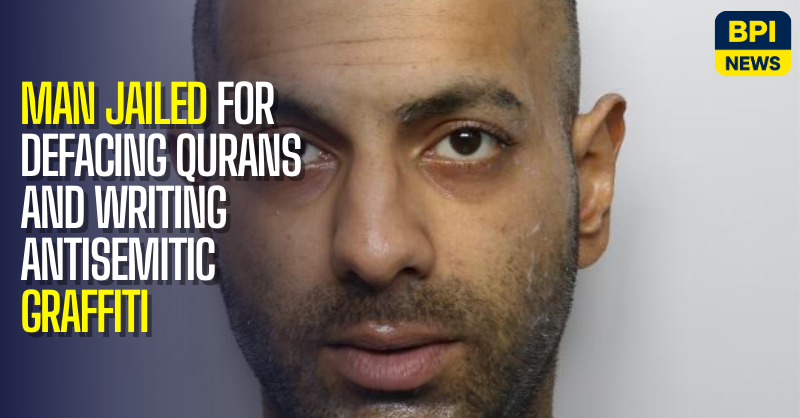
A man has been jailed for 40 months after defacing Qurans at a Leeds hospital and later writing an antisemitic message while in police custody.
Ibrahim Iqbal, 36, of no fixed address but listed as living in Leeds, was sentenced at Leeds Magistrates’ Court on Tuesday after being found guilty of two counts of religiously aggravated criminal damage and one count of criminal damage on 4 February.
The offences centred on repeated incidents at the Faith Centre in the Bexley Wing of St James’s Hospital, a multi-faith room open around the clock to people of all backgrounds.
In November 2025, Iqbal entered the room and caused significant damage. He smashed a framed Islamic scripture and defaced multiple copies of the Quran by tearing out pages, setting them alight, and using the burnt material to block sinks and toilets.
Police were called to the hospital following the incident.
On 9 December, Iqbal returned and again caused damage by deliberately blocking drains with miscellaneous items. The following day, he attempted to access the Faith Centre but found it locked due to the earlier damage. He was detained by hospital security and arrested.
While in custody, Iqbal requested crayons and wrote “kill Jews” on the wall of his police cell.
CCTV footage placed him at the scene on both occasions. On 9 December, he was seen walking through the hospital carrying a black bin liner later recovered at the scene. Staff discovered the damage just seven minutes after footage showed him leaving the room.
Investigators confirmed that Iqbal was the only person to enter the room between it last being checked and the damage being discovered. Prosecutors also demonstrated that the method used in both incidents was consistent, linking him to the earlier offence.
Luke Hopkinson, Senior Crown Prosecutor for the Crown Prosecution Service in Yorkshire and Humberside, said Iqbal had carried out a “deliberate and sustained campaign of hatred”, targeting both Muslim and Jewish communities.
Chief Superintendent Steve Dodds, Leeds District Commander, said the damage had affected a space used for reflection and prayer during difficult times, leading to its temporary closure for repairs.
He added that the impact would have been felt particularly by Muslim and Jewish communities, and said the case demonstrated that hate crime would not be tolerated.