

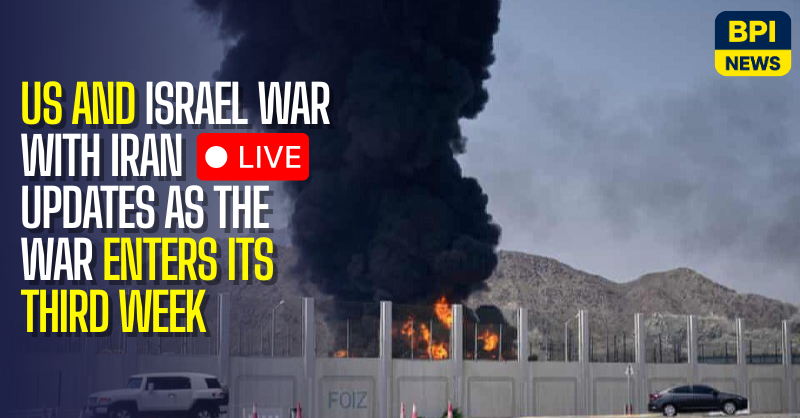
Follow live coverage of the war between the United States and Israel and Iran as missile strikes, drone attacks and regional military escalation unfold across the Middle East.
Live Updates

Three members of Iran’s women’s national football team who had sought asylum in Australia during the Women’s Asian Cup have withdrawn their requests and will return to Iran, according to reports by Iran’s Fars news agency.
The report said two players and a member of the team’s logistics staff reversed their earlier decisions after initially seeking protection while the tournament was being held in Australia.
The situation had drawn attention after several members of the Iranian team reportedly refused to sing the national anthem before a match, prompting controversy around the team’s stance.
Australia later granted humanitarian visas to several members of the squad who said they feared persecution if they returned to Iran.
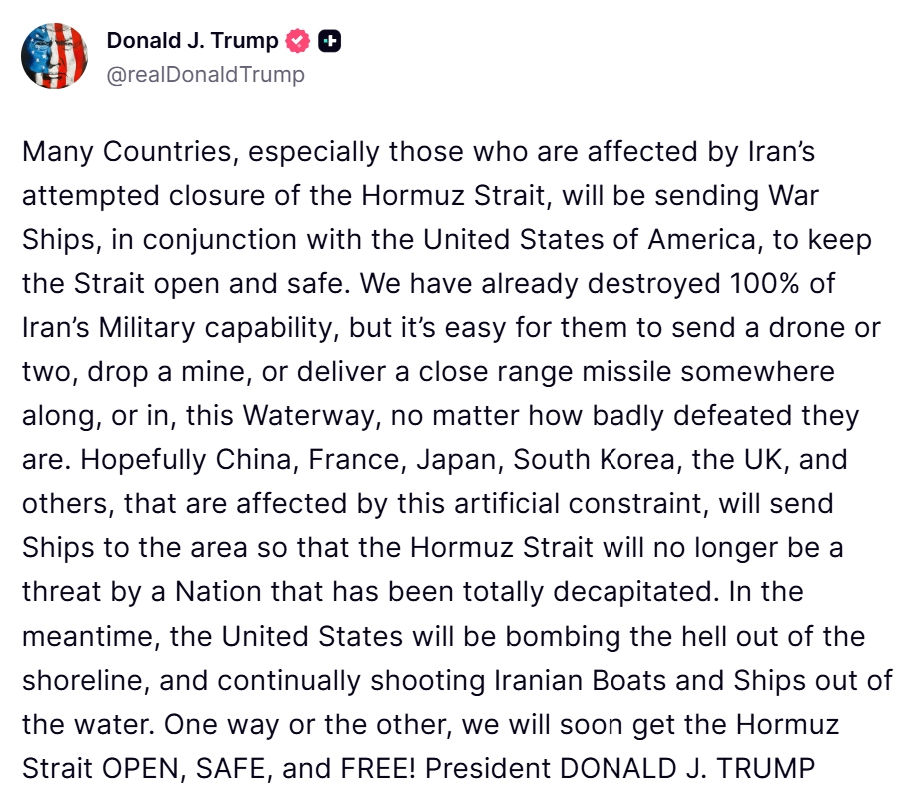
US President Donald Trump says he hopes several countries will send naval vessels to help secure the Strait of Hormuz amid the ongoing conflict with Iran.
In a post on Truth Social, Trump said “many countries” affected by disruptions to the key shipping route would deploy warships alongside the United States to keep the waterway open.
He said he hoped the United Kingdom, China, France, Japan and South Korea would send ships to the region.
Trump also said the United States would continue military operations along Iran’s coastline, stating that US forces would strike Iranian coastal positions and target Iranian boats operating in the area.

US President Donald Trump says reports claiming that five tanker aircraft were destroyed in an attack on a Saudi airbase are incorrect.
In a message posted on social media, Trump said the base had been hit a few days earlier but insisted the aircraft were not destroyed. He said four of the five planes suffered little or no damage and are already back in service, while the fifth sustained slightly more damage but is expected to return to flight operations soon.
Trump criticised reporting by several media outlets, saying headlines suggesting the aircraft had been destroyed were misleading.
Exiled Iranian opposition figure Reza Pahlavi, the son of Iran’s last shah, says he is ready to lead a political transition in Iran if the Islamic Republic collapses.
In a message posted on social media, Pahlavi said preparations are underway for what he described as a “Transitional System” that would assume governance following the fall of the current government.
He said individuals both inside and outside Iran had been identified and evaluated to lead different sections of a future transitional administration.
According to Pahlavi, the process of selecting members of the proposed body has been led by Saeed Ghasseminejad, an Iran specialist and financial economics adviser at the US-based think tank Foundation for Defense of Democracies.
Pahlavi added that the transitional system under his leadership would seek to restore order and security and prepare the country for what he described as conditions for political freedom and economic recovery.
Missile warheads have fallen in several locations in the southern Israeli city of Eilat during a new wave of missile launches from Iran.
Israeli authorities say two people were injured in the incident as emergency services responded to explosions reported across parts of the city.
Officials are investigating whether the damage was caused by submunitions from cluster-type warheads or debris from intercepted missiles.
US officials had long warned that Iran could attempt to close the Strait of Hormuz using naval mines, drones and missiles, according to a report by the Wall Street Journal.
The report says General Dan Caine and other advisers had repeatedly briefed US officials that Iran possessed the capability to disrupt the world’s most important oil shipping route if conflict broke out.
According to people familiar with the discussions, President Donald Trump acknowledged the risk but believed Tehran would likely back down before closing the strait. He also reportedly told advisers that if Iran attempted such a move, the US military would be able to deal with it.
However, with the waterway now largely disrupted, the Pentagon is said to be concerned that US warships escorting commercial tankers could become targets unless American forces first destroy Iranian vessels and coastal defence systems, including drones and missile launch sites.


Iran’s Islamic Revolutionary Guard Corps has issued a warning urging residents near several major ports in the United Arab Emirates to immediately leave surrounding areas.
The warning names Jebel Ali Port in Dubai, Khalifa Port in Abu Dhabi and Fujairah Port as locations people should avoid, with images circulating online showing the ports highlighted alongside an urgent warning message.
The message follows earlier statements from Iranian officials that US-linked facilities in the UAE — including ports, docks and military locations — could become targets during the ongoing conflict.
Iranian officials say the locations are being considered potential targets following US strikes on Iran’s Kharg Island and other Iranian infrastructure overnight.
Kharg Island is Iran’s main oil export hub and was hit during large-scale US strikes that Washington said targeted Iranian military facilities on the island. Iranian authorities have since warned that US-linked facilities in the region could face retaliation.

Some oil-loading operations at the Fujairah export terminal in the United Arab Emirates have been suspended after a drone attack caused a fire at the site.
Authorities said an intercepted drone triggered the blaze in the Fujairah emirate, where one of the region’s largest oil storage and export facilities is located.
Fujairah serves as the outlet for roughly one million barrels per day of the UAE’s Murban crude, equivalent to around 1% of global oil demand, making it a significant hub for international energy markets.
The disruption comes after Iran’s Islamic Revolutionary Guard Corps warned that US interests in the UAE including ports, docks and military facilities were legitimate targets if Iranian infrastructure was attacked.

Attention in Iran is focusing on who will lead the funeral prayer for the late Supreme Leader Ali Khamenei, a decision that could signal how political and religious authority will be structured after his death.
If the prayer is led by Mojtaba Khamenei, who has been named Iran’s new leader, it would indicate an effort to combine political leadership and religious legitimacy in a single figure. Such a move would present Mojtaba not only as the political successor to his father but also as the symbolic continuation of the religious authority that has underpinned the Islamic Republic.
If the prayer is led instead by a senior marjaʿ or another prominent cleric, it could suggest the system is maintaining a distinction between the political leadership of the Islamic Republic and the wider religious authority of the Shia clerical establishment.
The symbolism has historical precedent. When Ayatollah Ruhollah Khomeini died in 1989, the funeral prayer was led by senior cleric Grand Ayatollah Mohammad-Reza Golpaygani rather than the newly appointed Supreme Leader Ali Khamenei, highlighting the distinction between religious authority and political leadership during that transition.


The reported death toll across the Middle East has surpassed 2,200 since the United States and Israel launched strikes on Iran on 28 February. The latest figures indicate casualties across multiple countries in the region.
Breakdown of reported deaths:
Iran: 1,444 killed
Lebanon: 773 killed
Iraq: 26 killed
Israel: 14 killed
United Arab Emirates: 6 killed
Kuwait: 6 killed
Oman: 3 killed
Bahrain: 2 killed
Saudi Arabia: 2 killed
US forces: 11 killed
Iran and Lebanon account for the majority of reported deaths since the conflict began, while smaller numbers of casualties have been reported across Gulf states and among US forces operating in the region.
A missile has struck a helipad inside the United States embassy compound in Baghdad, according to Iraqi security sources speaking to the Associated Press.
The strike reportedly caused a small fire within the compound. Other reports suggest the attack may have involved a drone or rocket impact. There have been no immediate reports of casualties.
A missile struck a helipad at the US embassy compound in Baghdad, causing a small fire, Iraqi security sources told the Associated Press.
— BPI News (@BPINewsOrg) March 14, 2026
No group has claimed responsibility, but Iran-aligned militias have repeatedly targeted US facilities in Iraq during the war. pic.twitter.com/dmbElUC7uf
Local reports indicate a unit linked to the C-RAM air defence system inside the embassy complex may have been hit. No group has so far claimed responsibility for the attack.
Iran-aligned armed groups in Iraq, known collectively as the Islamic Resistance, have repeatedly targeted US facilities and bases in the country since the conflict with Iran escalated. The coalition of militias has also pledged to avenge the death of Iran’s Supreme Leader Ali Khamenei.
The attack follows recent statements from the group offering $100,000 for information leading to the capture or targeting of US military or intelligence personnel, amid ongoing drone strikes and retaliatory operations across Iraq.
Iran has published footage it says shows the 49th wave of ballistic missile launches targeting US military bases across the region.
Iran has released footage it says shows the 49th wave of ballistic missile launches targeting US bases in the region.
— BPI News (@BPINewsOrg) March 14, 2026
Iranian state media said the attacks were carried out in three separate salvos early this morning as part of continuing retaliation in the war. pic.twitter.com/qPU1JGJAyR
In a statement, the IRGC said Iranian missile and drone units targeted Patriot radar systems, a control tower and air-defence hangars at Al Dhafra Air Base using what it described as kamikaze drones and precision ballistic missiles.
The Guards also claimed strikes on Sheikh Isa Air Base, saying early-warning radar systems, aircraft shelters, a central ramp and fuel tanks used by American aircraft were hit during the attack.
According to the statement, Al Adairi helicopter base was also targeted with heavy missile and drone strikes that the IRGC said destroyed equipment hangars, gathering points and helicopter storage facilities.
The IRGC added that the Strait of Hormuz remains under the “intelligent control” of its naval forces and warned that oil tankers and commercial vessels belonging to what it called aggressor states and their allies would not be permitted to transit the waterway.
US Central Command says American forces carried out a large-scale precision strike on Iran’s Kharg Island overnight, targeting a wide range of military facilities on the strategic island.
In a statement posted online, CENTCOM said the operation destroyed naval mine storage sites, missile storage bunkers and other military infrastructure, with more than 90 Iranian military targets struck during the attack.
CENTCOM says American forces struck more than 90 Iranian military targets on Kharg Island, including naval mine storage and missile bunkers, while leaving oil infrastructure intact.
— BPI News (@BPINewsOrg) March 14, 2026
TankerTrackers indicates two tankers are loading at the island after the strike. pic.twitter.com/sFX0nhf2mH
The US military said the strike was conducted while preserving the island’s oil export infrastructure. Kharg Island is Iran’s main crude export hub and previously handled around 90 percent of the country’s oil shipments.
However, ship-tracking data from the monitoring service TankerTrackers indicates that two oil tankers are currently loading at the island following the strike, suggesting export activity may still be continuing.
A drone strike has hit the port of Fujairah in the United Arab Emirates, one of the largest oil storage facilities in the Middle East and a major bunkering hub used for refuelling ships.
Video circulating online shows large plumes of smoke rising from the complex on the UAE’s eastern coast. The port sits on the Gulf of Oman rather than inside the Persian Gulf, allowing vessels to avoid the Strait of Hormuz.
A drone strike has hit the UAE port of Fujairah, one of the Middle East’s largest oil storage and bunkering hubs. Footage shows large plumes of smoke rising from the site.
— BPI News (@BPINewsOrg) March 14, 2026
IRGC say US-linked ports, docks and military sites in the UAE are now legitimate targets. pic.twitter.com/bwvp6Dmzhp
Fujairah has become a key logistics hub as maritime traffic through the Strait of Hormuz has been heavily disrupted since the start of the war between the United States, Israel and Iran.
The strike came after Iran’s Islamic Revolutionary Guard Corps said US interests in the UAE, including ports, docks and military sites, had become legitimate targets following American attacks on Kharg Island, a critical centre of Iran’s oil export infrastructure.
Two weeks after the United States and Israel launched joint strikes on Iran on 28 February, the conflict has expanded across the Middle East with multiple countries drawn into the crisis.
Iran responded to the initial strikes with missile and drone attacks targeting Israel as well as locations in Gulf states hosting US military assets. A day after the conflict began, Iran’s Supreme Leader Ayatollah Ali Khamenei was confirmed dead following the opening phase of the war.
Satellite imagery indicates extensive damage in and around Tehran, including sites linked to nuclear and missile programmes as well as oil depots and refineries. Images from affected areas have shown dark residue falling after strikes on fuel infrastructure.
Israel has also expanded its campaign beyond Iran, launching strikes in Beirut and southern Lebanon and carrying out commando operations inside Lebanese territory. Israeli officials say operations will continue until the armed group Hezbollah is disarmed.
The wider consequences of the war continue to develop. Thousands of deaths have been reported across the region, while 13 US service members have been killed during operations, including six crew members who died when a military refuelling aircraft crashed in western Iraq.
Energy markets and international travel have also been disrupted. Oil prices have risen above $100 per barrel amid supply concerns, and widespread airspace closures have forced airlines to suspend routes, with more than 170,000 British nationals registering their presence in the region.
1 comment
[…] This page is now closed but join our new live blog by clicking here. […]