QUETTA — At least 24 people have been killed and dozens more injured after a powerful blast struck a shuttle train near Chaman Phatak in Quetta, with officials saying the train was carrying security personnel and families before Eid al-Azha.
The Balochistan government initially said 14 people had been killed, including three Frontier Corps personnel, but the death toll later rose as rescue teams continued operations. Reuters reported at least 24 deaths and around 70 injuries, while AP reported at least 23 killed and more than 70 injured.
Security and hospital sources cited in local reporting said the figures were expected to rise further, with several of the injured in critical condition. Separate accounts from the scene put the number of injured above 90, although official figures were still being updated as rescue operations continued.
State-run APP, citing railway authorities, said the shuttle train was travelling from Quetta Cantonment towards the railway station when it was targeted near Chaman Phatak shortly after 8am. The explosion derailed the locomotive and several coaches, with two coaches reportedly overturning.
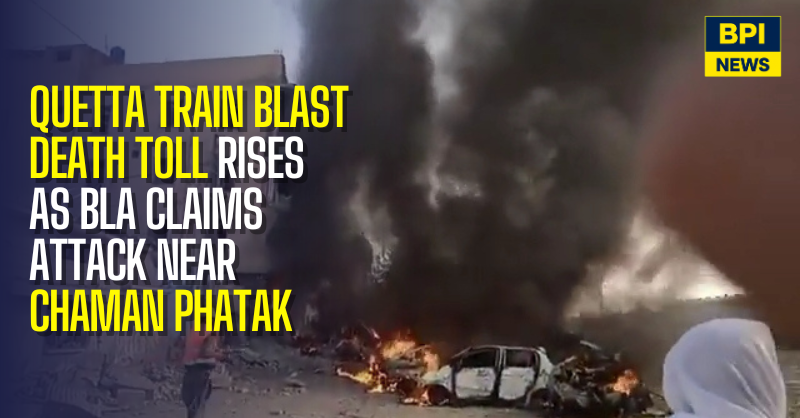
Images and videos from the scene showed a mangled train carriage on its side, smoke rising from the area, damaged vehicles and emergency workers carrying bloodied victims away from the wreckage.
BLA Claims Responsibility
The Baloch Liberation Army claimed responsibility for the attack, saying its Majeed Brigade carried out the suicide bombing. Reuters and AP both reported that the separatist group said it had targeted a train carrying security personnel.
The blast took place in an area close to security installations and caused damage to nearby buildings and vehicles. One video from the area showed several small cars burnt out as fire and black smoke rose from the scene.
A medical emergency was declared in Quetta’s hospitals, with doctors, paramedical staff and medical personnel summoned to duty.
BPI News Sources Say Attack Followed Changed Train Movement Protocol
A Pakistani security source familiar with railway security movements told BPI News that the Pakistan Army had quietly changed its Quetta train movement protocol after the Jaffar Express attack.
According to the source, instead of personnel boarding from the main railway station, carriages were being moved overnight to Quetta Cantonment, where army personnel on leave and their families would board in the morning. Those carriages would then be attached to the main train at Quetta Railway Station before departure.
The source told BPI News that attackers appeared to have studied that pattern and planned the strike near Chaman Phatak before the train reached the main station.
Initial accounts from security sources suggested the blast may have been a suicide bombing. Officials have not yet publicly released a final forensic assessment, and police, the Counter-Terrorism Department and the bomb disposal squad have reached the site to collect evidence.
Women And Children Among The Casualties
Balochistan government spokesperson Shahid Rind said “multiple people” were injured, including women and children, and that the wounded had been shifted to hospital.
A security source told BPI News that the train was carrying around 330 passengers, including troops and civilians travelling home for Eid al-Azha.
Initial investigations, according to a source familiar with the matter, suggested the train had stopped at a paramilitary installation to attach additional bogeys for families of personnel returning home. The source said many of the casualties were women and children.
Nearby homes were also affected by the force of the explosion, with casualties reported in surrounding residential areas.
Witnesses Describe Panic After Loud Explosion
Witnesses described a powerful blast that shook nearby homes and businesses.
Mohammad Rahim, who was near the site, told AFP he was sleeping when the explosion tore through the area. He said his family jumped out of bed after hearing a loud bang, followed by screaming and crying from women and children.
Another witness, Abdul Basit, said he was standing in a queue to buy breakfast when the blast happened and people began running for shelter. Mujib Ahmad said his car was damaged in the explosion and that he immediately feared it was an attack.
The explosion was heard across distant parts of Quetta and triggered fires in nearby vehicles, which were later brought under control by fire brigade teams.
Government Condemns Attack
Prime Minister Shehbaz Sharif condemned what he called a “heinous bomb explosion”, saying such attacks would not weaken Pakistan’s resolve against terrorism.
“The entire nation stands in solidarity with the people of Balochistan in this hour of grief,” he said.
Balochistan Chief Minister Sarfraz Bugti also condemned the attack, saying militants had targeted innocent civilians, women and children. He said those involved, their facilitators and masterminds would be pursued and brought to justice.
Railways Minister Hanif Abbasi condemned the attack and directed authorities to submit an immediate report. He said Pakistan Railways’ operations would continue despite the attack.
Pakistani officials again accused hostile networks operating from India and Afghanistan of sponsoring terrorism to destabilise the country. India has previously denied Pakistani allegations that it supports militancy in Balochistan. AP reported that Pakistan’s government has designated Balochistan-based militant groups as “Fitna-al-Hindustan” to highlight its allegation of Indian involvement.
Attack Follows Earlier Jaffar Express Assault
The bombing comes after a series of attacks targeting railway and security movements in Balochistan.
The BLA previously claimed high-profile attacks, including the Jaffar Express incident, which raised serious concerns over the vulnerability of rail routes used by civilians and security personnel. Reuters noted that the latest blast follows a wider pattern of militant violence in Balochistan, where separatist groups have repeatedly targeted security forces, infrastructure and transport links.
Security sources told BPI News that Sunday’s attack appears to have been designed to exploit a specific movement pattern rather than strike a random public train.
That detail, if confirmed by investigators, would raise major questions over operational security around troop and family movements from Quetta Cantonment to the main railway network.
Rescue Operation Continues
Pakistan Railways said rescue trucks and a relief train were sent to the site to assist emergency operations.
Police, CTD teams, railway officials, bomb disposal experts and rescue workers remained at the scene as investigators examined the blast site, damaged coaches, vehicles and surrounding buildings.
Authorities have not yet issued a final confirmed toll, and officials warned that casualties could rise further because several of the injured remain in serious condition.