

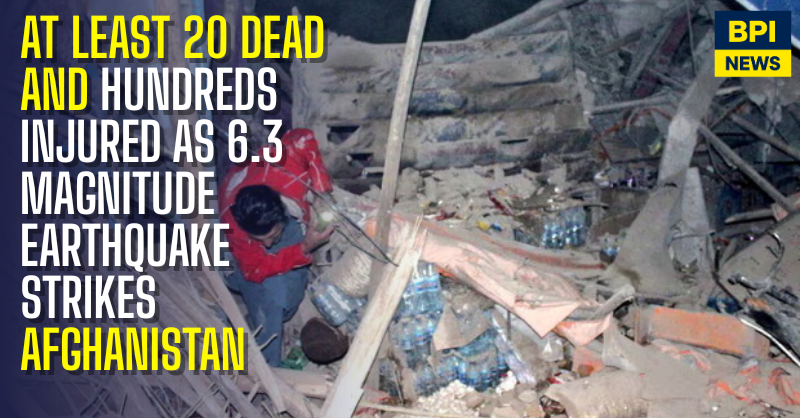
At least 20 people have been killed and hundreds injured after a powerful earthquake struck northern Afghanistan early on Monday morning.
The 6.3 magnitude quake hit near the city of Mazar-e-Sharif, one of Afghanistan’s largest urban centres, at around 01:00 local time (20:30 GMT Sunday). The United States Geological Survey recorded its depth at 28km (17 miles) and issued an orange alert level, indicating that “significant casualties” are likely.
The Taliban government’s health ministry said more than 530 people have been injured, with the toll expected to rise as rescue operations continue.
Provincial officials told the BBC that many victims were reported in Sholgara district, south of Mazar-e-Sharif, while others were injured in nearby Samangan province. Haji Zaid, a Taliban spokesman in Balkh province, said on X that “many people are injured,” with most of the wounds caused by people “falling from tall buildings” as they rushed to safety.
Residents of Mazar-e-Sharif described scenes of panic as people fled into the streets, fearing their homes would collapse. Local media reported debris scattered across parts of the historic Blue Mosque — a 15th-century shrine revered by Shia Muslims and believed to house the tomb of the Prophet Muhammad’s son-in-law.
The earthquake also caused widespread power outages after electricity lines from Uzbekistan and Tajikistan, Afghanistan’s key external suppliers, were damaged. Kabul and other major cities were left partially without power overnight.
Footage shared online by Taliban officials showed collapsed walls, cracked buildings, and residents digging through rubble by hand. The Taliban said emergency response teams and police are “closely monitoring the situation” across affected regions.
Numerous fatalities were reported in Samangan province, while officials in Balkh said damage assessments were still underway.
Monday’s earthquake follows a 6.0 magnitude tremor in eastern Afghanistan in August that killed more than 1,100 people. Experts say the country’s location along major tectonic fault lines — where the Indian and Eurasian plates meet makes it one of the world’s most earthquake-prone regions.