
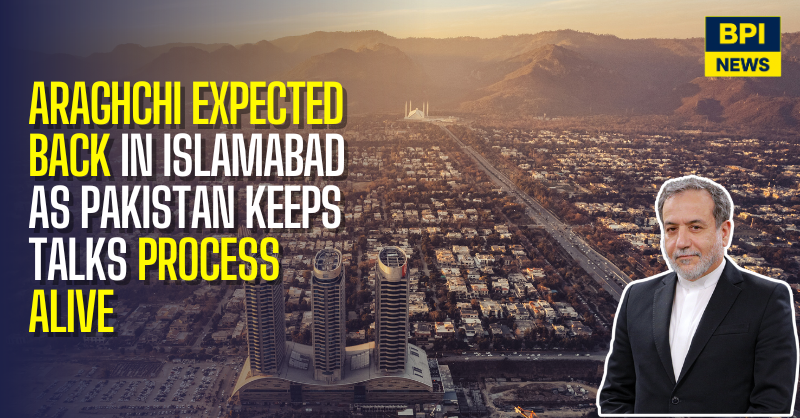
ISLAMABAD — Iranian Foreign Minister Abbas Araghchi is expected to return to Islamabad after high-level consultations in Oman, as Pakistani officials frame the latest movements as part of a continuing diplomatic process rather than a collapse of talks.
Two Pakistani security sources familiar with the negotiations told BPI News that Araghchi has already delivered Tehran’s views during his visit to Islamabad, with Pakistani officials continuing to prepare for further engagement.
Iranian state-linked reporting said Araghchi will visit Pakistan again after his trip to Oman and before travelling to Moscow, while part of his delegation returned to Tehran to seek guidance on issues related to ending the war. The delegation is expected to rejoin him in Islamabad on Sunday night, according to IRNA reporting cited by Anadolu and Arab News.
Pakistani officials are underscoring that the expected return of Araghchi is part of a staged process. In other words, Islamabad does not see the latest delay as the end of talks, but as another phase in a delicate diplomatic sequence.
Oman And Russia Seen As Key Stops Before Next Islamabad Push
Araghchi travelled to Oman after leaving Islamabad, where he met Sultan Haitham bin Tariq and discussed the regional situation, including mediation efforts linked to the US–Iran war.
The Oman stop is significant because Muscat has long played a mediation role between Tehran and Washington. Pakistani and regional sources believe the discussions are tied to future arrangements around the Strait of Hormuz, including possible mechanisms involving Oman in managing or facilitating maritime access.
Araghchi is also expected to travel to Moscow, where the uranium issue is understood to be part of the diplomatic conversation. TASS reported earlier that the Iranian foreign minister’s tour of Islamabad, Muscat and Moscow was intended to discuss the latest developments in the Iran–US conflict.
A Pakistani security source familiar with the process said Araghchi had delivered Tehran’s views in Islamabad and could return again after Muscat and Moscow, potentially by next Thursday, depending on how the consultations progress.
Possible Monday Meetings With Pakistan’s Leadership
Pakistani officials expect that if Araghchi returns to Islamabad on Sunday night, he is likely to meet Prime Minister Shehbaz Sharif and Field Marshal Asim Munir on Monday.
That would follow his earlier meetings with Pakistan’s leadership, including talks attended by senior Pakistani officials such as Ishaq Dar and Field Marshal Asim Munir, according to Iranian media.
Officials familiar with the process told BPI News that the expected meetings are being viewed as a hopeful sign because they suggest Tehran is still using Islamabad as a diplomatic channel, even if it has not yet agreed to direct talks with the United States.
Talks Have Not Collapsed, But Remain Conditional
The central issue remains the US blockade on Iranian ports and shipping routes. Tehran has repeatedly indicated that it will not enter talks under pressure, while Pakistan has been working to keep communication channels open.
Publicly, Iran has continued to describe Araghchi’s travel as a regional tour involving Pakistan, Oman and Russia, rather than a direct negotiating mission with the United States. Araghchi said the purpose of his visits was to coordinate with partners on bilateral matters and consult on regional developments.
However, Pakistani sources with knowledge of the security arrangements and negotiations told BPI News that Islamabad has continued planning on the basis that Iran will remain engaged in the process.
One source described the latest movement as “incremental”, saying the goal is to move from separate consultations towards a framework that could allow talks to resume.
Islamabad Still Acting As The Bridge
The latest developments reinforce Pakistan’s position as the central mediator between Tehran and Washington.
Araghchi’s return, if confirmed, would indicate that Tehran is not walking away from Islamabad’s channel, even as it seeks input from Oman and Russia before committing to the next stage.
For now, the process appears to be moving through indirect steps: Tehran delivers its views to Islamabad, consults Muscat and Moscow, reports back to Tehran, and then returns to Pakistan for another round of discussions.
That sequencing suggests the talks remain fragile, but still active.
1 comment