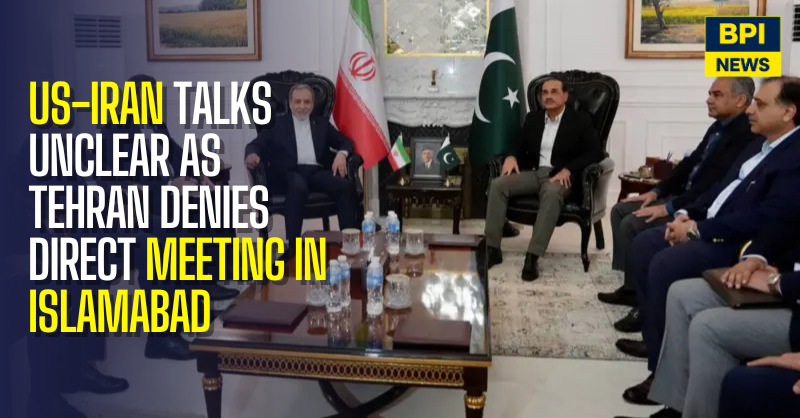
ISLAMABAD — It remains unclear whether direct talks between the United States and Iran will take place in Pakistan this weekend, despite the arrival of Iranian Foreign Minister Abbas Araghchi in Islamabad and continuing security restrictions across the capital.
Tehran has said there are no current plans for direct negotiations with the United States in Pakistan, while describing Araghchi’s visit as part of a three-stop regional tour that will also include Oman and Russia.
Araghchi met Pakistan’s Field Marshal Asim Munir, who leads the country’s armed forces, and said his regional travel was aimed at coordinating with partners on bilateral matters and consulting on wider regional developments.
Iran’s state broadcaster IRIB reported that Araghchi does not plan to meet US officials in Pakistan, but said Islamabad could act as a “bridge” to convey Iran’s position on ending the conflict.
The White House, however, said on Friday that US envoys Steve Witkoff and Jared Kushner would travel to Islamabad because Iranian officials wanted to speak “in person”. Vice-President JD Vance is understood to remain on standby.
ABC News, citing a senior Pakistani government official, reported that US and Iranian delegations are expected to hold separate meetings with Pakistani officials this weekend. If those meetings progress, direct talks between US and Iranian officials could follow on Sunday.
The diplomatic uncertainty comes as Islamabad remains under heavy security restrictions, with road closures, Red Zone controls and movement curbs continuing across parts of the capital.
BPI News has previously reported that Pakistani sources with direct knowledge of the security arrangements and negotiations expected an Iranian delegation to arrive in Islamabad, even as Tehran publicly denied that direct talks had been agreed.
Residents affected by the lockdown told BPI News that the restrictions have disrupted daily life and work, particularly in central areas of the capital.
One resident from G-6 said he was losing income because of the lockdown but still supported Pakistan’s diplomatic role.
“I am losing money, but what Pakistan is doing is important. The world is seeing Pakistan’s role, and I feel immense pride,” he told BPI News.
His friend said he also felt proud of Pakistan’s role but was becoming concerned about the financial impact of the prolonged restrictions.
“We are proud of what Pakistan is doing, but we are also starting to worry about when we will be able to earn again,” he said.
The comments reflect the wider mood in parts of Islamabad, where residents are facing disruption but also recognise the significance of Pakistan hosting high-level mediation efforts.
The central sticking point remains the US blockade on Iranian ports and shipping routes. Tehran has indicated it is unwilling to enter talks under pressure, while Pakistani mediation efforts have focused on keeping channels open and preventing the ceasefire from collapsing.
The situation remains fluid, with Washington sending senior envoys to Islamabad, Tehran insisting Araghchi’s visit is part of regional consultations, and Pakistan continuing to position itself as a bridge between the two sides.