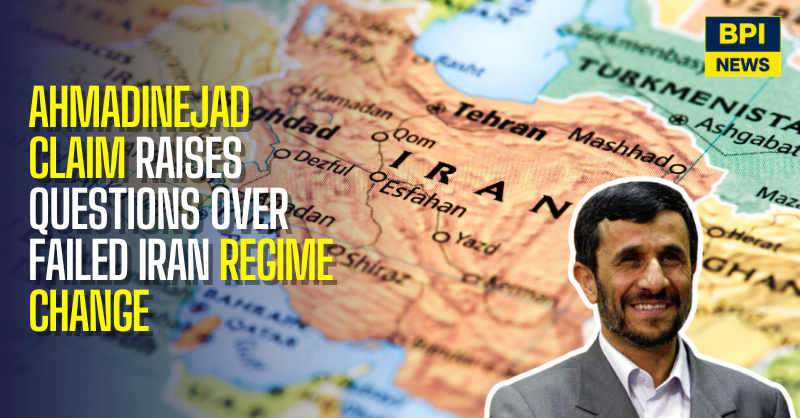
ISLAMABAD — Reports that former Iranian President Mahmoud Ahmadinejad was considered as a possible transitional figure in the event of regime change in Iran have raised fresh questions over whether the US-Israeli regime-change track had already collapsed before serious diplomatic momentum returned.
The claim is significant because Ahmadinejad does not fit the profile of a straightforward Western-backed opposition figure. He served as Iran’s president from 2005 to 2013, became one of the most recognisable hardline faces of the Islamic Republic, defended Iran’s nuclear programme and built much of his international image around confrontation with the United States and Israel.
Sources familiar with regional discussions told BPI News that officials and analysts in Islamabad are treating the Ahmadinejad story less as proof of a viable transition plan and more as a sign that the regime-change track lacked a credible domestic centre of gravity.
One source said the leak appeared to show that “the regime-change plan had already run out of usable options”, while another said Tehran may now believe Ahmadinejad was not the real preferred figure, but a name placed into the conversation after the fact.
Why Ahmadinejad’s Name Matters
Ahmadinejad’s political history makes the claim unusual.
He is not an exile figure, not a liberal opposition leader and not someone who could easily be presented as a clean break from the Islamic Republic. Although he later clashed with Iran’s ruling establishment and was repeatedly blocked from returning to high office, he remains deeply associated with the system he once led.
That is why the leak has drawn attention. If Washington and Israel were genuinely considering Ahmadinejad, it suggests they may have been looking for a figure who could appeal to parts of the Iranian state while creating the appearance of transition. But that also exposes the weakness of the plan: Ahmadinejad would not have represented a simple democratic alternative to the current leadership.
A prewar US intelligence assessment reported by the Associated Press found that military intervention was unlikely to produce regime change in Iran, even if senior leaders were killed, because there was no powerful or unified opposition ready to take control.
That assessment now appears central to how the Ahmadinejad story is being interpreted.
Attack Reports And His Sudden Disappearance From View
Ahmadinejad’s name had already resurfaced earlier in the conflict after reports claimed he had been targeted or injured during Israeli strikes.
The Times reported that Ahmadinejad was injured in an Israeli strike that was allegedly intended to free him from house arrest during the early stages of the war, and that he later withdrew from the plan. The report also said he has not been seen publicly since.
That sequence has made his status politically sensitive. If he was genuinely being courted as part of a transition scenario, then the reported attack raises questions about whether the operation failed because Tehran disrupted it, because the plan itself collapsed, or because Ahmadinejad backed away once the risks became clear.
Sources told BPI News that Iranian-linked circles are likely to read the story as evidence that Tehran had identified at least part of the external political architecture being built around a potential postwar transition.
PBD Podcast Episode Added Another Layer
The confusion around Ahmadinejad deepened after his reported connection to the PBD Podcast, hosted by Patrick Bet-David.
Bet-David said Ahmadinejad had been scheduled for an interview but that the appearance was cancelled over safety concerns. After claims circulated that Ahmadinejad had been killed, Bet-David later said Ahmadinejad’s team had contacted them to say he was alive.
That episode matters because it placed Ahmadinejad inside the wider information war.
If Ahmadinejad was preparing for a major public-facing media appearance shortly before or during the period in which he was reportedly targeted, it suggests he may have been attempting to re-enter the political conversation. But it also raises another possibility: his name may now be useful to multiple sides as a distraction from the identity of more serious channels or figures.
Sources familiar with the diplomatic mood in Islamabad told BPI News that the Ahmadinejad story is being read alongside wider questions about whether the United States had quietly explored political alternatives in Iran while also pursuing military and diplomatic pressure.
Not The Real US Preference?
The most important question may not be whether Ahmadinejad was seriously considered. It may be whether he was ever the real choice.
Pakistani security sources told BPI News that some regional officials believe Tehran now has a clearer idea of who Washington may have viewed as a more viable postwar figure or network. In that reading, Ahmadinejad’s name entering the public domain may not reveal the real plan it may obscure it.
This matters because regime-change planning does not always depend on public endorsement. It can involve quiet contact, media amplification, political signalling, exile networks, internal factions and regional intermediaries.
Ahmadinejad’s name may therefore serve two purposes: it draws attention because of his profile, but it may also divert attention from other figures who had more realistic external support.
Negotiations Now Shape How The Leak Is Read
The Ahmadinejad report comes as US–Iran diplomacy enters a fragile but active phase, with Pakistan playing a central mediation role.
The United States and Iran are closing in on a one-page memorandum of understanding aimed at ending the war and opening a 30-day period for more detailed negotiations, according to reports confirmed by a Pakistani source involved in the peace efforts. Reuters reported that the Pakistani source said: “We will close this very soon. We are getting close.”
A Pakistani security source familiar with the negotiations told BPI News that officials involved in the process feel they are “on the cusp” of a breakthrough, although neither Washington nor Tehran has formally confirmed a final agreement.
The proposed memo is expected to deal with three central issues: ending the war, setting a framework for future nuclear negotiations and easing restrictions around the Strait of Hormuz.
The negotiations also make the Ahmadinejad story more sensitive. If Tehran believes Washington explored regime change while also pursuing talks, it strengthens Iran’s mistrust of any US proposal. Iranian officials have already argued that negotiations cannot be separated from military pressure, sanctions, the naval blockade and previous strikes during periods of diplomatic engagement.
Why This Could Strengthen Tehran’s Suspicion
For Tehran, the Ahmadinejad leak may confirm an existing belief: that the military campaign, the blockade, the political pressure and the negotiations were never separate tracks.
Instead, Iranian officials may see them as parts of the same strategy pressure the state militarily, test internal fractures politically, then push for concessions diplomatically.
That interpretation could complicate the final stages of the current talks. Even if a one-page memo is close, Iran may demand stronger guarantees that the agreement is not simply a pause before renewed pressure.
Pakistani security sources familiar with the negotiations told BPI News that Pakistani mediators are aware of this mistrust and have focused heavily on the need for stable guarantees, particularly around shipping access, sanctions relief and the sequencing of any nuclear commitments.
Leak May Reveal More Than Intended
Whoever placed the Ahmadinejad story into the public domain may have intended to show that Washington and Israel had a plan for Iran after the war.
But the effect may be the opposite.
The story shows the lack of a clear replacement figure, the difficulty of engineering political change inside Iran from outside, and the possibility that Tehran has already identified more serious channels of attempted cooperation.
It also suggests that the regime-change track has lost momentum at the same time diplomacy is regaining it.
For Islamabad, that matters. Pakistan is now trying to help convert military de-escalation into a structured settlement. Any perception that Washington was still exploring regime-change options while negotiating could make that task harder.
For Tehran, the question is no longer simply whether Ahmadinejad was involved. The larger question is who the United States really wanted, who cooperated, and whether the leak was meant to distract from that.