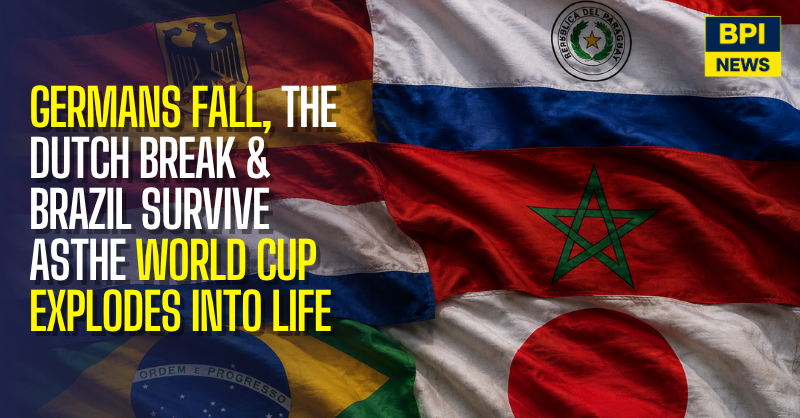
he first day of the World Cup knockout stage delivered chaos, cruelty and history, as Germany suffered another national football trauma, Morocco broke Dutch hearts on penalties and Brazil escaped humiliation only after Don Carlo’s side stared into the abyss.
For Germany, it was not just defeat. It was the shattering of one of football’s old certainties, no team dared to go to a penalty shootout against the Germans.
The four-time world champions had never lost a World Cup penalty shootout. Four played, four won. For decades, penalties had been Germany’s refuge, their cold-blooded, cool inheritance, the place where panic belonged to everyone else.
Then came Paraguay.
A side ranked 41st in the world at the start of the tournament, 31 places below Germany, stood in Boston with 25% of the ball, absorbed wave after wave of pressure, and dragged one of football’s great powers into the mud.
After 120 minutes ended 1-1, Paraguay won 4-3 on penalties to reach the last 16 and hand Germany what Bild called “the next German football nightmare”.
Germany had 75% possession, 719 passes and 21 shots. Paraguay had discipline, defiance and the kind of stubborn national spirit that refuses to be measured by statistics and even with all the German domination they still looked like the team full of zip and energy.
Julio Enciso gave Paraguay a shock lead before Kai Havertz equalised early in the second half. Jonathan Tah thought he had completed Germany’s escape in extra time, only for his header to be ruled out after a controversial VAR review for a foul on goalkeeper Orlando Gill.
Former England striker Alan Shearer called the decision “terrible” and said the goalkeeper had “conned the referee”. Jurgen Klopp, working on German television, said if that goal was illegal, Arsenal would not have won the Premier League because they had scored so many similar goals.
But controversy did not save Germany.
Havertz saw the first penalty saved. Nick Woltemade was denied. Tah later blasted over. Paraguay missed two chances to win it themselves and we all thought they had crumbled and were the Germans going to win again, but Jose Canale finally held his nerve, sending the South Americans into history and Germany into another inquest.
Paraguay did not outplay Germany. They endured them. For 120 minutes they absorbed wave after wave of pressure, meeting German possession with tireless running, fierce defending and an unbreakable resolve. Germany had the ball, but Paraguay had the energy. The four-time world champions controlled the game, yet never seemed to carry the conviction that once made them so feared.
And when the moment came to decide it, the old German aura was nowhere to be found. Paraguay seized it instead, felling one of football’s great giants not with brilliance, but with courage, belief and the refusal to bow.
Nagelsmann Left Fighting For His Future
Julian Nagelsmann admitted Germany are no longer among football’s elite after a third straight major World Cup failure.
“When you exit the World Cup after you play Paraguay it is very bitter. It is very hurtful,” he said. “This is the third elimination in a row, so we are not part of the first-class teams any more.”
The words were brutal because they were true.
Since winning the World Cup in 2014, Germany have failed twice to get out of the group stage and have now fallen at the first knockout hurdle in 2026. What was once a tournament machine now looks like a side haunted by its own decline.
Former Germany defender Arne Friedrich said Nagelsmann “has to face the consequences”, while Thomas Hitzlsperger said it was “unacceptable” for a country of Germany’s stature to go out so early in an expanded World Cup.
Nagelsmann insisted he would not walk away unless the German FA decided otherwise.
“I’m not going to step back only because we are eliminated,” he said.
But the mood around German football has changed. The aura is gone. Teams still respect Germany, but they no longer fear them.
That may be the deepest wound of all.
Paraguay Turn Limitation Into Glory
For Paraguay, this was one of the greatest results in their football history.
Their football was not expansive. It was not polished. But it was honest, organised and brave. They defended deep, accepted long spells without the ball and trusted that if they could stay alive, pressure would eventually turn against Germany.
This was the South American art of suffering: bodies behind the ball, hearts ahead of the odds, and one final kick strong enough to shake a continent awake.
Paraguay’s players collapsed into a pile after Canale’s winning penalty. Their supporters cried in the stands. Their president declared a public holiday.
One teenage fan outside the stadium said: “Not many people know what or who Paraguay is. Now everyone is going to know who Paraguay is.”
That is what World Cups do. They give small nations giant nights when they knock down the immortal football giants.
Morocco Break Dutch Hearts As Africa Roars Again
If Paraguay gave South America its poetry, Morocco gave Africa another thunderclap.
The Atlas Lions came from behind to beat the Netherlands 3-2 on penalties after a 1-1 draw, reaching the last 16 and underlining once again that their 2022 semi-final run was not a miracle but a warning.
Morocco dominated much of the game but found Bart Verbruggen inspired in the Dutch goal and the woodwork standing in their way. Then Cody Gakpo, playing days after the devastating loss of his unborn son, struck for the Netherlands after a rapid counter-attack.
It was a moment heavy with emotion. Gakpo fell to his knees, surrounded by team-mates, as grief and glory collided in front of the world.
But Morocco refused to let the night belong to the Dutch.
In stoppage time, Issa Diop rose to hammer home a header and drag the game into extra time. Then, after a tense shootout, Ismail Saibari sent Verbruggen the wrong way and Morocco into the next round.
The Dutch missed three penalties. Morocco endured.
Four years after beating Spain and Portugal on their way to a World Cup semi-final, Morocco have now removed another European heavyweight. Their victory was not an upset in the old sense. Ranked sixth in the world, filled with talent and sharpened by belief, they are no longer outsiders.
They are contenders.
The Flying Dutchmen eneded up cowering from the roaring Atlas Lions.
Brazil Survive Japan Scare As Ancelotti Keeps His Cool
Brazil came closer than they will want to admit to a national humiliation.
At half-time in Houston, they trailed Japan 1-0 and were 45 minutes away from their earliest World Cup exit since 1966. Japan were organised, calm and dangerous. Brazil looked slow, blocked off and short of answers.
Then Don Carlo did what Don Carlo does.
He did not panic. He did not tear the team apart. He adjusted the rhythm, pushed Brazil to attack the box more directly and trusted his players to find a way.
Brazil crossed repeatedly after the break, abandoned some of the over-elaboration and began asking Japan a different question. Casemiro equalised, before Gabriel Martinelli struck a dramatic 95th-minute winner to complete a 2-1 comeback.
It was not beautiful Brazil we know, It was purely get the job done by Brazil.
But knockout football does not always reward beauty. It rewards nerve, timing and the ability to suffer without collapsing.
Don Carlo’s calm may become Brazil’s greatest weapon. In a tournament where giants are falling, Brazil nearly joined them. Instead, they found a way through.
A Knockout Day That Changed The Tournament
The first day of knockout football has already changed the shape of this World Cup.
Germany are gone, and with them another piece of the old football order. Paraguay have turned grit into national immortality. Morocco have confirmed Africa’s place at the sharp end of the tournament. Brazil have survived the kind of scare that can either expose a team or harden it.
The lesson was clear: history does not take penalties for you, reputation does not defend crosses, and old powers do not advance simply because their shirts carry weight.
Germany learned that most painfully.
They arrived with the memory of four World Cups, three European Championships and a perfect shootout record. They left with Paraguayans dancing around them and a question that will now consume German football.
What happened to the team everyone used to fear?