
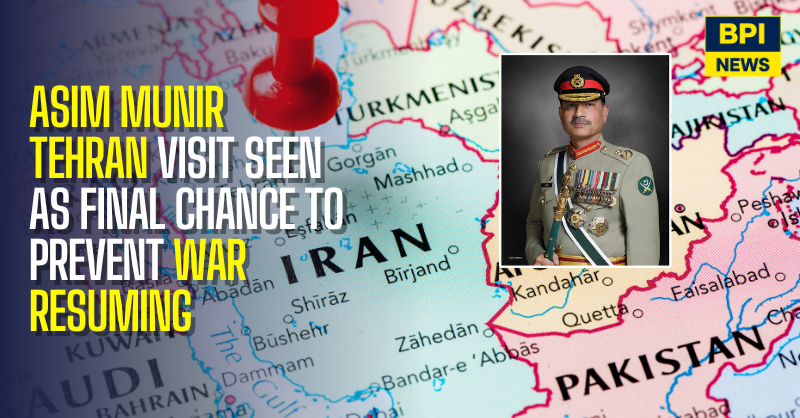
ISLAMABAD — Pakistan Army Chief Field Marshal Asim Munir’s reported visit to Tehran is being viewed as a critical attempt to prevent the resumption of war between Iran and the United States, as Pakistani mediation efforts enter one of their most sensitive stages.
Iran’s semi-official ISNA news agency reported that Munir was expected to visit Tehran for meetings with senior Iranian officials, while Pakistan’s Interior Minister Mohsin Naqvi also travelled to Iran for his second visit in less than a week. Anadolu reported that the visit comes as Islamabad continues mediation efforts between Tehran and Washington.
The reported trip is significant because it would not be taking place unless important messages were being relayed between the two sides. Pakistani sources familiar with the negotiations told BPI News that the purpose of the visit is to narrow the remaining gaps and keep momentum behind a possible memorandum of understanding.
Iranian media framed the visit in similar terms, saying it was aimed at minimising differences between Iran and the US and moving both sides closer to an official announcement of an understanding.
Iranian Text Under Discussion In Tehran
ISNA reported that Iran is discussing its own text in Tehran, including the broad framework of an agreement, technical details and confidence-building measures that Tehran wants treated as guarantees.
A Pakistani security source familiar with the process told BPI News that Tehran’s latest position has been communicated through mediation channels, but that guarantees remain the main barrier to any formal announcement.
The agency said the submitted text had narrowed some gaps, but that further progress depended on ending what it described as Washington’s “temptation for war”.
That language reflects the central Iranian concern: Tehran wants guarantees that a ceasefire or memorandum will not simply become a pause before renewed US or Israeli military action.
Guarantees Remain The Core Dispute
Iran is seeking assurances that there will not be another war once any understanding is announced.
That remains one of the hardest demands to resolve. The United States may be able to commit to its own military posture, but it cannot easily guarantee that Israel will not continue high-level assassinations or covert operations inside Iran.
This is a major concern for Tehran. Iranian officials have repeatedly argued that negotiations cannot be separated from military pressure, past strikes during diplomatic engagement and the wider campaign against Iranian leadership and nuclear infrastructure.
Sources familiar with the Pakistani mediation track told BPI News that this issue is now central to the negotiations because Iran does not want to enter a process that leaves it exposed to further attacks while making concessions.
Hormuz, Frozen Assets And Uranium Still On The Table
Several major disputes remain unresolved.
Iran is asking to retain control over security arrangements in the Strait of Hormuz, where shipping restrictions and the US naval blockade have become central to the wider conflict. Iranian Foreign Minister Abbas Araghchi previously said Tehran has “no trust” in the US and would only negotiate if Washington showed seriousness, while also stressing Iran’s role in safeguarding the Strait of Hormuz.
Tehran is also seeking the return of frozen assets and wants at least a certain amount of enriched uranium to remain inside Iran.
That last point is a major obstacle. Reuters reported that Iran’s Supreme Leader has ordered that Iran’s highly enriched uranium must remain in the country, rejecting a key US demand in the peace negotiations. The same report said the dispute risks undermining progress because Washington wants Iran’s near-weapons-grade uranium shipped abroad.
Pakistani security sources with knowledge of the negotiations told BPI News that Munir’s reported visit should be seen as a high-level intervention aimed at keeping the diplomatic track alive at a critical stage.
US Demands Nuclear Facilities Be Closed
The United States is pushing for Iran to close its nuclear facilities, with only one facility in Tehran allowed to remain operational, but without enrichment.
That demand goes far beyond a temporary freeze and cuts into Iran’s long-standing position that it has a right to maintain a civilian nuclear programme.
Iran has rejected removing its enriched uranium from the country, while the US and Israel have continued to argue that uranium stockpiles and enrichment capacity must be dealt with before any durable settlement can take hold.
Dispute Over How Agreement Should Be Implemented
There are also serious disagreements over implementation.
The US wants any agreement implemented all at once, ensuring that Iranian concessions, limits on nuclear activity and security arrangements take effect together.
Iran is pushing for a phased approach. Under Tehran’s preferred sequence, the war would end first during an initial 30-day period, with other phases following after confidence-building measures and guarantees are in place.
This is not just a technical dispute. For Washington, all-at-once implementation reduces the risk of Iran gaining relief without making irreversible concessions. For Tehran, phased implementation reduces the risk of making concessions while still facing military pressure.
Pakistan Tries To Keep The Process Alive
Pakistan’s role has become increasingly important because it is one of the few channels still able to speak to both sides with credibility.
Islamabad previously helped mediate the April ceasefire, but its efforts have faced limits as rhetoric has escalated and both sides continue to test each other’s red lines. Al Jazeera reported last month that Munir and Prime Minister Shehbaz Sharif were involved in regional diplomacy aimed at keeping hopes of another US–Iran round alive.
Pakistani sources with knowledge of the negotiations told BPI News that Munir’s reported visit should be read as a final high-level effort to keep the memorandum process from collapsing.
One source said the visit is not symbolic, but part of a direct attempt to move Tehran towards a position that can be carried back to Washington.
Final Chance Before The War Track Returns
The visit is being viewed by many officials as a final chance to prevent the conflict from moving back towards open war.
The gaps have narrowed, but they have not closed. Iran wants guarantees, control over Hormuz arrangements, asset relief and protection of some nuclear material inside the country. The US wants nuclear facilities closed, enrichment halted and implementation carried out immediately.
For Pakistan, the challenge is to reduce those gaps quickly enough to allow an announcement of an understanding before military pressure returns.
One Pakistani security source with knowledge of the talks told BPI News that Munir’s reported Tehran visit is being viewed as “one of the last serious chances” to prevent the process from sliding back towards war.
For Tehran, the decision is whether the guarantees are strong enough to justify entering a new phase of talks.
For Washington, the question is whether it can accept a phased deal without appearing to concede too much leverage.
Munir’s reported visit to Tehran now sits at the centre of that calculation.

1 comment