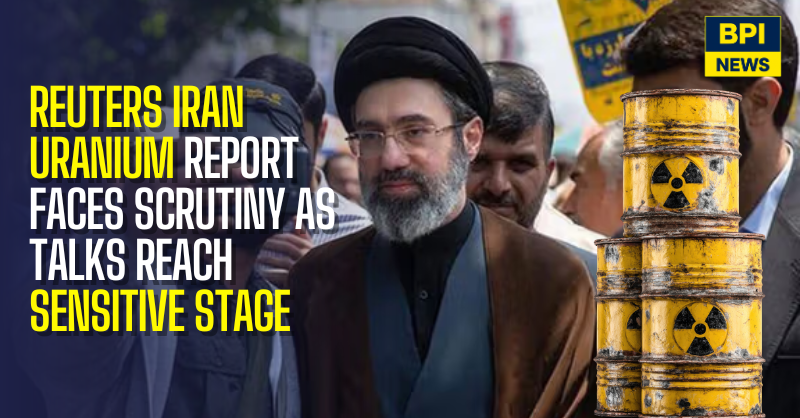
ISLAMABAD — A Reuters report claiming Iran’s Supreme Leader Mojtaba Khamenei has directed that the country’s highly enriched uranium stockpile must not be sent abroad has raised questions among Pakistani officials and sources familiar with the negotiations, as the nuclear file becomes one of the most sensitive obstacles in efforts to end the war.
Reuters, a large and highly respected international news organisation, reported that two senior Iranian sources said Khamenei had issued a directive that Iran’s near-weapons-grade uranium must remain inside the country, rejecting a key United States demand in the ongoing peace negotiations. The report said Iranian officials believe surrendering the stockpile would leave Tehran vulnerable to future US or Israeli attacks.
However, multiple Pakistani sources familiar with the negotiations told BPI News that they have not seen any formal decree or official document relating to Iran’s new leadership structure, appointments or internal chain of authority that has been signed by new Ayatollah.
The sources said they have been informed that messages connected to the negotiations have been sent to the new Ayatollah, and that well wishes have been passed on to him through relevant channels. But they stressed that this is different from seeing a formal decree or official document confirming the precise structure through which sensitive decisions are now being issued in Tehran.
That distinction is central to how the Reuters report is being read by some sources involved in the mediation track.
The question being raised is not whether Reuters is credible. Reuters has a long record of reporting on closed-door diplomacy through senior anonymous sources. The question is how a highly sensitive supreme-level directive on Iran’s nuclear file can be established with certainty when officials close to the Pakistan mediation channel say they have not seen formal documentation signed by Ayatollah Mojtaba Khamenei at all.
Why The Claim Matters
The uranium stockpile is one of the hardest issues in the proposed US–Iran understanding.
Washington wants Iran’s highly enriched uranium removed from the country as part of any settlement. Reuters previously reported that President Donald Trump said the United States would get enriched uranium from Iran, while earlier reporting also said Trump had spoken about recovering Iranian uranium as part of the conflict’s settlement terms.
Iran, however, views the stockpile differently. According to the Reuters report, Iranian officials believe sending the uranium abroad would weaken Iran’s deterrent and leave the country exposed if the US or Israel resumed strikes.
Pakistani sources familiar with the negotiations told BPI News that the uranium issue remains one of the most difficult points in the talks because it affects both sides’ domestic credibility.
For Tehran, removing the stockpile could be seen internally as surrendering strategic leverage under military pressure. For Washington, allowing it to remain in Iran could be attacked as a failure to remove the core nuclear risk.
Formal Directive Or Negotiating Signal?
The key issue now is whether the Reuters report reflects a fixed directive from the highest level of Iran’s system or a hard negotiating position being communicated through officials close to the process.
If the position has been formally locked in through a supreme-level directive, it would sharply narrow the space for compromise. If it remains a negotiating signal, mediators may still have room to work around technical formulas.
Reuters reported that possible alternatives include diluting the stockpile under International Atomic Energy Agency supervision rather than shipping it abroad. Iran had previously signalled that dilution could be considered if financial sanctions were lifted.
That type of formula could allow Tehran to say the uranium did not leave Iranian territory, while allowing Washington to claim that the most sensitive material had been reduced, monitored or neutralised under international supervision.
Pakistani sources told BPI News that this distinction matters because the mediation effort depends heavily on whether Iran’s position is still negotiable or has become politically irreversible.
Mistrust Shapes Iran’s Position
The Reuters report also said there is deep suspicion among Iran’s leadership that the current pause in hostilities could be a tactical move by Washington to create a sense of security before renewed airstrikes.
That suspicion is not separate from the uranium issue. Iranian officials have repeatedly argued that they cannot make irreversible concessions while they believe military pressure could resume.
Sources familiar with Pakistan’s mediation effort told BPI News that this mistrust is now shaping nearly every part of the talks, including guarantees, the sequencing of implementation, the Strait of Hormuz, frozen Iranian assets and the nuclear file.
The concern in Tehran is that if Iran sends away or neutralises its most sensitive uranium stockpile before receiving enforceable guarantees, it could lose leverage while still remaining exposed to further attacks.
Pakistan’s Mediation Path Narrows
For Pakistan, the dispute makes an already difficult mediation process more complicated.
Islamabad has been trying to keep both sides engaged while narrowing gaps over the proposed memorandum, which is expected to address the end of the war, a framework for nuclear negotiations, shipping through the Strait of Hormuz, sanctions relief and guarantees against renewed escalation.
Pakistani sources familiar with the negotiations told BPI News that they are treating the Reuters report cautiously because neither Tehran nor the mediators have publicly produced or received formal documentation confirming the reported directive.
They said the practical issue for Pakistan is not only what Iran’s position is, but how that position has been authorised and whether there remains room for compromise.
If the uranium stance has been formally issued from the top, Pakistan’s space to mediate narrows. If it is a negotiating position carried through channels, there may still be room for a staged formula involving dilution, monitoring, sanctions relief and security guarantees.
Markets React As Nuclear Issue Threatens Talks
The report has already affected markets. Reuters reported that oil prices rose and stocks fell after the uranium claim raised concerns that the dispute could obstruct the US–Iran process. Brent crude climbed as investors reassessed the risk of renewed conflict and disruption to energy flows.
That reaction shows how sensitive the uranium file has become. A single report about Iran’s internal position can affect oil prices because traders view it as directly linked to the future of the war, the Strait of Hormuz, sanctions and the wider regional security picture.
For now, the report has added another layer of uncertainty.
Reuters says senior Iranian sources have described a directive that the uranium must remain in Iran. Pakistani sources familiar with the negotiations tell BPI News they have not seen formal decrees or official documents relating to the new leadership structure or appointment process, even though they have been told messages have been sent to the new Ayatollah and have passed well wishes through relevant channels.
That gap is now part of the story.