
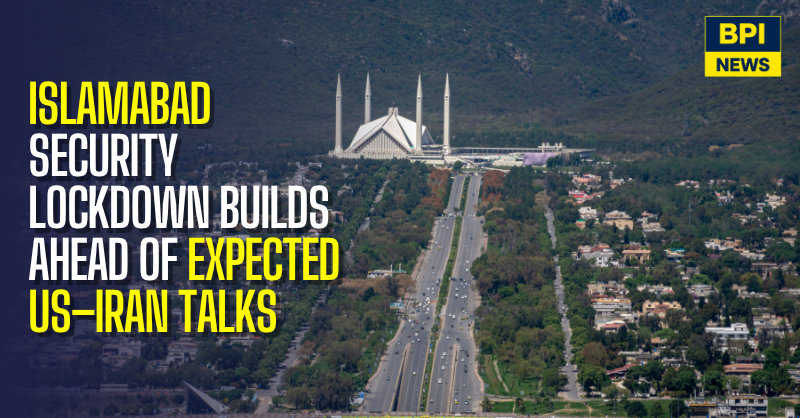
Islamabad is moving towards a full security lockdown ahead of an expected second round of talks between the United States and Iran, with multiple on-the-ground indicators pointing to imminent high-level diplomatic activity, according to information gathered by BPI News.
Residents living along key routes between Nur Khan Airbase and the Serena Hotel told BPI News they have been instructed not to record videos of official convoys, while security personnel have been deployed on rooftops overlooking these corridors.
“Everyone has been told not to film anything,” one resident who wished to remain anonymous said.
Security sources told BPI News that preparations currently underway mirror those seen during the first round of talks earlier this month, when large parts of the capital were effectively placed under lockdown.
Hotel guests have also begun reporting disruptions. Multiple guests at major hotels in Islamabad told BPI News they have been asked to vacate their rooms, with management informing them that no new bookings will be accepted in the coming days. Similar measures were implemented during the previous round of negotiations, when hotels were cleared and events, including weddings, were cancelled.
At the same time, the district administration has formally suspended all public and heavy transport in the capital until further notice. Deputy Commissioner Irfan Nawaz Memon confirmed the move, urging residents to cooperate with security agencies.
Islamabad Police said the Red Zone and Extended Red Zone will remain completely closed to all traffic due to the expected arrival of foreign delegations, while major routes including Murree Road have also been shut. An alternate traffic plan has been issued for residents.
In Rawalpindi, more than 10,000 police personnel have been deployed, with authorities placing the area on high alert.
Security sources told BPI News that the tightening measures are consistent with preparations for high-level diplomatic arrivals, adding that multiple indicators suggest talks could take place within days.
Iran Signals Mixed Position As Delegation Placed On Standby
Despite preparations in Islamabad, messaging from Tehran remains inconsistent.
The Supreme National Security Council of Iran confirmed that new proposals from the United States are currently under review following recent mediation efforts involving Pakistan’s army chief, Field Marshal Asim Munir, who visited Tehran in recent days.
“In recent days, with the presence of the Pakistani Army Commander in Tehran as a mediator, new proposals have been put forward by the Americans, which Iran is currently reviewing,” the council said.
Sources in Iran told BPI News that the Iranian delegation has been instructed to be ready to travel to Islamabad at very short notice.
However, one of the sources said resistance from hard-line factions inside Iran has intensified, complicating the decision-making process and potentially delaying a final agreement.
Ceasefire Deadline Nears As Strait Of Hormuz Closes Again
The developments come as a two-week ceasefire approaches its expiry on Wednesday, increasing pressure on both sides to reach an agreement.
The Strait of Hormuz briefly reopened before closing again, with Iranian officials linking access to the lifting of a US naval blockade on Iranian ports.
Iranian parliament speaker Mohammad Bagher Ghalibaf said there had been “progress” in negotiations but warned the sides remain “far from a final agreement”.
“If America does not lift the blockade, traffic in the Strait of Hormuz will definitely be limited,” he said.
US President Donald Trump said talks were ongoing and described them as “very good conversations”, while warning Iran against attempting to use the strait as leverage.
Maritime incidents have also been reported during the period of instability, including warning fire from Iranian forces and damage to at least one vessel, according to security agencies.
Separately, Yemen’s Houthi movement has warned it could move to shut the Bab al-Mandab strait if negotiations collapse, raising the risk of wider disruption to global shipping routes.
Pakistan Positions Itself At Centre Of Mediation Efforts
Security and diplomatic sources indicate that Islamabad is being prepared for a potentially significant international gathering.
Officials expect multiple foreign delegations, with indications that representatives from the United States, Iran and several regional and international partners could arrive in the capital.
Security sources noted that police leave cancellations implemented during the first round of talks have not yet been reversed, reinforcing expectations that preparations are ongoing.
Pakistan’s role as a mediator is underpinned by longstanding security coordination with Iran, particularly along the Balochistan border, where intelligence cooperation between Pakistani and Iranian agencies has focused on countering militant threats, including ISKP and cross-border insurgent groups.
Field Marshal Asim Munir’s visit to Tehran is understood to have reinforced these channels, positioning Pakistan as a key intermediary in ongoing diplomatic efforts between Washington and Tehran.
With preparations accelerating on the ground and diplomatic signals continuing to shift, the situation remains fluid as the ceasefire deadline approaches as Pakistan is pushing from all angles for a permanent ceasefire.
2 comments