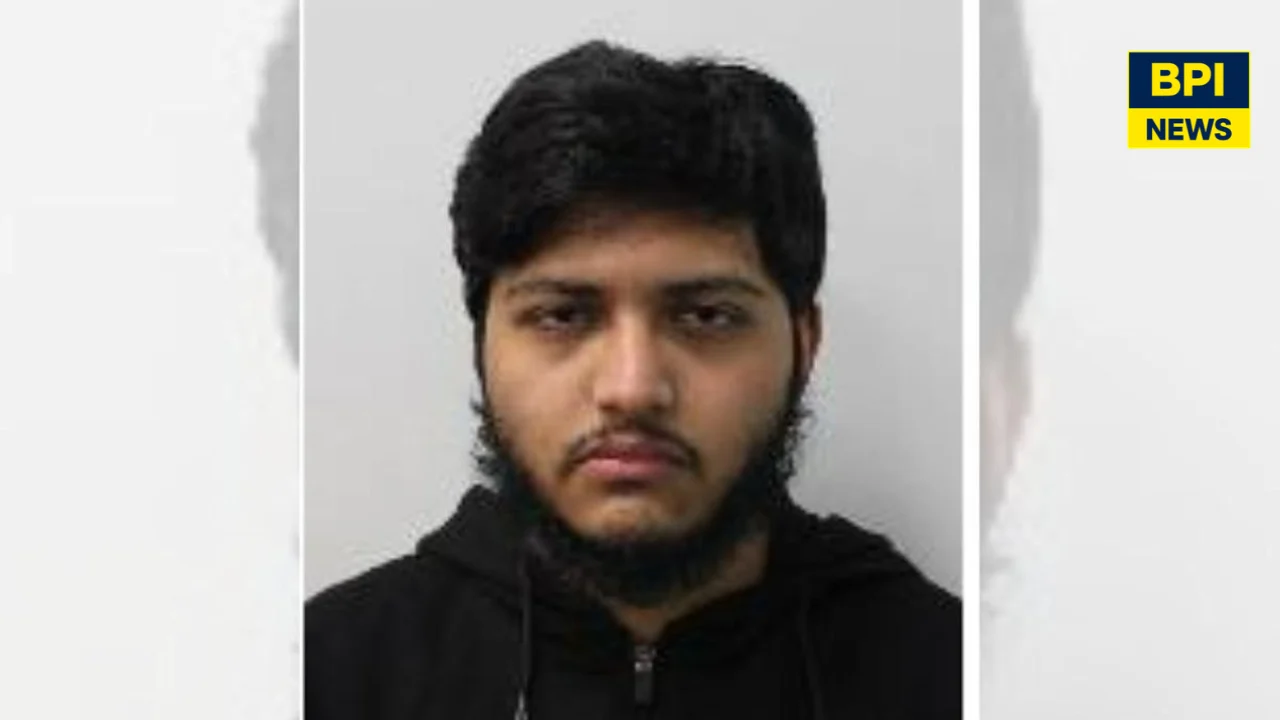
A 20-year-old man from south London has been sentenced to four years in custody for terrorism offences following an investigation launched after counter-terrorism officers stopped him at Heathrow Airport on his return from Pakistan.
Shuja Gibraeel Mohsin, of Mitcham, was sentenced at the Old Bailey on Thursday, 26 November, after being convicted of possessing a document likely to be useful to a terrorist and two counts of disseminating terrorist material.

He will serve his sentence in a Young Offender Institution, with the court also ordering the forfeiture and destruction of his mobile phone.
The investigation began in January 2024 when Mohsin was stopped by counter-terrorism officers under Schedule 7 of the Terrorism Act 2000 after arriving at Heathrow following a trip to Pakistan.
Although he was initially allowed to continue his journey, officers seized his mobile phone for further examination.
Specialist investigators examining his phone and a USB stick uncovered evidence that Mohsin had accessed extremist material and participated in online chat groups associated with the Taliban, Hamas and Daesh.
Among the material discovered was a bomb-making manual and several Daesh execution videos that Mohsin had distributed to an online contact.
Mohsin was arrested in March 2024, when officers also seized his computer. He was arrested again in July that year and gave no comment when questioned by detectives about material recovered from his electronic devices.
Following further investigation and forensic examination, the Crown Prosecution Service authorised charges against him in April 2025.
Mohsin was found guilty on 19 June 2026 following a two-week trial at the Old Bailey.
His convictions comprised one offence under Section 58 of the Terrorism Act 2000 for possessing a document likely to be of use to a terrorist and two offences under Section 2 of the Terrorism Act 2006 for disseminating terrorist publications.
Police Warn Over Online Radicalisation of Children
Commander Helen Flanagan, head of Counter Terrorism Policing London, said investigators had established that Mohsin’s exposure to extremist ideologies began several years before his arrest.
“Our investigation showed that Mohsin was being drawn into extremist and terrorist material and ideologies from when he was only 14 or 15 years old,” she said.
“This is reflective of a growing trend and concern over children and young people being radicalised and accessing extremely dangerous and violent terrorist ideologies and material online.”
Flanagan urged parents and carers to take an active interest in their children’s online activities and to seek assistance if they identified signs of radicalisation.
“It’s vital that parents and carers are aware of what their children are doing online. I would implore you to have conversations, to be inquisitive about what your children are viewing, and if you have any concerns, then there is help available to you via the ACT Early website.
“Otherwise, there are very clear and serious consequences for those who are involved in downloading or sharing terrorist content online, a reality that Mohsin is now facing.”