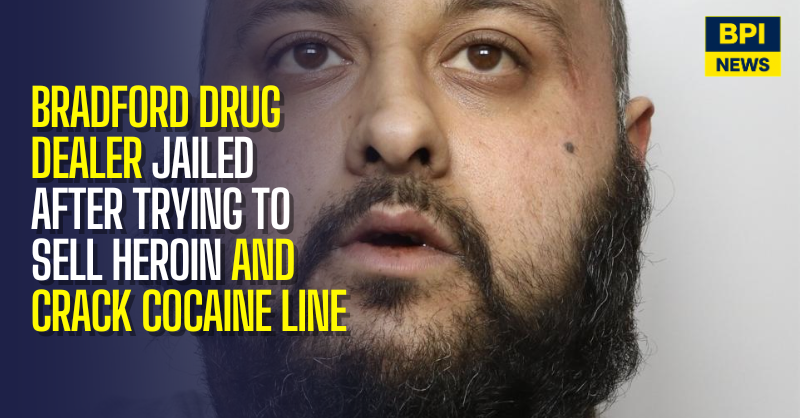
A Bradford man who previously survived being shot in the face by a masked gunman has been jailed for 40 months for supplying heroin and crack cocaine and attempting to sell a drugs line containing around 800 customer contacts.
Hameed Shah, 34, of Hope Avenue, Little Horton, was identified by police as running a drugs line which stopped operating after he was arrested on unrelated matters last November.
Bradford Crown Court heard that another drugs line began operating following his release and was also directly linked to him.
Police raided Shah’s home in March, discovering drugs paraphernalia and cannabis.
Officers also recovered two mobile phones which, when examined, were found to contain advertisements for heroin and crack cocaine over a six-month period.
The devices contained communications with multiple customers discussing drug prices and quantities.
Investigators also discovered an attempt by Shah to sell the drugs line itself, with Shah boasting that it contained around 800 customer contacts.
During an initial police interview, Shah claimed one of the phones belonged to a friend. He exercised his right to silence during a later interview.
Shah pleaded guilty at the magistrates’ court to being concerned in the supply of heroin and crack cocaine.
The court heard his previous offending history was “limited”, with his last offence dating to 2012.
In mitigation, Shah was said to have been using drugs himself during the period of his offending and to have associated “with the wrong crowd”.
The court was also told that Shah had previously been the victim of a shooting which left him with a significant facial wound and post-traumatic stress disorder.
Shah was seriously injured when a masked gunman opened fire inside ADR Convenience Stores on Torre Road, off Cooper Lane in Bradford, on 11 November 2022.
The shooting was a separate incident and was not connected to the drug-supply offences for which Shah has now been sentenced.
Evidence given during court proceedings relating to that attack described how a gunman entered the shop carrying a long, single-barrelled black shotgun, raised the weapon and asked: “Who wants it?” before firing.
Shah was struck by the first shot.
“The first shot hit me. The second shot hit everywhere on the shop,” he later told the court.
Shah said he initially did not realise the extent of his injury.
“When I looked down at my track suit, it went straight to red. That’s when I knew I’d been hit,” he said.
He went into a storeroom and toilet at the back of the premises, leaving a trail of blood behind him.
“It was that quiet, I could hear something dripping. It was actually my blood dripping and hitting the floor,” Shah recalled.
A witness, Shehzeb Rafiq, described seeing Shah emerge from the rear of the shop “in a panic”, holding his face and shouting: “I’m going to die.”
During those proceedings, the defence suggested Shah had been the intended target of the gunman and questioned him about alleged drug-dealing at the premises.
Shah denied having any knowledge of drug-dealing at the shop and said he believed he had been caught in “crossfire”.
He also denied going to the toilet to dispose of anything from a Louis Vuitton bag he was carrying, saying it contained £270 in cash and fat-burning pills.
Another witness, Kyle Salim, who had accompanied Shah to the shop, also denied being involved in illegal drug-dealing when questioned.
Shah’s previous experience of being shot and the resulting PTSD were raised in mitigation during his latest sentencing hearing.
His defence said he accepted his drug-supply offending had been foolish, deeply regretted his actions, had ended his previous associations and was now drug-free.
Sentencing him, Recorder Taryn Turner said the evidence demonstrated that his Class A drug dealing was an established operation.
“There was an attempt by you seemingly to sell the drugs line itself, boasting that it contained some 800 customer contacts,” she said.
“That in my judgement demonstrates an established operation rather than this being an isolated act.”
Recorder Turner told Shah: “These are serious offences.
“Class A drugs cause significant harm both to users and to the wider community.
“Those that participate in their supply contribute directly to the issues of their addiction, associated criminality, and the exploitation of vulnerable people.”
Shah was sentenced to 40 months in prison for being concerned in the supply of heroin and a further 40 months for being concerned in the supply of crack cocaine, with the sentences to run concurrently.
The court ordered the forfeiture and destruction of the drugs, mobile phones and SIM cards.