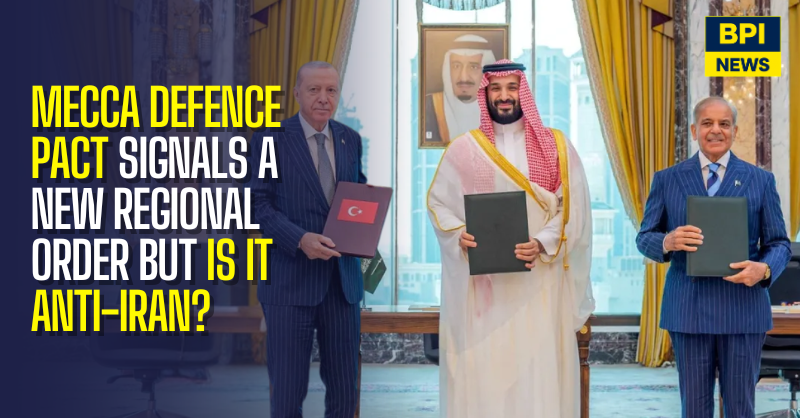
ISLAMABAD — Saudi Arabia, Pakistan and Türkiye have signed the Mecca Joint Defence Pact, a landmark collective defence agreement that could reshape the Middle East’s security architecture at a time of war, maritime disruption and growing doubts over the reliability of the United States security umbrella.
The agreement, signed in Mecca by Saudi Crown Prince Mohammed bin Salman, Turkish President Recep Tayyip Erdoğan and Pakistani Prime Minister Shehbaz Sharif, commits the three countries to treat an armed attack on one member as an attack on all. The pact is intended to strengthen collective deterrence and deepen defence cooperation between three of the Muslim world’s most powerful states.
The symbolism is difficult to miss. One member, Pakistan, is the Islamic world’s only declared nuclear power. Another, Türkiye, is a NATO member with one of the alliance’s largest militaries and a rapidly expanding defence industry. Saudi Arabia brings enormous political, religious and economic weight as custodian of the two holy mosques and one of the world’s central energy powers.
Together, they have created what many are already calling an “Islamic NATO”.
Western Media Frames It As A Blow To The Abraham Accords
Much of the Western and Israeli-aligned reading of the pact has focused on what it means for the Abraham Accords and the US-backed plan to build a Saudi-Israeli-Emirati security order.
The pact also lands directly against the direction Washington had wanted for the region. For years, the expectation was that Saudi Arabia would eventually be drawn into a wider security and normalisation framework with Israel. Instead, Riyadh has signed a collective defence pact in Mecca with Pakistan and Türkiye. That does not formally end the Abraham Accords, but it does show that Saudi Arabia is now looking at a different security path one built around Muslim-majority regional powers, collective deterrence and reduced dependence on external guarantees.
That reading matters because Saudi normalisation with Israel was once treated as the great prize of US Middle East strategy. Instead, Riyadh has now signed a collective defence arrangement in Mecca with Islamabad and Ankara, both of which have their own complicated relationships with Israel and Iran.
The timing makes the signal stronger. On the day the pact was signed, Indian Prime Minister Narendra Modi held a call with Israeli Prime Minister Benjamin Netanyahu to review the India-Israel strategic partnership and discuss the situation in West Asia, according to Indian media. Netanyahu later publicly thanked Modi and praised the India-Israel relationship.
For Pakistan, that timing will not go unnoticed. While Riyadh, Ankara and Islamabad were formalising a defence pact in Mecca, New Delhi and Tel Aviv were publicly reinforcing their own strategic bond.
Iranian-Linked Analysis Offers A Different Reading
But the most interesting early reaction may be coming from Iranian media and analysts close to parts of the security establishment.
Rather than portraying the Mecca Pact primarily as an anti-Iran coalition, some Iranian-linked readings frame it as a broader strategic response to the regional transformation caused by the recent war. That interpretation rests on three connected arguments: declining confidence in the US security umbrella, concern over Israel’s increasingly assertive regional posture, and a desire by major regional powers to shape the post-war security order themselves rather than have it imposed from Washington.
This is not the same as saying Iran welcomes the pact. Iranian criticism has already appeared, including an Iranian lawmaker dismissing it as a “paper agreement” that would not bring Saudi Arabia real security.
But BPI News understands, after speaking to multiple Pakistani security sources with knowledge of the regional security discussions, that Islamabad does not read the pact as a simple anti-Iran instrument. The Pakistani view is that the agreement is designed to raise the cost of aggression against any member state, while still preserving Pakistan’s mediation role with Tehran.
One Pakistani security source told BPI News that the agreement should be understood as “deterrence first, alignment second”, adding that Pakistan does not want the pact to become a mechanism that automatically drags it into every regional confrontation.
A Pact Born From Doubt In Washington
The Mecca Pact is also a vote of no confidence in the old security order.
For decades, Gulf security rested on a simple assumption: when the region faced a major external threat, the United States would act as ultimate guarantor. That assumption has weakened after years of missile and drone attacks, the war with Iran, disruption in the Strait of Hormuz and growing fears that Washington cannot, or will not, control Israel’s military actions.
The timing of the pact is central to understanding its purpose. This is not an agreement emerging in calm conditions, but in the middle of a region that has just watched war, maritime disruption and missile threats expose the limits of the old security order.
For Saudi Arabia, the concern is not abstract. The kingdom has seen how quickly threats from Yemen, Iraq and the wider Iran-aligned network can place ports, airports, energy sites and civilian infrastructure within range. For Pakistan and Türkiye, the same lesson is broader: the region can no longer assume that Washington will always prevent escalation, restrain Israel or guarantee stability around the Gulf and Red Sea.
That is why the Mecca Pact should be read less as a sudden military bloc and more as a response to a changed strategic environment. The recent war has shown regional powers that they need their own mechanisms for deterrence, intelligence sharing and crisis management. In that sense, the agreement is not only about who these countries may stand against. It is about who they no longer fully trust to stand for them.
That is the deeper story. Saudi Arabia is not only looking for protection from Iran or the Houthis. It is looking for options beyond Washington.
Houthis And Hormuz Give The Pact Immediate Context
The pact does not exist in theory. It has been signed while the Middle East’s two most important maritime corridors the Strait of Hormuz and the Red Sea/Bab el-Mandeb route remain under pressure.
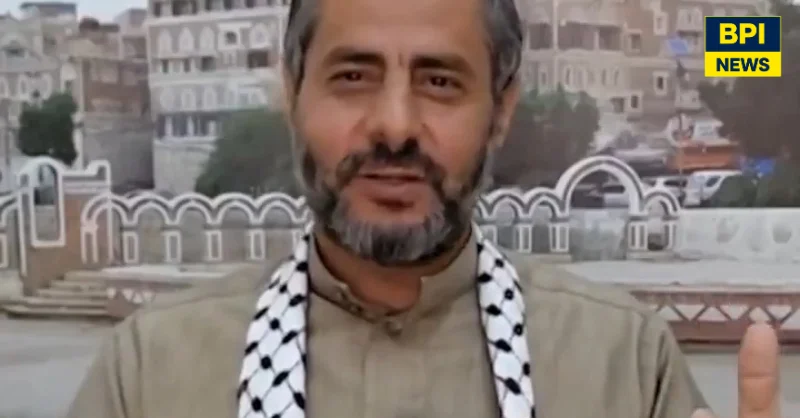
Yemen’s Houthi movement has announced a complete ban on Israeli maritime navigation in the Red Sea, saying Israeli-linked vessels would again be considered targets. The group also claimed missile attacks on sensitive Israeli targets in the Jaffa region.
The Red Sea crisis gives the pact another layer of urgency. Houthi threats against shipping have shown how quickly a regional war can become a global economic problem, with one armed group able to disrupt trade routes, raise insurance costs and force ships away from one of the world’s most important maritime corridors.
For Saudi Arabia, this is not distant geopolitics. Houthi attacks have repeatedly threatened Saudi territory, energy infrastructure and shipping routes. For Pakistan, energy security depends heavily on Gulf stability. For Türkiye, maritime security, arms exports and regional influence all intersect in the same crisis.
That is why the Mecca Pact is being read as more than a symbolic agreement. It gives the three states a formal structure for intelligence sharing, joint military training, counterterrorism coordination and defence industry cooperation.
Is This Really An Islamic NATO?
The phrase “Islamic NATO” is powerful, but it needs caution.
NATO’s Article 5 states that an armed attack against one or more members shall be considered an attack against them all, and that each member will assist by taking action it deems necessary, including possible use of armed force.
The collective defence clause is what gives the pact its weight and why it is already being compared to NATO. On paper, the message is simple and powerful: an armed attack on one member will be treated as an attack on all. That is a NATO-style collective defence clause, and it is the reason the agreement is being described by some as an “Islamic NATO”.
But the detail still matters. The real test will be how Saudi Arabia, Pakistan and Türkiye define an “attack”, what level of response would be required, and whether that response means direct military action, air defence support, intelligence sharing, diplomatic backing or something more limited.
That ambiguity may be deliberate.
It gives the pact enough force to deter rivals, while leaving all three states room to avoid being automatically dragged into every crisis.That distinction matters.
Would Pakistan and Türkiye automatically fight India in a future India-Pakistan war because Pakistan is a member of the pact? Would Pakistan and Türkiye directly enter a Saudi confrontation with the Houthis? Would Saudi Arabia and Türkiye fight if Pakistan came under attack?
The answer is not yet clear.
BPI News understands from Pakistani security sources familiar with the thinking around the agreement that Islamabad views the pact as a deterrent framework, not a blank cheque for automatic escalation. One source said Pakistan’s experience in the recent India-Pakistan conflict showed the limits of treaty language when nuclear risk and major-power pressure are involved.
In other words, the pact is serious but it does not mean every crisis becomes a three-state war overnight.
The Treaty Trap And The World War Question
The reason the “Islamic NATO” label carries weight is because collective defence pacts can deter war, but they can also widen one if deterrence fails.
That is the uncomfortable historical parallel.
Before the First World War, Europe’s alliance system helped turn a regional crisis into a continent-wide war. The assassination of Archduke Franz Ferdinand was the spark, but the complex web of alliances, mobilisations and security guarantees helped expand the conflict far beyond the Balkans. Historians generally caution that alliances were not the only cause of the war, but they were a major mechanism through which local violence became general war.
The Second World War was different, but treaty guarantees still mattered. Britain and France declared war on Germany in September 1939 after Germany invaded Poland, honouring their guarantee of Poland’s borders.
That is why the Mecca Pact raises such serious questions.
If one member is attacked, the agreement is designed to deter the attacker by threatening collective response. But if deterrence fails, the same mechanism could create pressure for escalation. In a region already containing Israel, Iran, the Houthis, US bases, Indian-Israeli strategic ties, Gulf energy routes and a NATO member, the risk is not theoretical.
The Middle East does not need another 1914-style chain reaction.
But the fact that regional powers are now building treaty structures shows how little confidence they have in the old order.
Pakistan’s Nuclear Role Changes The Weight Of The Pact
Pakistan’s presence is the most sensitive part of the agreement.
Islamabad has long insisted that its nuclear deterrent is for Pakistan’s defence. But the political symbolism of Pakistan entering a collective defence pact with Saudi Arabia and Türkiye is unavoidable.
What makes the pact so significant is the combination of power sitting inside it. Saudi Arabia brings money, energy influence, religious weight and control of the two holy sites. Pakistan brings one of the Muslim world’s largest militaries and its only declared nuclear deterrent.
Türkiye brings NATO membership, a battle-tested defence industry and one of the alliance’s biggest armies. Put together, the pact is not just a diplomatic statement. It links Gulf wealth, South Asian nuclear deterrence and Turkish military reach inside one collective defence framework.
That combination creates a new kind of deterrent language in the Muslim world.
BPI News understands from Pakistani security sources that Islamabad is aware of the sensitivity around the nuclear question and does not want the pact interpreted as a Saudi nuclear umbrella. However, the fact that Pakistan is a member will inevitably shape how rivals read the agreement.
This is why India will watch the pact closely. The recent India-Pakistan conflict showed how quickly South Asian escalation can draw in wider diplomatic pressure. If another crisis erupts, the question will not simply be what Pakistan does, but whether Riyadh and Ankara provide diplomatic, intelligence, defence-industrial or military support.
That does not mean Saudi Arabia or Türkiye would “jump in” to fight India. It does mean India will have to consider a broader strategic picture than before.
A Message To Israel As Much As Iran
The pact is also being interpreted in Pakistan as a message to Israel.
BPI News spoke to Islamabad resident Akbar Ali, who said the agreement carried deep symbolic weight because it was signed in Mecca and involved the defence of Saudi Arabia.
“There is no greater honour than protecting the holy sites,” Akbar Ali told BPI News. “This is a message for Israel as well Muslim countries are no longer waiting for others to protect them.”
That sentiment reflects how the agreement is being received by many ordinary Pakistanis. For them, Saudi Arabia is not just another state. It is home to Makkah and Madinah. A defence pact signed in Mecca therefore carries religious emotion as well as strategic meaning.
Residents in Islamabad and Rawalpindi who spoke to BPI News described the pact as a moment of pride, but also warned that Pakistan must avoid being pulled into wars that do not directly serve its national interest.
That tension is likely to define Pakistan’s role: pride in defending the holy sites, caution over becoming entangled in every Middle Eastern battlefield.
Has The Pact Killed The Abraham Accords?
The Mecca Pact does not formally end the Abraham Accords. The UAE, Bahrain and Morocco remain part of that framework with Israel.
But politically, it is a major blow to the idea that Saudi Arabia was moving inevitably towards a US-Israel-led regional order.
Saudi Arabia’s choice of partners matters. Instead of signing a new defence framework with Israel or the United States, Riyadh signed in Mecca with Pakistan and Türkiye. That does not mean Saudi Arabia has chosen confrontation with Israel. It does mean normalisation is no longer the centre of gravity.
The Abraham Accords were built on the idea that Arab states would increasingly integrate with Israel under US protection. The Mecca Pact points in a different direction: Muslim-majority regional powers coordinating with each other because they no longer trust external guarantees to manage the region’s crises.
That is why the pact may be remembered as a turning point.
It does not destroy the Abraham Accords on paper. But it weakens their momentum and offers a competing model of regional order because no matter what, in the Middle East eyes are always on Saudi Arabia.
Iran’s Strategic Dilemma
For Iran, the pact creates both risk and opportunity.
The risk is obvious: three powerful Sunni-majority states have created a collective defence mechanism at a time when Iran and its allies are at the centre of multiple regional fronts.
But the opportunity is also real. If Iranian-linked analysis is correct, and the pact is partly a response to Israeli assertiveness and US unreliability, Tehran may try to avoid treating it as a hostile bloc. Instead, Iran could seek to engage Saudi Arabia, Pakistan and Türkiye as part of a broader regional security conversation.
This explains why some Iranian readings are not reducing the pact to an anti-Iran alliance. They see it as evidence that the region is trying to escape both Israeli dominance and American unpredictability.
That interpretation deserves attention because it suggests the next Middle East order may not be built around a simple Sunni-Shia divide. It may be built around states trying to survive a world where the US no longer guarantees stability and Israel is no longer seen as restrained by Washington.
The New Middle East Is Being Written In Mecca
The Mecca Pact is significant because it brings together three different forms of power.
Saudi Arabia brings money, religion, energy and diplomatic weight.
Türkiye brings a major military, NATO membership, drones, defence manufacturing and regional reach.
Pakistan brings battle-hardened armed forces and nuclear deterrence.
Together, they do not yet form a NATO. But they do form something new: a Muslim-majority collective defence framework with enough symbolism and substance to alter calculations in Tel Aviv, New Delhi and Washington.
Western commentary may see it as a Saudi move away from the Abraham Accords or a soft anti-Iran bloc. Iranian-linked analysis may see it as a step towards autonomous regional security. Pakistani sources tell BPI News it is best understood as deterrence, not automatic war.
All three readings can be true at once.
The pact is a warning to Iran, a message to Israel, a hedge against Washington, a signal to India and a statement to the Muslim world.
It may prevent war by raising the cost of aggression.
Or, if tested badly, it could widen one.