A senior figure in Yemen’s Houthi movement has threatened Pakistan and Türkiye with an “iron fist” and a “decisive and painful response” if either country intervenes militarily in support of Saudi Arabia.
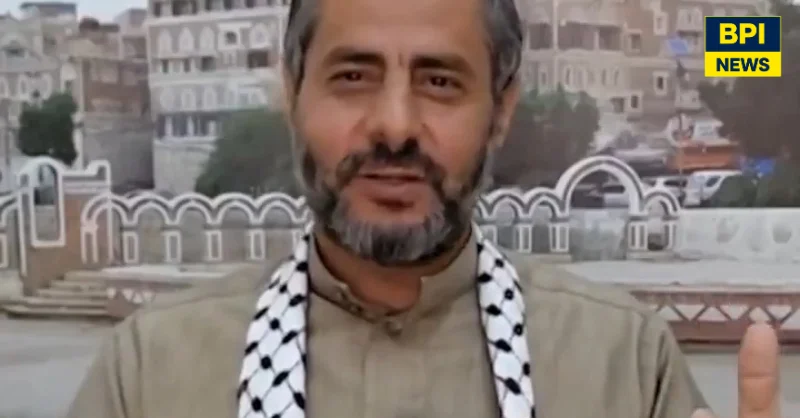
Mohammed al-Bukhaiti, a member of Ansar Allah’s political bureau and governor of Dhamar, made the comments during an interview with Iraqi satellite channel iNews on its political programme Another Reading.
The warning represents one of the clearest public threats yet directed by a senior Houthi figure towards Pakistan since renewed attacks on Saudi Arabia placed the recently signed Makkah Joint Defence Agreement under scrutiny.
‘We Will Strike Them With An Iron Fist’
Speaking during the interview, al-Bukhaiti said:
“By God, if Türkiye and Pakistan become involved, we will strike them with an iron fist, and just as we are disciplining Saudi Arabia today, we will discipline them.”
Asked specifically about Pakistan following warnings that the Makkah agreement could be activated, he repeated the threat.
Al-Bukhaiti said the Houthis were not asking other countries to assist them but were warning governments against joining Saudi Arabia militarily.
He said: “We warn any country against becoming involved alongside the Saudi enemy.”
He went on to say that any country participating directly in military action against Yemen would face retaliation.
‘Decisive And Painful Response’
Later in the interview, al-Bukhaiti acknowledged what he described as widespread sympathy for Yemen among both Turkish and Pakistani populations.
He said this did not change the movement’s position towards their governments.
“Any direct military move by the Turkish government or the Pakistani government to attack Yemen, in that case we will respond with a decisive and painful response and we will strike with an iron fist,” he said.
He argued that Yemen had not attacked Pakistan or Türkiye and portrayed the Houthis as fighting defensively against Saudi Arabia.
The Saudi government and its allies dispute that characterisation and accuse the Houthis of launching missiles and drones against civilian areas and critical infrastructure.
Houthis Point To Yemen War Death Toll
Al-Bukhaiti justified the warning by invoking the humanitarian toll of Yemen’s long-running conflict.
He accused the Saudi-led coalition of responsibility for hundreds of thousands of deaths and said many more Yemenis had died through hunger, malnutrition, shortages of medicines, restrictions and disease.
The scale and attribution of deaths during the Yemen war have long been disputed and include combat deaths as well as indirect deaths caused by hunger, disease and the collapse of infrastructure.
Al-Bukhaiti nevertheless presented those losses as the basis for what he called a “just cause” and said countries intervening on Saudi Arabia’s side would therefore become legitimate targets in the eyes of the Houthis.
Pakistani Security Officials Stress Pact Is Defensive
BPI News has spoken to multiple Pakistani security officials about the implications of the Houthi warning.
Those officials stressed that Islamabad continues to view the Makkah agreement as a defensive pact centred on collective deterrence and protection against external aggression.
They said the agreement should not be interpreted as an automatic commitment by Pakistan to join an offensive campaign inside Yemen.
That position mirrors Pakistan’s public statements since the agreement was signed.
The Foreign Ministry has repeatedly described the Makkah pact as defensive in nature and not directed against any country.
Pakistan’s military spokesman Lieutenant General Ahmed Sharif Chaudhry has also said the agreement has no “regional aspirations” and is intended to formalise collective deterrence and defence between Pakistan, Saudi Arabia and Türkiye.
Islamabad has separately said that no military response had been discussed under the pact following earlier Houthi attacks on Saudi territory.
Why The Threat To Pakistan Matters
The practical question is what the Houthis could actually target if Pakistan became militarily involved.
Geography places significant constraints on any direct conventional attack against Pakistan itself.
Yemen is separated from Pakistan by more than 2,000 kilometres, with Saudi Arabia, Oman and the Arabian Sea between the two theatres.
The Houthis have demonstrated increasingly long-range missile and drone capabilities, but there has been no public evidence that they currently possess a reliable conventional capability to conduct sustained strikes deep inside Pakistan.
That makes Pakistani interests outside the country potentially more exposed than Pakistan itself.
Five Possible Routes Of Escalation
BPI News analysis identifies five broad pathways through which a Houthi threat against Pakistan could potentially materialise if Islamabad entered the conflict.
Three relate to maritime activity.
Pakistani-linked commercial vessels operating through the Red Sea and Bab el-Mandeb could face increased risk if the Houthis chose to expand the categories of shipping they consider legitimate targets.
Pakistani-crewed or Pakistani-operated vessels could also become politically sensitive targets even where the ships themselves were registered elsewhere.
A third maritime pathway would arise if Pakistan deployed naval assets to escort shipping, protect Saudi interests or participate directly in operations close to Yemen.
The remaining two pathways involve Pakistani assets or personnel inside Saudi Arabia.
Any Pakistani military personnel, logistical facilities or defence infrastructure deployed in support of the Kingdom could theoretically become targets if the Houthis regarded them as directly participating in the conflict.
Pakistani-linked facilities connected with military cooperation inside Saudi Arabia could similarly become exposed depending on how far Islamabad’s role developed.
These are scenarios rather than confirmed Houthi operational plans. Al-Bukhaiti did not specify particular targets in the interview.
Pakistan Already Has Deep Military Links With Saudi Arabia
Pakistan’s defence relationship with Saudi Arabia predates the Makkah agreement by decades.
One of the clearest examples is former Pakistan Army chief General Raheel Sharif, who went on to become military commander of the Islamic Military Counter Terrorism Coalition after retiring as army chief.
The Riyadh-based coalition was established by Saudi Arabia as a multinational counter-terrorism grouping bringing together more than 40 Muslim-majority states.
Its work covers military cooperation, intelligence coordination, counter-terrorism financing, ideological initiatives and communications.
Raheel Sharif has served as its military commander since 2017.
The coalition is separate from the new Makkah Joint Defence Agreement, but his position illustrates the depth of long-standing Pakistani-Saudi military cooperation already present before the latest pact was signed.
The IMCTC’s own framework also makes clear that member states decide participation in military operations according to their own capabilities, resources and willingness to take part.
Attacking Pakistan Itself Would Be More Difficult
A direct strike deep inside Pakistan would be a considerably different proposition.
Unless the Houthis possessed capabilities not currently publicly demonstrated, or were able to operate through another territory or with assistance closer to Pakistan’s borders, their more immediate options would appear to lie around the Red Sea and Saudi Arabia.
Iran has long provided political and military support to the Houthis, although Tehran rejects claims that it directly controls the group’s operational decisions.
There is currently no evidence that Iran or another state intends to facilitate Houthi attacks from territory bordering Pakistan.
Warning Comes After Makkah Pact
The threat comes against the backdrop of the Makkah Joint Defence Agreement signed by Pakistan, Saudi Arabia and Türkiye on August 7.
The agreement states that an armed attack against any one of the three countries will be regarded as an attack against all three.
Pakistan’s Foreign Office has repeatedly stressed that the pact is defensive, is not directed against any country and is intended to strengthen collective deterrence against external aggression.
Pakistan’s Defence Minister Khawaja Asif has separately said continued Houthi attacks on Saudi Arabia could bring the agreement into play, although Islamabad later clarified that no military response had been discussed under the pact at that stage.
Pact Still Has Strategic Ambiguity
The agreement contains a NATO-style collective-defence principle, but the exact mechanisms through which the three countries would respond to an attack remain less clearly defined publicly.
Pakistan, Türkiye and Saudi Arabia have established a Strategic Political and Defence Committee and agreed to further institutionalise their military cooperation.
A permanent secretariat is also due to be established in Saudi Arabia, initially headed by a Pakistani secretary-general.
That ambiguity has allowed Islamabad to maintain its position that the agreement is fundamentally about deterrence while avoiding a commitment to a specific military response to every Houthi attack.
Pakistan Has Previously Avoided Yemen War
Pakistan’s involvement would carry particular significance because Islamabad has historically been cautious about direct military involvement in Yemen.
It also maintains relations with Iran while having longstanding strategic and defence ties with Saudi Arabia.
The renewed Houthi campaign against Saudi territory therefore creates a difficult balancing act: maintaining the credibility of the Makkah pact while avoiding becoming directly drawn into the Yemen conflict.
Al-Bukhaiti’s Warning Raises The Stakes
Al-Bukhaiti’s remarks show that the Houthis are already treating potential Pakistani and Turkish involvement as part of their strategic calculations.
His language also reflects growing confidence within the movement after years of confronting Saudi Arabia, and more recently the United States and Britain.
But threatening Pakistan and Türkiye while simultaneously fighting Saudi Arabia would also dramatically widen the number of states directly involved in the conflict.
The immediate question is therefore not whether the Houthis can threaten Pakistan rhetorically, but what they would realistically be capable of striking if Islamabad moved from diplomatic support for Saudi Arabia to direct military participation.