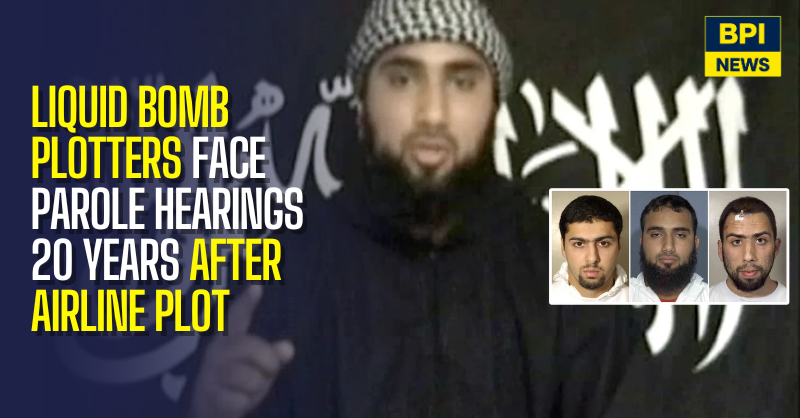
Three men convicted of conspiracy to murder over their involvement in an al-Qaeda-inspired suicide bombing plot are due to face Parole Board hearings, 20 years after the discovery of a plan to use liquid explosives that led to sweeping changes in airport security.
Ibrahim Savant, Arafat Waheed Khan and Waheed Zaman were sentenced to life imprisonment with minimum terms of 20 years after being convicted in 2010.
Zaman has a Parole Board hearing listed for 7 September, while Khan’s case is scheduled to be considered on 21 September. Savant is due before the board on 12 November.
Eligibility for parole does not mean any of the men will automatically be released. For a life-sentenced prisoner, the Parole Board must determine whether it is satisfied that continued detention is no longer necessary for the protection of the public before release can be directed.
The three men were part of the wider conspiracy uncovered by British authorities in August 2006 and were recruited by Abdulla Ahmed Ali, who was identified as the central figure in the plot.
The conspiracy involved plans to manufacture explosive devices using liquids that could be concealed inside ordinary drinks bottles and taken aboard passenger aircraft.
The main explosive charges were intended to use hydrogen peroxide and other chemicals to produce TATP, a highly unstable explosive. Prosecutors said small detonators could be constructed using components from disposable cameras.
Investigators established that the wider group considered targeting multiple aircraft travelling simultaneously from Britain to destinations in the United States and Canada.
Flights from Heathrow to San Francisco, Toronto, Montreal, Chicago, Washington DC and New York were among those considered.
Investigators also discovered discussions about an operation potentially involving as many as 18 suicide bombers.
Six suspects recorded martyrdom videos denouncing the West and explaining their willingness to die. The recordings were intended for distribution by al-Qaeda supporters following the planned attacks.
Police moved against the suspects on 10 August 2006 amid concerns that an attack could be imminent.
The UK’s terrorism threat level was raised to “critical”, while normal hand luggage was initially prohibited from flights departing British airports.
The emergency measures caused extensive disruption during the summer holiday period, with thousands of passengers facing lengthy queues.
British Airways cancelled 1,280 flights over eight days and subsequently estimated that the disruption had cost the airline £40 million.
The discovery of the conspiracy also had consequences for aviation security far beyond the immediate police operation.
Within months, restrictions were introduced limiting liquids carried in hand luggage to containers of no more than 100ml, which generally had to be presented for security screening inside transparent one-litre plastic bags.
The restrictions affected water, shampoo, toothpaste, deodorant, perfume, suncream, cosmetics and numerous other everyday products carried by airline passengers.
Manufacturers and retailers responded by expanding the availability of travel-sized toiletries, while reusable 100ml containers and transparent security bags became common items for travellers.
Airports have subsequently invested millions in computed tomography security scanners capable of producing more detailed images of baggage and detecting potential threats, including liquid explosives. The technology has allowed some airports to begin relaxing restrictions introduced in response to the 2006 conspiracy.
The prosecution of those involved in the plot took several years and multiple trials.
Ali, Assad Sarwar and Tanvir Hussain were ultimately convicted of conspiring specifically to murder passengers by detonating liquid explosive devices aboard transatlantic aircraft.
Ali received a life sentence with a minimum term of 40 years. Sarwar was ordered to serve at least 36 years and Hussain at least 32 years.
Another conspirator, Umar Islam, was convicted of conspiracy to murder and sentenced to life imprisonment with a minimum term of 22 years.
The cases against Savant, Khan and Zaman followed a more complicated path through the courts.
They were cleared of conspiring specifically to blow up aircraft because prosecutors had failed to establish beyond reasonable doubt that they knew passenger aircraft were the intended targets of the suicide operation.
Prosecutors nevertheless argued that the available evidence demonstrated that all three had committed themselves to participating in a suicide attack intended to kill members of the public.
Then-Director of Public Prosecutions Sir Keir Starmer authorised a further prosecution after determining there remained a realistic prospect of securing convictions.
A third jury convicted Savant, Khan and Zaman of conspiracy to murder in 2010.
Sentencing them to life imprisonment, Mr Justice Holroyde told the three: “Each of you agreed to join with others in this conspiracy, with each of you intending that you would kill members of the general public and yourselves by acting as a suicide bomber.”
Ghaffar Hussain, a former counter-terrorism officer who worked on the Government’s Prevent programme, told The Sun that he believed terrorists who intended to kill hundreds of people should remain imprisoned for life.
The Parole Board hearings will consider the current risk posed by each prisoner individually, rather than reconsidering their convictions or the seriousness of the original offences.