By Feroze Khan | Pakistan Correspondent
BPI News Exclusive Analysis
Pakistan finds itself navigating increasingly difficult diplomatic and military commitments as renewed fighting between Saudi Arabia and Yemen’s Houthi movement tests the purpose and limits of the Makkah Joint Defence Agreement.
The escalation comes as Islamabad maintains its role in negotiations involving Iran while simultaneously facing obligations to help defend Saudi Arabia under a collective security arrangement with Riyadh and Türkiye.
Saudi Arabia has faced repeated Houthi missile and drone attacks targeting airports, energy infrastructure and military facilities, prompting additional military operations against Houthi-controlled territory in Yemen.
Egypt has also signalled its willingness to provide military assistance, with President Abdel Fattah el-Sisi requesting parliamentary authorisation to support Saudi Arabia if Riyadh seeks help.
Pakistan’s position, however, is particularly complicated by its existing military cooperation with Saudi Arabia and its diplomatic involvement with Tehran.
Pakistani Security Sources Tell BPI News Pact Was Designed For Deterrence
Pakistani security sources with knowledge of the defence arrangements have repeatedly told BPI News that the Makkah Joint Defence Agreement was conceived as a defensive mechanism intended to deter aggression, rather than a framework for launching military operations against other countries.
According to the sources, the agreement was designed to strengthen collective security and discourage attacks against Pakistan, Saudi Arabia and Türkiye by demonstrating that the three countries would support one another in the event of external aggression.
The sources emphasised that deterrence, rather than confrontation, was central to the agreement’s original purpose.
Their account is consistent with Pakistan’s publicly stated position.
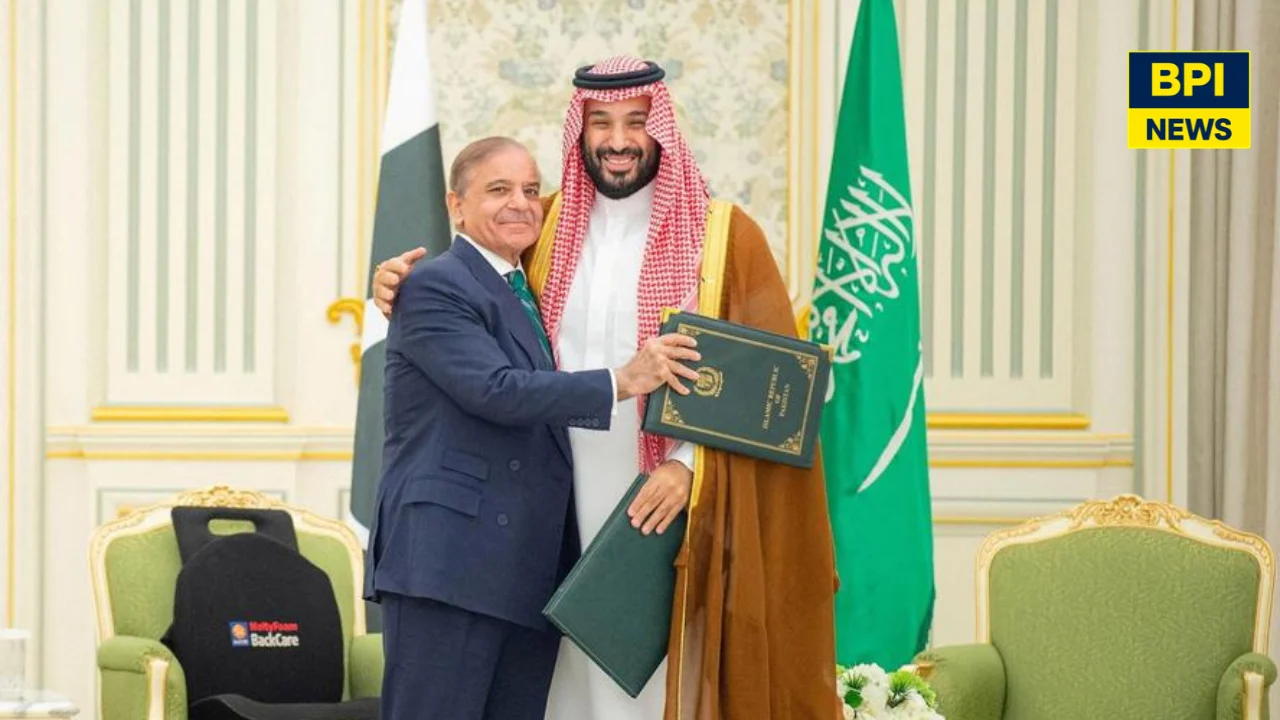
When the agreement was signed in Makkah on 7 August, Deputy Prime Minister and Foreign Minister Ishaq Dar described it as a defensive arrangement intended to strengthen collective deterrence.
The pact states that an armed attack against one member will be regarded as an attack against all three, consistent with the right of collective self-defence under Article 51 of the United Nations Charter.
However, the agreement’s current implementation is being tested by the renewed conflict between Saudi Arabia and the Houthis.
The central question is whether Pakistan can maintain a defensive military role without becoming directly involved in a wider conflict.
Sources Warn Pakistan Faces A Difficult Position Between Iran And Saudi Arabia
Security sources familiar with the situation have also told BPI News that Pakistan faces a particularly difficult diplomatic position because of its simultaneous responsibilities involving Iran and Saudi Arabia.
Islamabad has invested considerable diplomatic efforts in facilitating negotiations between Washington and Tehran, seeking to reduce tensions and establish a lasting agreement.
At the same time, Pakistan maintains longstanding military and economic ties with Saudi Arabia and has undertaken formal commitments to defend the kingdom against external aggression.
The sources identified the competing responsibilities as a significant challenge for Islamabad.
Pakistan must balance its efforts to maintain diplomatic engagement with Iran against its defence commitments to Saudi Arabia, particularly when the Houthis are widely regarded as an Iran-aligned movement.
Those competing responsibilities have become more pronounced as Houthi attacks against Saudi Arabia have intensified.
For Islamabad, involvement in negotiations with Tehran does not remove its obligations to Riyadh.
Equally, its defence commitments to Saudi Arabia do not necessarily mean that Pakistan intends to participate in offensive operations against Yemen.
The distinction between collective defence and direct military intervention remains central to the position described by the sources.
Security Sources Criticise Misinformation Over Pakistani Military Operations
The Pakistani security sources also expressed frustration with media coverage of the country’s military involvement in Saudi Arabia.
They told BPI News that numerous reports had circulated without a proper understanding of the defence arrangements or the operational decisions being considered.
The sources described much of the coverage as misinformation and criticised speculation that had been presented as established fact.
Their criticism comes amid reports concerning Pakistani fighter aircraft, additional troop deployments and possible participation in strikes against Houthi targets.
Pakistan’s Foreign Office has publicly rejected claims that Pakistani fighter jets have been conducting airstrikes inside Yemen.
At a briefing on 9 October, officials reiterated that the Makkah alliance was defensive and that Pakistani forces would not cross into Yemen to attack the Houthis.
The ministry also confirmed that Pakistan already had substantial military personnel and resources stationed in Saudi Arabia.
However, officials declined to disclose detailed operational arrangements, saying decisions about further military contributions would depend on the alliance’s assessment of threats.
BPI News has not independently established that Pakistani aircraft have participated in offensive operations inside Yemen.
What Military Support Could Pakistan Offer Saudi Arabia?
Pakistan possesses a range of conventional military capabilities that could support Saudi Arabia’s defence against Houthi missile and drone attacks.
These include fighter aircraft, air defence expertise, intelligence capabilities, surveillance systems and military personnel.
However, the availability of these capabilities does not mean that Pakistan has committed all of them to the current conflict.
Fighter Aircraft And Airspace Protection
The Pakistan Air Force operates F-16, JF-17 Thunder and J-10CE fighter aircraft.
These aircraft could potentially conduct defensive air patrols, protect Saudi airspace and support the interception of aerial threats.
Such operations would require coordination with Saudi military command structures and existing air defence systems.
Pakistan has not publicly confirmed the full composition or operational assignments of its air assets in the kingdom.
Air Defence And Missile Protection
The Houthis have used ballistic missiles, cruise missiles and drones to target Saudi territory.
Pakistan could provide air defence specialists to support radar surveillance, threat detection and coordination between defensive systems.
Such personnel could assist Saudi Arabia in protecting airports, military installations and critical energy infrastructure.
The precise contribution would depend on operational requirements and the compatibility of available systems.
Intelligence And Surveillance
Pakistan operates airborne early-warning and surveillance aircraft, including Saab 2000 Erieye platforms.
Its military could potentially contribute intelligence analysis, surveillance expertise and early-warning coordination.
These capabilities would be relevant to detecting incoming drones and missiles, although Pakistan has not confirmed the deployment of specific surveillance aircraft under the current arrangements.
Military Personnel And Infrastructure Protection
Pakistan already maintains a military presence in Saudi Arabia.
Additional personnel could be assigned to military installations, communications systems, logistics and infrastructure protection.
Such deployments would be consistent with the alliance’s publicly stated defensive role.
Naval And Maritime Security
Pakistan’s navy could potentially contribute to maritime surveillance and defensive coordination around Saudi waters and regional shipping routes.
The Red Sea and Bab el-Mandeb Strait remain strategically important because of their role in international trade and the Houthis’ history of attacks on commercial vessels.
No specific additional Pakistani naval deployment under the current arrangement has been publicly confirmed.
Houthis Welcome Pakistani Mediation Despite Earlier Threats Of Military Action
A senior Houthi official has welcomed potential mediation by Pakistan and Türkiye to end the conflict with Saudi Arabia, despite previously threatening military retaliation if either country joined Saudi-led operations against Yemen.
Mohammed al-Bukhaiti, a member of Ansarallah’s political bureau and governor of Yemen’s Dhamar province, made the latest remarks during an interview broadcast by Al-Araby TV.
“We welcome any mediation, whether Iranian, Omani, or even Turkish or Pakistani,” he said.
Al-Bukhaiti argued that ending the fighting and associated blockades would benefit both Yemen and Saudi Arabia.
His remarks contrast with an earlier interview on the Iraqi television programme Another Reading, in which he threatened Pakistan and Türkiye if they became militarily involved alongside Saudi Arabia.
“By God, if Türkiye and Pakistan become involved, we will strike them with an iron fist,” he said.
He also warned that the Houthis would teach both countries a lesson if they participated in what he described as Saudi aggression against Yemen.
Al-Bukhaiti nevertheless acknowledged sympathy for Yemen among Pakistani and Turkish populations, distinguishing between ordinary citizens and the policies of their governments.
His latest remarks indicate that the Houthis are willing to consider diplomatic involvement by Pakistan and Türkiye while continuing to oppose their potential participation in military operations against Yemen.
There has been no confirmed announcement of formal Pakistani-led negotiations between Saudi Arabia and the Houthis.
Could Pakistani Forces Become Houthi Targets?
The Houthis’ earlier threats have raised questions about the potential risks facing Pakistani personnel and interests if Islamabad becomes more directly involved in the conflict.
BPI News analysis identifies Pakistani-linked shipping in the Red Sea and Pakistani military personnel or facilities operating inside Saudi Arabia as potential areas of exposure.
The Houthis have previously targeted commercial shipping and military installations across the region.
Their ability to conduct missile and drone attacks against Saudi territory means that personnel from countries supporting Saudi military operations could face risks if deployed at targeted facilities.
However, no publicly confirmed Houthi targeting plan against Pakistani personnel or Pakistan-linked vessels has been established.
Al-Bukhaiti’s earlier warning was conditional on Pakistan or Türkiye joining military operations against Yemen.
His subsequent willingness to consider mediation suggests that the movement continues to distinguish between diplomatic involvement and direct participation in the conflict.
Why Pakistan’s Relationship With Iran Complicates The Situation
Pakistan’s diplomatic relationship with Iran adds another layer of complexity to its defence commitments.
Islamabad has been involved in efforts to facilitate negotiations between Iran and the United States, using its relationships with both governments to support diplomatic engagement.
Pakistan also shares a border with Iran and maintains political, economic and security interests that require continued communication with Tehran.
The Houthis’ relationship with Iran has consequently become an important factor in Pakistan’s calculations.
Although the Houthis are aligned with Iran, they remain a distinct Yemeni movement with their own political and military leadership.
It would therefore be inaccurate to assume that every Houthi military decision is directed by Tehran.
Nevertheless, attacks against Saudi Arabia by an Iran-aligned movement create a difficult environment for Pakistan as it seeks to maintain relations with both countries.
The security sources who spoke to BPI News described this as one of Islamabad’s central diplomatic challenges.
Pakistan’s 2015 Yemen Decision Remains Relevant
Pakistan previously faced pressure to join Saudi Arabia’s military campaign against the Houthis in 2015.
At the time, Pakistan’s parliament adopted a resolution calling for neutrality in the Yemen conflict while reaffirming its commitment to defending Saudi Arabia’s territorial integrity.
The decision reflected concerns about becoming directly involved in another country’s civil war.
Pakistan continued military cooperation with Saudi Arabia without formally joining the Saudi-led offensive.
The situation has changed following the signing of the Strategic Mutual Defence Agreement in September 2025 and the Makkah Joint Defence Agreement in August 2026.
Those arrangements have established stronger collective defence commitments.
However, Pakistan’s publicly stated distinction between defending Saudi territory and participating in offensive operations inside Yemen remains consistent with the position it adopted in 2015.
What Does The Makkah Joint Defence Agreement Require?
Pakistan, Saudi Arabia and Türkiye signed the Makkah Joint Defence Agreement on 7 August 2026.
The agreement established that an armed attack against one member would be considered an attack against all three.
It was presented as a collective defence arrangement intended to strengthen deterrence and protect the sovereignty and territorial integrity of its members.
Following renewed Houthi attacks, senior representatives of the three countries met in Riyadh on 5 October.
The meeting included Pakistan’s Deputy Prime Minister Ishaq Dar, Defence Minister Khawaja Asif and Chief of Defence Forces Field Marshal Asim Munir.
The participating countries agreed to take steps towards implementing collective defence commitments and improving military readiness.
Pakistan’s Foreign Office subsequently confirmed that the alliance would determine military contributions according to operational requirements.
It also stressed that the arrangement was defensive and did not authorise Pakistani forces to conduct offensive operations inside Yemen.
The agreement therefore provides a framework for military assistance without publicly establishing an automatic obligation to participate in every operation undertaken by Saudi Arabia.
Can Pakistan Maintain Its Role As A Mediator?
Pakistan’s potential involvement in mediation between Saudi Arabia and the Houthis would place it in an unusual position.
The country has formal defence commitments to Riyadh while maintaining diplomatic engagement with Tehran.
The Houthis have now publicly welcomed the possibility of Pakistani mediation, despite their earlier warnings against military intervention.
For Islamabad, the immediate challenge is to maintain its deterrence commitments without allowing its military role to undermine the diplomatic relationships it has developed across the region.
Security sources familiar with the situation have repeatedly told BPI News that the Makkah agreement was intended to prevent aggression rather than create another military confrontation.