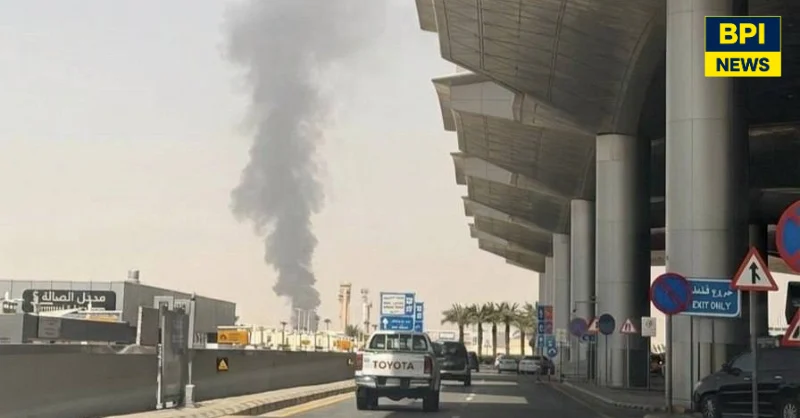
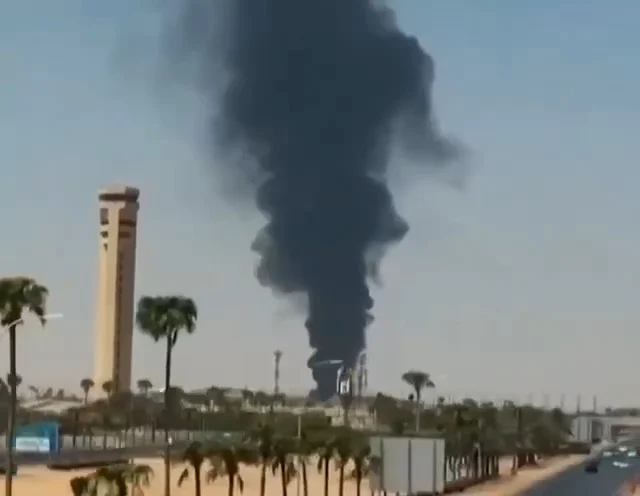
Flames and thick black smoke have been seen near Riyadh’s main international airport after Saudi Arabia issued an emergency warning over a hostile aerial threat to the capital.
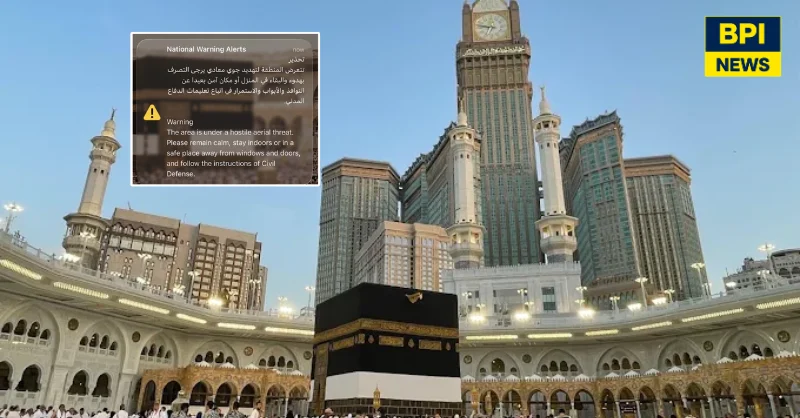
Saudi Civil Defence activated its National Early Warning Platform in Riyadh and nearby Al-Kharj during the early hours of Saturday, instructing residents to remain indoors, stay away from windows and open areas and follow official instructions.
The warning was later lifted, with authorities announcing that the immediate danger had passed.
The incident represents a significant escalation in the renewed confrontation between Saudi Arabia and Yemen’s Houthi movement, with Riyadh itself now being placed under aerial-threat warnings.
BPI News Speaks To Riyadh Resident
BPI News has spoken to an expatriate living in Riyadh who said sirens were activated in the capital before a series of loud explosions were heard.
He said the sounds appeared to include both incoming Houthi ballistic missiles and Saudi air-defence interceptors being launched to confront the attack.
The resident said the explosions were clearly audible during the early hours as emergency warnings were sent to mobile phones across the city.
Saudi authorities have not yet released a full account of what was intercepted or what, if anything, successfully struck the Riyadh area.
Flames And Black Smoke Near King Khalid International Airport
A witness cited by Reuters reported flames and a substantial plume of black smoke rising near King Khalid International Airport.
Images and reports circulating from Riyadh also showed dark smoke in the airport area.
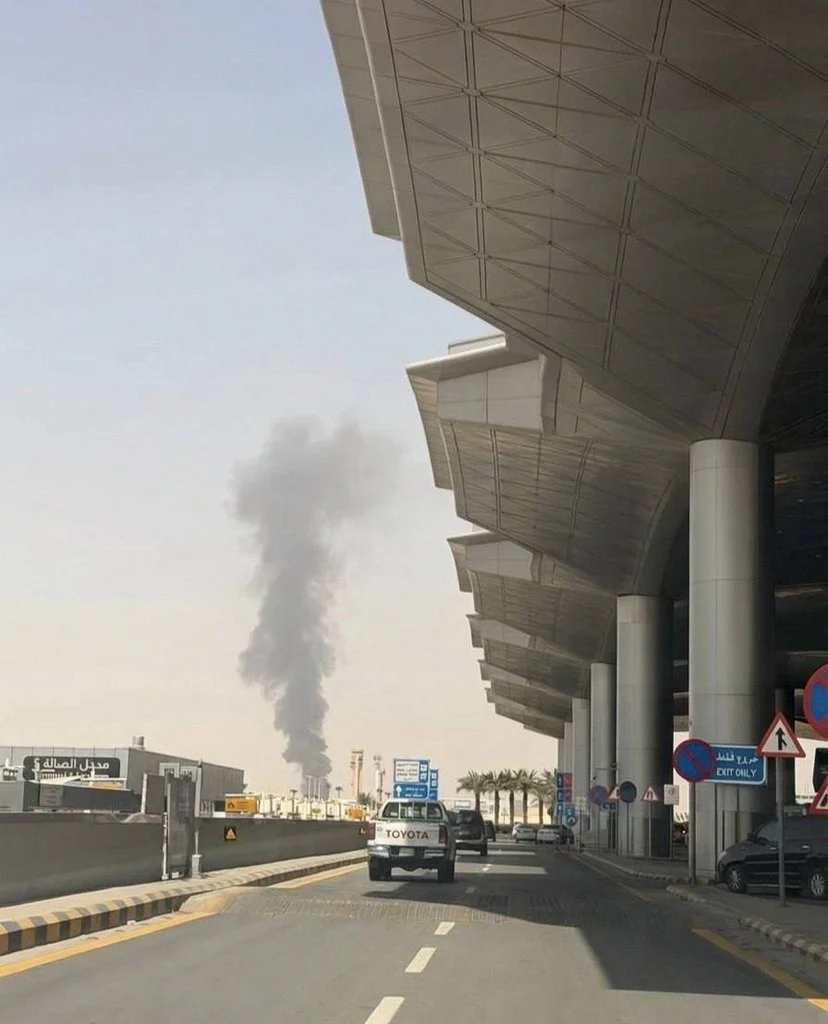
There are reports that fuel storage facilities at or near the airport were hit and caught fire.
However, Saudi authorities have not yet publicly confirmed that fuel tanks were struck, and the precise cause of the fire remains unclear.
Flights Disrupted
Flight operations at Riyadh’s international airport were disrupted during the incident as the aerial warning remained active.
The extent and duration of the disruption have not yet been fully detailed by Saudi authorities.
The emergency warning advised people to immediately move to the nearest safe location, remain inside buildings and stay away from windows, glass, balconies and rooftops.
Drivers receiving a warning were told to pull over away from bridges and tall buildings.
Saudi Civil Defence subsequently issued the all-clear for Riyadh and Al-Kharj.
First Major Aerial Warning For Riyadh In Latest Escalation
The Riyadh alert comes after repeated Houthi missile and drone attacks against other parts of Saudi Arabia in recent weeks.
Saudi cities including Makkah, Jeddah, Taif, Yanbu, Abha, Jazan and Khamis Mushait have all been placed under emergency warnings during the latest escalation.
Earlier this week, Saudi Arabia said a Houthi drone had been launched towards Makkah but was intercepted and destroyed before entering restricted airspace around the Holy City.
A separate interception over Taif resulted in falling debris which killed a Yemeni resident and injured a Saudi woman and Pakistani resident.
The warnings in Riyadh now show the geographic reach of the confrontation extending to the Saudi capital.
Houthis Had Threatened Retaliation
The latest incident followed renewed threats from Yemen’s Houthis after Saudi strikes on Sanaa.
Houthi military spokesman Yahya Saree accused Saudi Arabia of attacks against Yemen and threatened retaliation.
The group has intensified missile and drone operations against Saudi cities, energy installations and other infrastructure as fighting inside Yemen has also escalated.
Saudi Arabia has accused the Houthis of deliberately targeting civilian and economic infrastructure.
Makkah Pact Comes Under New Scrutiny
The attack has also placed fresh attention on the Makkah Joint Defence Agreement signed by Saudi Arabia, Pakistan and Türkiye on August 7.
The agreement contains a collective-defence provision stating that an armed attack against any one of the three countries will be regarded as an attack against all.
That language has led to comparisons with NATO’s Article 5 collective-defence principle.
However, Pakistan has repeatedly stressed that the agreement is defensive rather than offensive.
Pakistan’s Foreign Ministry has described the pact as intended to strengthen collective deterrence against external aggression and has said it is not directed against any country.
Pakistan Says Pact Is Defensive
Pakistan’s Foreign Office has subsequently reiterated that the alliance is primarily intended to ensure regional security through deterrence.
Pakistan’s military spokesman, Lieutenant General Ahmed Sharif Chaudhry, has also said the agreement has “no regional aspirations” and contains no aggressive or interventionist element.
Islamabad has said it intends to honour the agreement in both its intent and spirit but has not publicly explained exactly what military action would automatically follow an attack on Saudi Arabia.
Pakistan has also previously said that no military action under the pact was being discussed in response to earlier Houthi strikes.
Pact Says Attack On One Is Attack On All
The Makkah agreement was signed by Saudi Crown Prince Mohammed bin Salman, Turkish President Recep Tayyip Erdoğan and Pakistani Prime Minister Shehbaz Sharif.
It states that an armed attack against Saudi Arabia, Pakistan or Türkiye should be considered an attack against all three countries.
Pakistan has sought to frame the pact as a mechanism for deterrence rather than as the formation of an offensive military bloc.
That distinction is increasingly important as Saudi Arabia faces sustained attacks from Yemen while Pakistan also maintains diplomatic relations with Iran and has previously sought to avoid direct involvement in the Yemen conflict.
Saudi authorities have not yet issued a full assessment of the damage around Riyadh airport or confirmed reports that fuel storage tanks were struck.