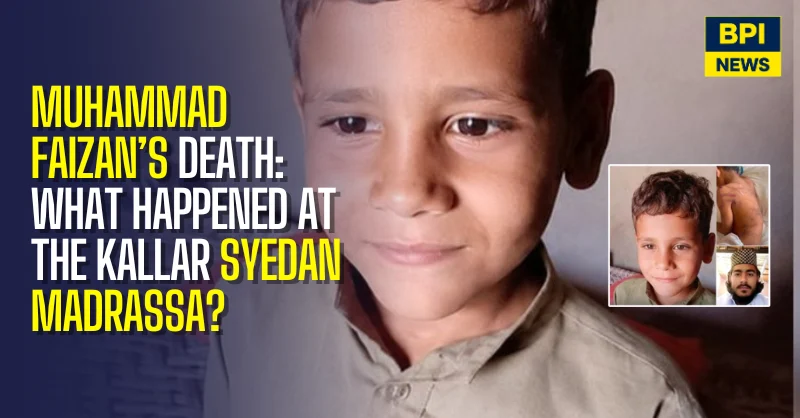
Feroz Khan, Islamabad- When Muhammad Sultan agreed to send his eldest son to a madrassa in Kallar Syedan, the teacher taking him there was someone from his own village.
According to Sultan’s statement to police, Qari Sanaullah Chishti promised that Muhammad Faizan would be looked after. There would be food, accommodation and religious education. Other children from the area were going too.
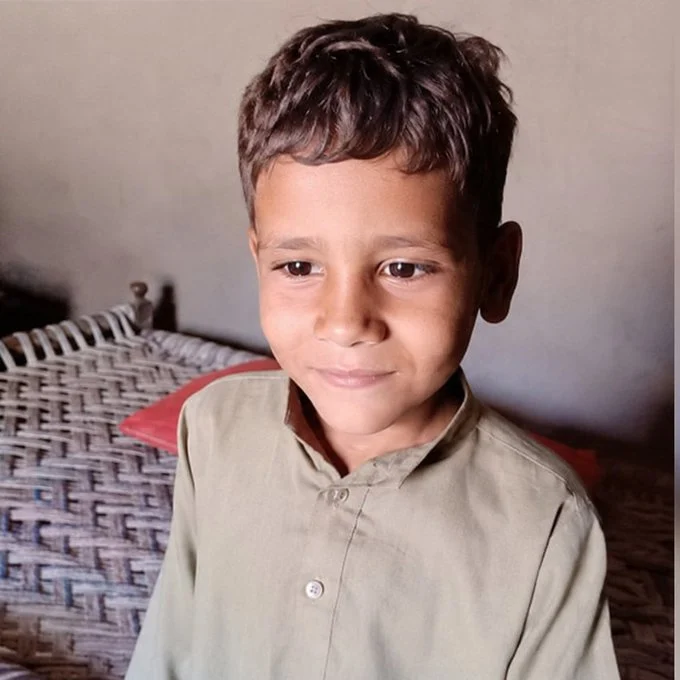
Around three months later, Sanaullah accompanied Faizan’s body back to Bhakkar.
The family says it discovered marks of violence while preparing the child for burial. What followed was a police case alleging not only a fatal beating, but also an attempt by people connected to the seminary to conceal what had happened and delay proper medical care.
BPI News has seen the First Information Report and reviewed journalist Abrar Qureshi’s later interview with Haji Muhammad Sharif, who oversees the organisation’s approximately 35 seminaries.
The FIR sets out the father’s allegations. The interview gives management’s response including Sharif’s acknowledgement that he learnt of the beating before Faizan died, although he says he did not know how badly the child had been injured.
A Father’s Trust
Faizan was the eldest of Sultan’s five children, according to the FIR registered at Kallar Syedan police station on the night of 25 August.
Most of the supplied local reporting identifies him as nine years old. Another account gives his age as 11.
Sultan told police that Sanaullah approached him about taking Faizan to the Mohi-ul-Islam Sadiqiya seminary in Nalla Muslimana. The teacher said he was already taking five other children and assured him that his son’s needs would be met.
Sultan agreed. Once Faizan was at the madrassa, Sanaullah helped arrange telephone calls between father and son.
On 24 August, at around 4.30pm, the teacher called with a different message. According to the FIR, he said Faizan was ill and asked Sultan to reach District Headquarters Hospital in Rawalpindi.
Sultan contacted his brother Zafar, who lived in Rawalpindi. Zafar asked their cousin Yaqoob to go to the hospital.
The FIR records that Sanaullah then told Yaqoob the boy had died. When Yaqoob arrived, he learnt that Faizan had been brought to hospital dead.
Zafar and Yaqoob travelled with Sanaullah to take the body home.
The Injuries Discovered Before Burial
Sultan told police that relatives found welts and other marks on Faizan’s body when they removed his clothes for the ritual washing before burial.
He sent his younger brother Tariq to fetch Sanaullah. According to his statement, the teacher’s house was locked from the outside.
Sultan later reached him by telephone and asked about the injuries.
The father alleges that Sanaullah admitted beating Faizan because he had failed to memorise his lessons. According to Sultan, the teacher said the child’s condition deteriorated afterwards.
That alleged admission comes from the father’s statement in the FIR. It has not been independently obtained by BPI News.
The family contacted police. Faizan’s body was taken back to Kallar Syedan, where a post-mortem examination was carried out at Tehsil Headquarters Hospital before it was returned to his relatives.
Who Else Was Told?
The father’s complaint names a series of people whom he alleges became involved after the beating.
According to Sultan’s account, Sanaullah said he contacted Hamza Tayyab, the Nalla Muslimana seminary’s in-charge. Hamza allegedly told him that he would inform administrator Asim Sharif.
The FIR then records the father’s allegation that Hamza relayed instructions from Asim to contact Imran, who was in charge of the Sir Suba Shah branch.
Imran allegedly took Faizan and Sanaullah to Ghulam Mujtaba, identified as the in-charge of the Balyam branch in Gujar Khan, where arrangements were made to look after the boy.
Sultan accuses those involved of concealing the incident and delaying proper treatment, contributing to his son’s death.
These are allegations in the father’s complaint. Police must establish what each person knew about Faizan’s injuries and what they did after being told.
The Days Before His Death
A local report published on 1 September alleged that approximately a week was lost while Faizan was taken to different private practitioners. It said he was eventually moved to a Rawalpindi hospital when his condition became critical.
Earlier reporting also described a local practitioner advising that he be taken elsewhere.
The later interview with Sharif returned repeatedly to this period. Qureshi put the date of the alleged beating at 17 August and Faizan’s death at 24 August.
There is still no complete account in the available material of where Faizan spent each of those days, which practitioners examined him or what treatment they prescribed.
Those details matter to the father’s allegation that proper care was delayed. Hospital and clinic records would also be needed to establish whether earlier treatment could have changed the outcome.
What Police Said About the Injuries
A police statement described multiple marks of severe physical assault on Faizan’s body.
A subsequent news report, citing a senior police officer familiar with the investigation and a family member, said the post-mortem examination found multiple fractures in one arm as well as marks of severe beating elsewhere.
BPI News has not reviewed the signed post-mortem report. The fractures are therefore reported findings attributed to those sources, rather than medical findings independently verified by this newsroom.
Sexual abuse was also alleged in some reporting and raised by Qureshi during the interview. No verified medical evidence available for this report establishes that allegation. The post-mortem findings and investigation would need to determine whether it is supported.
Arrest in Bhakkar
Early reports said police detained two people after registering the case. A report published on 1 September then recorded Sanaullah’s arrest in Bhakkar and his transfer to Kallar Syedan.
Rawalpindi City Police Officer Hassan Mushtaq Sukhera reportedly formed special teams to find the principal suspect and ordered investigators to examine the case from every angle.
Police said other suspects named in the case would be pursued. The available reports do not establish the present custody status of everyone named.
The CPO’s reported response was that violence against children was unacceptable and anyone found involved would face legal action.
There were also questions about the release of information. One supplied report cited unnamed sources claiming that access to the FIR had been restricted because of concerns about protests by the seminary administration. That claim has not been independently confirmed, and the available material contains no verified official explanation for any restriction.
Haji Sharif: “They Did Not Tell Me”
The latest reporting reviewed by BPI News is Abrar Qureshi’s interview with Haji Muhammad Sharif. BPI News has added AI English subtitles, and readers can watch the original interview by clicking here.
Sharif said he was in Britain when Faizan was beaten and returned to Pakistan on 22 August. He acknowledged learning about the incident after his return.
Asked whether management had informed him while he was abroad, his answer was that it had not.
He described this as a failure on their part, but defended their intentions. He said he had not been told the full extent of Faizan’s injuries and had understood the marks to be relatively minor.
Sharif said he never saw the injured child. He also alleged that Sanaullah had prevented others from properly seeing the injuries.
Qureshi asked whether he had dismissed anyone, including his son Asim, for failing to inform him. Sharif said he had not. He said he was angry with them and that they were cooperating with the investigation.
His answers leave a clear distinction between what he acknowledged and what he disputed. He accepted that he knew of a beating before Faizan died. He denied knowing how serious the injuries were.
Management’s Account of the Medical Care
Sharif said Faizan was taken to the Sir Suba Shah centre and that a doctor advised taking him to Rawalpindi.
According to his account, others offered to take the boy, but Sanaullah insisted on taking him himself. Sharif alleged that the teacher then switched off his telephone.
He rejected Qureshi’s suggestion that management sent Faizan’s body home with Sanaullah. He said the teacher took the child away and later accompanied the body on his own initiative.
Sharif also acknowledged that Asim had been informed about the incident. He said his son asked people closer to the location to find out what had happened.
This is management’s explanation. It differs from Sultan’s allegation that several people knowingly helped conceal the beating and delayed appropriate care.
During the interview, Sharif said he asked for the father’s telephone number and was told the admission paperwork was at the Nalla Muslimana institution.
He did not describe successfully contacting Sultan before Faizan’s death. In the father’s FIR account, the call telling him to come to hospital came from Sanaullah.
Support for Sultan and a Denied Settlement Offer
Sharif condemned the beating and said he helped police look for Sanaullah, including travelling to Bhakkar.
He also said he stood with Faizan’s father. When Qureshi pressed him on what help had actually been provided, Sharif promised assistance with expenses and legal support where requested.
The interview does not establish that the institution had already paid for a lawyer or met the family’s expenses.
Sharif denied an allegation put to him that money had been offered to settle the case.
He also said he was not personally named in the FIR, while acknowledging that his son was named. He maintained that the investigation should proceed freely and anyone found responsible should be punished.
When questioned about alleged sexual abuse, Sharif denied that such abuse occurred in the institutions. He said what he knew about Faizan concerned physical punishment and that the post-mortem report would establish the medical findings.
How the Wider Network Is Run
Qureshi’s questions then moved beyond the days before Faizan’s death to the organisation responsible for the madrassa.
Sharif said he oversaw approximately 35 seminaries, with around 1,500 to 1,600 children across the network. Those numbers have not been independently audited for this report.
He said the Nalla Muslimana institution had existed for around 10 to 15 years. He rejected suggestions that many branches were closed, identifying that institution as the one then shut.
Sharif described a system in which local management handled admissions and local communities also participated in running institutions.
Asked about teachers arriving from other districts with groups of children, he defended giving poor families access to education, food and accommodation. He rejected the suggestion that the seminaries had been handed over on a contractual basis.
But the interview did not establish what checks were made on Sanaullah before he began teaching, who independently checked on the children he brought or how parents could raise concerns without going through him.
Sharif said the institutions had been registered during the Musharraf period and referred to educational approvals elsewhere in the organisation. He did not provide a branch-by-branch account of current registration, inspections or child protection arrangements.
He acknowledged that shortcomings occurred and said management worked to correct them. He did not set out specific changes introduced after Faizan’s death.
British Donations and the Charity’s Accounts
The final part of the interview examined the organisation’s British funding links.
Sharif acknowledged receiving donations from the UK. He identified Chaudhry Zaigham Sharif as a relative involved in a UK-linked educational welfare charity bearing the Sharif name.
When asked about his son Nazim Sharif, he also acknowledged his involvement, while disputing the interviewer’s description of when he became a trustee.
Qureshi questioned him about annual collections approaching £100,000 and a smaller sum released. The transcript is unclear around the precise figures, and BPI News has not independently verified them against filed accounts.
Sharif said the people running the charity held the financial statements. He said money went into accounts rather than being handed to him personally and was released in stages.
Qureshi also challenged him over an earlier conversation in which, the journalist said, Sharif had denied a connection to the UK charity and said funding came from Pakistan. Sharif said he did not recall making those statements.
The interview alone does not establish the charity’s exact registered identity, its current trustees or how funds are allocated between the Pakistani institutions. Nor does it establish financial misconduct.
Sharif ended by saying that records were available for inspection. Donors, he said, could examine the account books and check how their money had been spent.