British Pakistani men filmed enjoying themselves at weddings have become the targets of an online pile-on, with abuse coming from both anti-immigration audiences and people mocking them through the language of their own community.
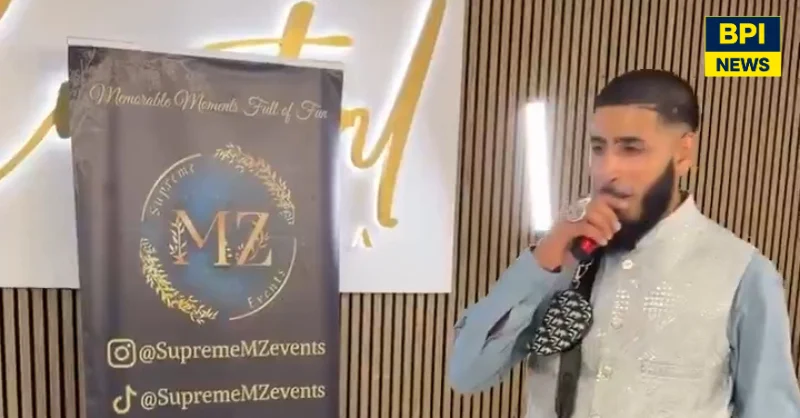
The clips show guests posing and dancing on 360-degree video booths. Some wear shalwar kameez with waistcoats, trainers and crossbody bags. They smile, move for the camera and take part in the sort of entertainment booked for weddings across Britain.
As the footage spread, comments about the dancing gave way to stereotypes about Pakistani households, insults directed at Muslims and sneering references to “Mirpuris”. Other posts brought Shia and Sunni identities into a discussion about men whose religious views were not established.
Comedian Guz Khan intervened in defence of one of the men.
“The brother is having fun and living his life whilst you moaning pricks are hating. Be more like him,” he wrote.
A wedding clip becomes an argument about immigration
Several of the circulating clips carry the branding of Supreme MZ Events, a Birmingham-based events business which advertises photo booths and wedding services.
Its name appears on the platform and banners visible in the footage. A screenshot of another clip includes a competition encouraging guests to take part in a dance trend, with a free service offered to the winner.
One repost by the X account Yookay Aesthetics, published on 16 September, displayed 14.3 million views when checked on 18 September. The account describes its subject as a changing Britain shaped by immigration and changing social norms, although its biography says its posts are not implicit value judgements.
That placed the footage before an audience already being invited to think about immigration. In the replies, one commenter mocked a man through a stereotype about sharing a small house with numerous relatives. A response to Guz Khan used an explicitly anti-Muslim insult.
There is a difference between finding a dance funny and using the person dancing to demean Pakistanis or Muslims. Some of the responses crossed that line plainly.
The posts reviewed do not establish a coordinated campaign or the politics of everyone who shared them. They do show how footage of an ordinary celebration became a vehicle for racial hostility.
The prejudice coming from within
Alongside that reaction was another, more familiar to people who have encountered prejudice within Pakistani and Muslim communities.
“Mirpuri” was used as a put-down. A regional identity became shorthand for someone supposedly embarrassing, badly dressed or lacking sophistication.
One defender disputed the label, claiming the man was from Jhelum in Punjab. But the same post insulted Punjabis, replacing one regional slur with another. The claim about the man’s origins has not been independently verified.
This kind of exchange does little to defend the people in the footage. It leaves the underlying prejudice intact: that a person’s behaviour can be explained, and their worth judged, by the place their family comes from.
The religious commentary was similarly detached from anything the men were shown doing. One post suggested a wedding guest was the sort of person who calls Shias unbelievers online. Replies continued the sectarian argument.
Nothing in the wedding material reviewed established that he had made such statements.
The criticism circulating within Muslim social media spaces therefore deserves scrutiny alongside the hostility from anti-immigration audiences. Sharing a religion, nationality or family background with someone does not make ethnic contempt harmless.
There are distinctions to preserve. Anti-Muslim abuse targets religion; anti-Pakistani racism targets ethnicity or perceived origin; sectarian abuse attacks people over divisions within a faith. Mockery of Mirpuris can combine regional prejudice with class snobbery. In these exchanges, several appeared together.
The individual faith of every commenter cannot be verified from a username or post. But the use of sectarian accusations and regional hierarchies makes clear that part of the pile-on was taking place through arguments within Muslim and Pakistani communities.
Why “Mirpuri” keeps being used as an insult
Mirpuri is an identity, not a description of someone’s manners, education or clothes.
Mirpur lies in Pakistan-administered Kashmir. Across the neighbouring region of northern Punjab is Potohar, also known as Pothwar. Families from these areas share close cultural and linguistic connections, including related varieties commonly described as Pahari-Pothwari.
That wider connection is often lost in British discussions, where “Mirpuri” is applied loosely to people whose families may come from different places.
Linguist Farah Nazir has written about the problems with treating “Mirpuri” as a straightforward name for the language. It describes an association with a place, while Pahari-Pothwari extends across a much wider area. Speakers also use different names for their language according to locality and identity.
Some of what gets labelled “Mirpuri culture” in Britain is therefore shared across a broader Pahari-Pothwari-speaking population. But it would be equally inaccurate to insist that everyone described as Mirpuri is actually from Pothwar. People can identify as Mirpuri and speak a variety of Pahari-Pothwari.
None of those distinctions can be settled by watching a man on a wedding booth. The men’s clothes do not establish their ancestral villages.
More troubling is the assumption behind the labelling: that identifying someone as Mirpuri is, by itself, a sufficient explanation for why others should laugh at him.
Class snobbery behind the comments
These attitudes did not begin with this week’s videos.
A study by Alexandra Hall and Steve Taylor, published in 2023, examined class, consumption and status within Pakistani communities in Newcastle. It documented prejudice towards Mirpuris, including descriptions of them as “new money” and criticism of their wedding spending.
Those were prejudices expressed by participants in a particular study, not facts about Mirpuris. They offer useful context for the present argument, where clothes and celebrations again become grounds for judging a whole community.
The suggestion is that certain people wear their money badly, celebrate too loudly or fail to display the right kind of respectability. Regional identity then supplies the insult.
When those judgements appear beneath videos already attracting racist attention, they can reinforce the same humiliation, even where the people making them have very different politics.
A Pakistani or Muslim commenter may reject the racism of the far right while still treating another Pakistani community as inferior. Both positions can exist in the same comment section.
The clothes are part of their British life
Much of the attention has settled on the combination of traditional clothing and contemporary accessories: shalwar kameez, embroidered waistcoats, trainers, watches and crossbody bags.
For the wearer, there need be nothing unusual about that combination. These are clothes available to the same person, worn together at a celebration.
British Pakistani weddings bring generations and influences into the same room. Guests can dress in clothes associated with their family heritage while choosing shoes and accessories from the fashions around them.
The men in the clips do not owe strangers a more carefully managed version of themselves. Nor does an awkward pose or an outfit someone dislikes say anything useful about whether a community belongs in Britain.
Some viewers have treated the videos as ordinary internet humour. Captions about finding money in a pocket or receiving a message use the dancing as a reaction, without necessarily attacking the person’s background.
Others have objected to how far the sharing has gone. One user, posting as AT, pointed out that the men had been having fun at a wedding and were now being circulated across Twitter. In a follow-up, the account distinguished harmless jokes from posts intended to mock them.
That distinction is more useful than pretending every joke is racist, or that racism disappears because it is presented as a joke.
Supporters share footage of haircuts for homeless people
People defending one of the wedding guests have also circulated footage which they say shows him giving free haircuts to homeless people.
A screenshot supplied to BPI News places a wedding clip beside footage of a barber cutting an older man’s hair. A separate reply to the viral post makes the same claim.
Those sharing it were trying to show something about the person beyond the few seconds being mocked. Guz Khan’s defence was simpler: the man was enjoying himself at a wedding. He did not need to produce a record of charitable work to be allowed that.