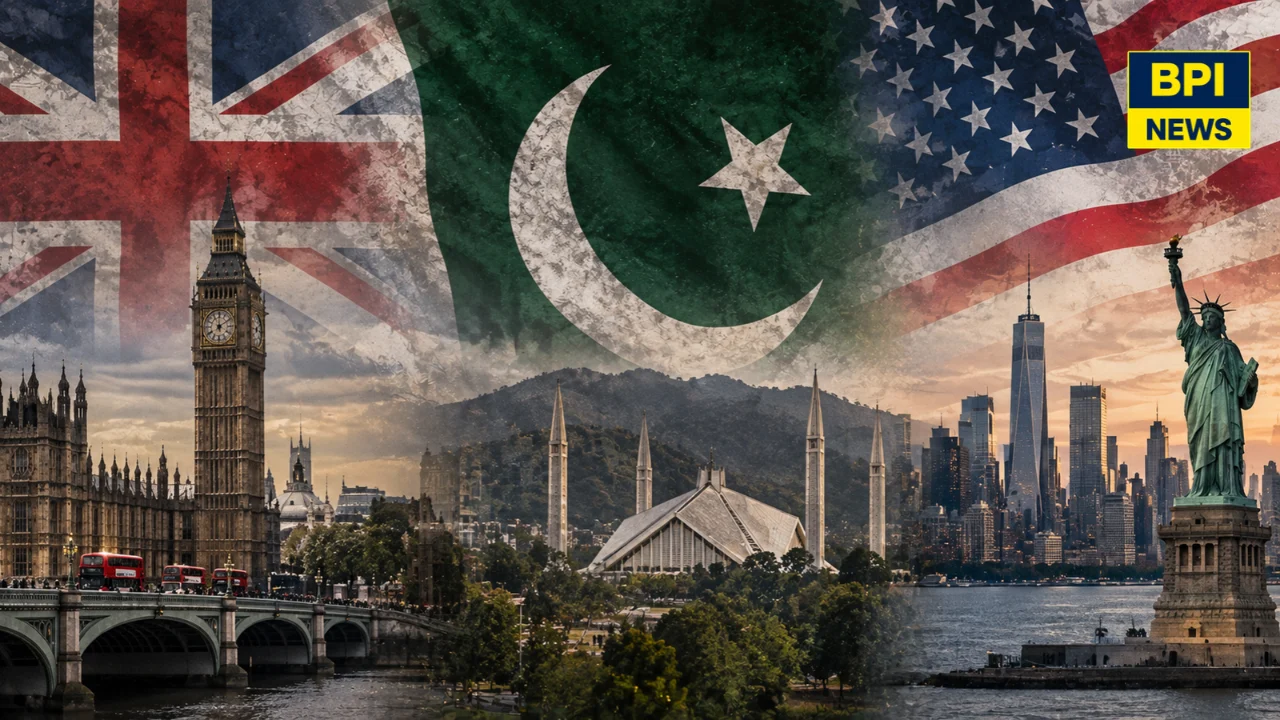
The flags and landmarks of Britain, Pakistan and the United States reflect three countries that have shaped two very different Pakistani diaspora stories, from post-war labour migration in Britain to professional migration in America.
A growing argument has been circulating across Pakistani social media in which Pakistani Americans are presented as more educated, sophisticated and successful than British Pakistanis, while the British community is caricatured through references to Mirpur, northern English towns, grooming gangs, drug dealing, taxi driving and supposedly poor integration.
Posts circulating on X comparing Pakistani Americans with British Pakistanis have helped fuel a wider debate over migration, class, Mirpuri identity and the different trajectories of the two diasporas.
For BPI News, the British Pakistani Index, this was always going to require a deeper examination. British Pakistanis are the community this publication was created to report on, and the increasingly casual use of “Mirpuri” as a synonym for backwardness raises a much bigger question about how class, migration, language and regional prejudice have shaped the way one of the world’s largest Pakistani diasporas is viewed.
The comparison with America initially appears compelling because Pakistani Americans do, on average, include an unusually large professional and highly educated population. Doctors, engineers, academics, scientists and wealthy entrepreneurs feature prominently in the community’s public image. By comparison, the story of British Pakistanis began overwhelmingly among industrial workers who settled in the mills and factories of post-war Britain.
But those two outcomes cannot be understood without first recognising that Britain and America did not receive comparable groups of Pakistani migrants. They received people at different periods, under different immigration systems, from different socioeconomic backgrounds and, crucially, from very different parts of Pakistan and Pakistan-administered Kashmir.
The debate therefore tells us considerably more about migration history and class selection than it does about whether one Pakistani diaspora is somehow “better” than another.
Britain Has A Much Larger Pakistani Population
The scale of the British Pakistani community is often overlooked in comparisons with America. The 2021 Census recorded approximately 1.59 million people identifying as Pakistani in England and Wales alone, before adding Pakistanis living in Scotland and Northern Ireland.
The United States, despite having a population more than five times larger than the United Kingdom, has a much smaller Pakistani-origin population. Recent US Census estimates put the number identifying as Pakistani alone at roughly 625,000.
England and Wales therefore contain around two and a half times as many people recorded as Pakistani as the whole of the United States.
That difference changes almost everything about the two diaspora experiences. Pakistani Americans are dispersed across an enormous country and frequently form one component of much larger Asian and Muslim populations. British Pakistanis, by contrast, have established major population centres where the community has enough density to shape local businesses, schools, mosques, politics and entire neighbourhoods.
Birmingham alone contains close to 200,000 Pakistani residents. Bradford, Blackburn, Oldham, Rochdale, Manchester, Luton, Slough and several London boroughs also contain large and established populations.
A community of that scale inevitably produces both success stories and social problems in greater absolute numbers, while its visibility ensures that those problems become part of Britain’s national conversation in a way Pakistani-American issues often do not.
Britain And America Selected Different Migrants
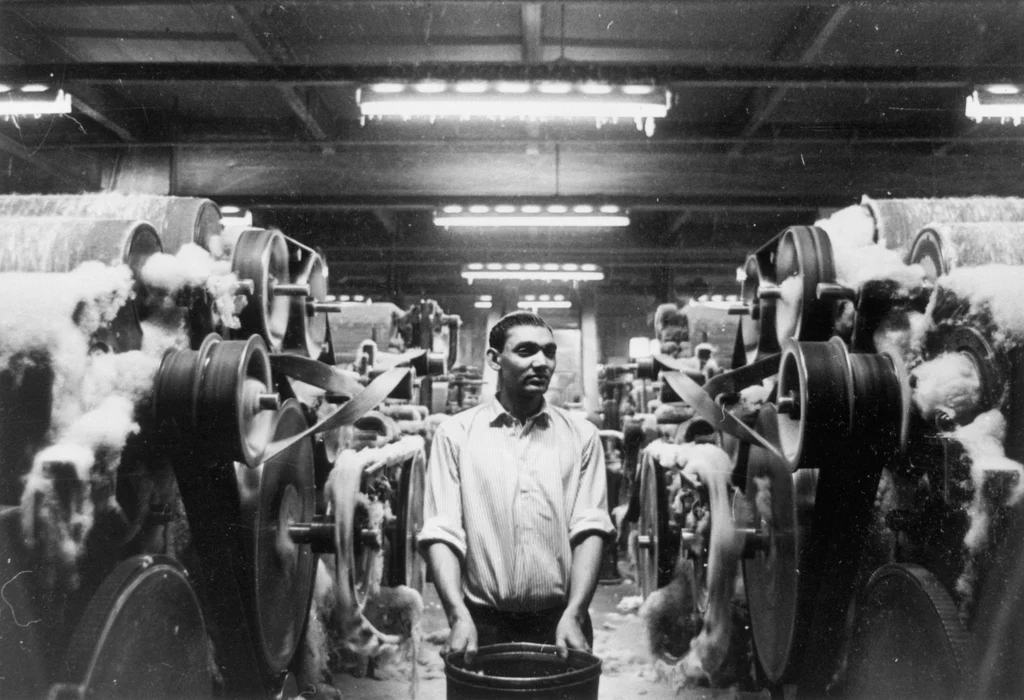
A Pakistani migrant working inside a Bradford wool mill during the post-war industrial era. Britain’s first major Pakistani migration was shaped heavily by labour demand rather than professional selection.
The most important distinction begins with immigration policy.
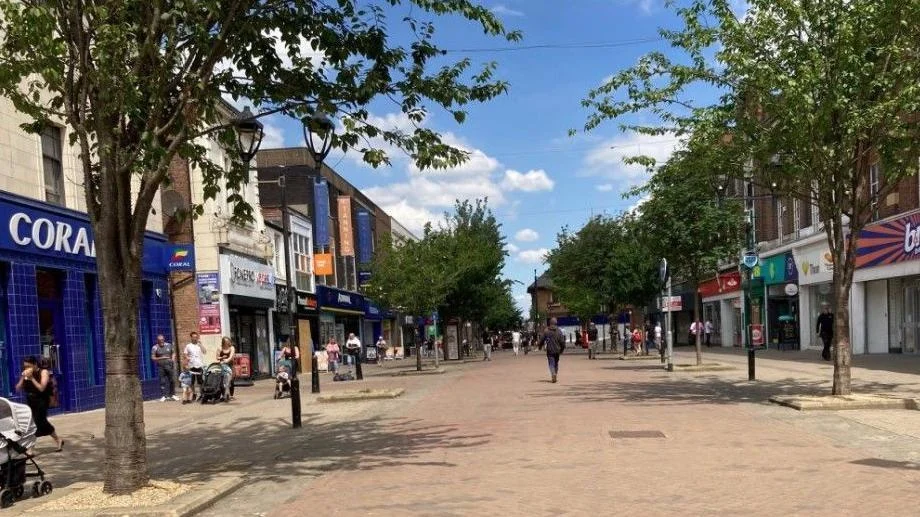
Britain’s major Pakistani migration developed during the post-war period when industrial Britain needed workers. Men arrived to work in textile mills, factories, foundries, transport and manufacturing, particularly across Yorkshire, Lancashire and the West Midlands.
They were not selected because they possessed postgraduate degrees or professional qualifications. Britain needed labour, and migrants filled those jobs.
The American story developed differently. Pakistani immigration to the United States expanded particularly after the 1965 Immigration and Nationality Act, which dismantled the old national-origin quota system and opened routes that strongly favoured skilled and educated migration.
Doctors, engineers, academics, scientists and other professionals therefore formed an unusually important part of early Pakistani migration to America. Family migration later broadened the community, but the initial selection effect remained significant.
That makes many modern comparisons deeply misleading. If one immigration system disproportionately selects educated professionals from across Pakistan while another draws working-class labourers from rural districts, the communities do not begin from the same starting line.
Decades later, comparing their average outcomes without acknowledging how they were selected turns the consequences of immigration policy into a supposed judgement about culture.
Why Britain Became So Closely Associated With Mirpur
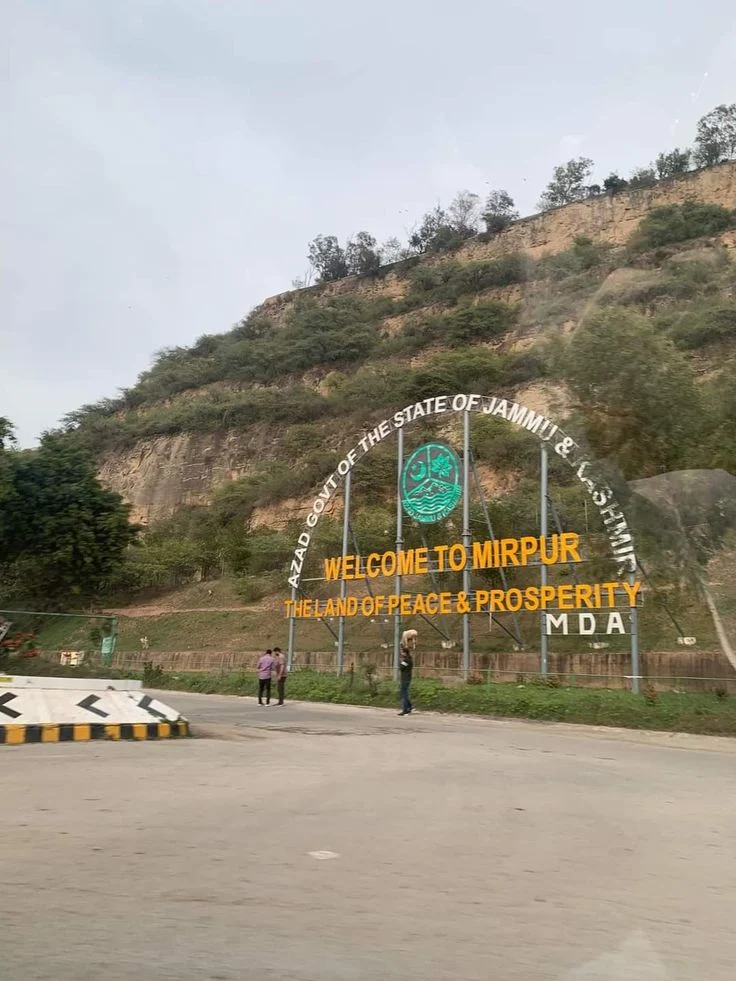
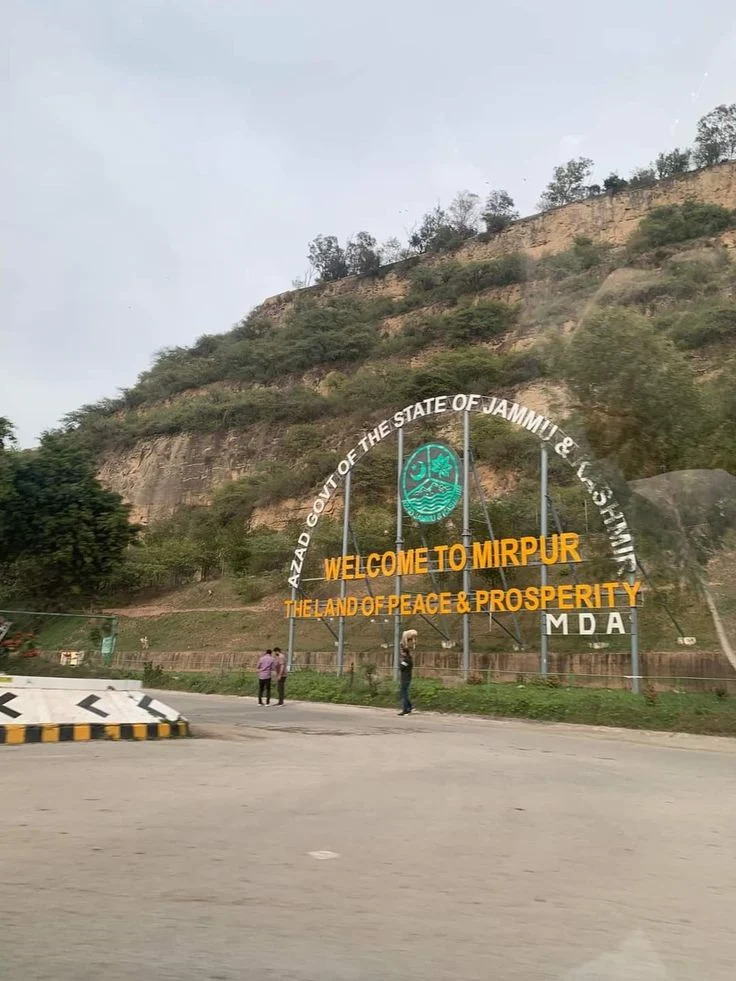
The entrance to Mirpur in Azad Jammu and Kashmir. Mirpur and the wider Pahari-Pothwari region form the ancestral homeland of a large proportion of Britain’s Pakistani-origin population.
British Pakistani migration is unusual because such a large proportion of the community originates from a relatively concentrated geographical area.
Academic estimates vary, but research has frequently estimated that around 60 to 70 per cent of British Pakistanis have roots in Mirpur and the surrounding region of Azad Jammu and Kashmir. Migration developed through powerful family, village and biraderi networks, particularly as workers already established in Britain sponsored or helped relatives and neighbours to follow them.
The construction of the Mangla Dam in the 1960s also displaced communities in the Mirpur region during roughly the same period that British industry was looking overseas for labour.
Over time, those migration chains became self-reinforcing. A man from one village settled in Bradford or Birmingham, found employment and accommodation, then helped brothers, cousins or neighbours make the same journey. What began as labour migration gradually became the transplantation of entire extended social networks.
This is why Britain developed a Pakistani diaspora with such a distinctive Pahari-Pothwari character while America’s Pakistani community was drawn from a geographically broader and more professionally selected population.
What Does ‘Mirpuri’ Actually Mean?
This is also where the language used in the online debate becomes misleading.
In British Pakistani conversation, “Mirpuri” is often used extremely loosely as a label for Pahari-Pothwari-speaking people generally, including families whose ancestral homes are not actually inside Mirpur district.
The linguistic reality is more complicated. Researchers describe a broader Pahari-Pothwari language complex containing closely related varieties spoken across Mirpur, Kotli, Bhimber and neighbouring areas extending towards the Potohar plateau and Rawalpindi region. Speakers themselves variously describe their language as Pahari, Pothwari, Mirpuri, Punjabi or simply apni zaban, meaning “our own language”.
Academic research has specifically noted that “Mirpuri” became an umbrella term in Britain even where speakers themselves preferred Pahari or Pothwari. One linguistic study records claims that the label itself became popular in Britain as a way of describing migrants from the wider Azad Kashmir community.
This matters because social media increasingly uses “Mirpuri” not as a precise geographical description but as a broad cultural label for British Pothwari-speaking Pakistanis and Kashmiris.
A person from Kotli, Gujar Khan, Kallar Syedan, Jhelum or another part of the wider linguistic belt may therefore find themselves called “Mirpuri” online despite having no family connection to Mirpur city.
The term has become cultural shorthand rather than accurate geography.
How ‘Mirpuri’ Became A Class Insult
There is nothing inherently insulting about being from Mirpur. It should be no more derogatory than calling somebody Lahori, Karachiite or Peshawari.
Yet sections of Pakistani social media increasingly use “Mirpuri” to imply someone is uncultured, poorly educated, rural, loud, badly dressed or socially backward.
This prejudice is not merely anecdotal. Academic research into Pakistani communities in Britain has documented examples of non-Mirpuri Pakistanis referring to Mirpuris as “low class” or “rough”. Linguistic research also demonstrates that Pahari-Pothwari has historically lacked the prestige afforded to Urdu, which is associated with education, official communication and Pakistan’s urban middle classes.
What appears online as a cultural judgement is therefore often a class judgement.
Someone whose family came from Lahore or Karachi, speaks polished Urdu and belongs to an educated professional family may fit the image of Pakistani sophistication promoted through television, universities and urban elite culture.
A Pothwari-speaking family whose grandfather worked nights in a Bradford textile mill occupies a very different position in that social hierarchy.
This is one reason “Mirpuri” has gradually become detached from its literal geographical meaning and turned into a catch-all insult for a particular type of British Pakistani.
From Kachay Makaans To Kothis
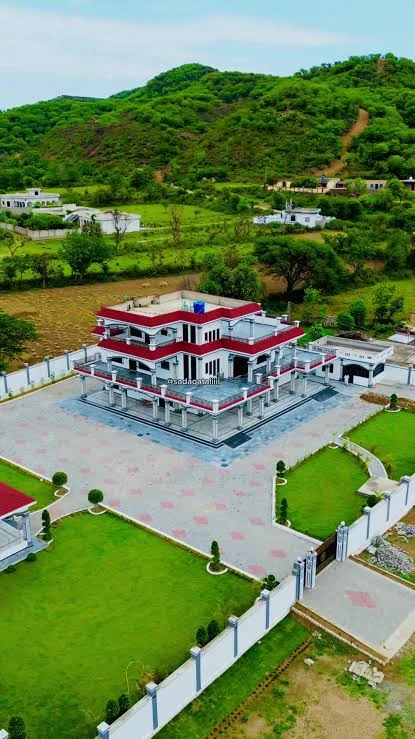
Large villas and kothis have become a familiar feature of Mirpur and the wider Pahari-Pothwari region, reflecting decades of remittances and investment from families established in Britain.
There is another side to the British Pahari-Pothwari story that is rarely acknowledged in these comparisons.
Many first-generation migrants came from rural communities where families lived with considerably fewer material resources than they possess today. Some came from villages containing kachay makaans.
Kacha makaan literally refers to an unbaked, non-permanent or mud-built house, as opposed to a pakka structure constructed permanently from brick and cement.
The contrast with what exists across parts of the region today is extraordinary.
Across Mirpur and the wider Pahari-Pothwari belt, diaspora wealth transformed villages and towns. Large detached homes appeared alongside roads that had once been surrounded by basic rural housing. Mirpur itself became famous for imposing diaspora-funded properties, and the landscape around parts of Azad Kashmir and northern Punjab is filled with homes built from money earned in Britain.
The word frequently used for these houses is kothi.
In Urdu and regional usage, kothi means a large house, villa, bungalow or mansion, particularly a substantial permanent home associated with wealth and status.
Among diaspora families, parts of the Pahari-Pothwari region have effectively become a landscape of kothis. International reporting from Mirpur has described the large tiled villas and palatial homes surrounding the Mangla region as physical evidence of decades of British remittances.
That transformation deserves to be understood for what it represents.
Within the space of one or two generations, men who arrived in Britain with little money, limited formal education and sometimes limited English worked factory shifts, drove buses and taxis, opened shops and restaurants, bought homes in Britain, educated their children and simultaneously financed houses and entire families thousands of miles away.
Families went, quite literally in some cases, from kachay makaans to kothis, from modest mud-built or semi-permanent village homes to substantial brick-built villas and mansions.
That is not a story of failure.
It is one of the most visible examples of working-class upward mobility anywhere in the Pakistani diaspora.
British Pakistanis Built Something From Almost Nothing
The first generation did not arrive with the advantages enjoyed by many professional migrants entering the United States.
Many came with little formal schooling and entered some of Britain’s hardest industrial jobs. They worked in mills, foundries, factories, transport and manufacturing, often taking shifts that established workers did not want.
They frequently lived several men to a house while sending part of their wages back to families in Pakistan and Kashmir.
As manufacturing declined, the next phase of economic survival increasingly came through self-employment. Corner shops, takeaways, restaurants, textile businesses, wholesale companies, taxis and property became routes towards financial independence.
Some of those businesses remained small family operations. Others became enormous.
The Bestway Group, founded by Sir Anwar Pervez after he had worked as a bus conductor in Britain, eventually became one of Britain’s largest privately owned companies.
Sir Anwar Pervez went from working as a bus conductor in Britain to founding Bestway Group, now one of Britain’s largest privately owned businesses.
The broader story is not that every British Pakistani became wealthy. Poverty and inequality remain substantial issues within sections of the community.
The more important point is where the community started.
British Pakistanis did not arrive as a pre-selected professional elite. A substantial part of the population came from rural working-class families and then built businesses, bought property, financed relatives overseas and sent their children into universities and professional careers within a relatively short historical period.
Comparing their grandchildren directly with the descendants of doctors and engineers selected for American immigration without accounting for those starting points misses perhaps the most important feature of the entire debate.
Pakistani Americans Have An Extraordinary Success Story Too
None of this diminishes Pakistani-American achievement.
Pakistanis in the United States have produced extraordinary success stories in science, academia, medicine, technology, business and entertainment.
Pakistani-born physicist Nergis Mavalvala became Dean of MIT’s School of Science and was a major figure in the scientific work surrounding the detection of gravitational waves.
Shahid Khan arrived from Lahore and built one of America’s largest automotive-parts fortunes before becoming the owner of the Jacksonville Jaguars and Fulham Football Club.
Kumail Nanjiani became a major Hollywood actor and Oscar-nominated screenwriter, while Arooj Aftab became a Grammy-winning artist.
Pakistani-American doctors, engineers and entrepreneurs occupy influential positions across the country.
The mistake occurs when these successes are used as evidence that Pakistani Americans belong to a supposedly superior cultural strain of Pakistanis.
America selected heavily for professional skills. The resulting professional success should therefore surprise nobody.
Britain Produced A Different Kind Of Influence
British Pakistanis have developed a form of influence that is often much more visible in politics and public life.
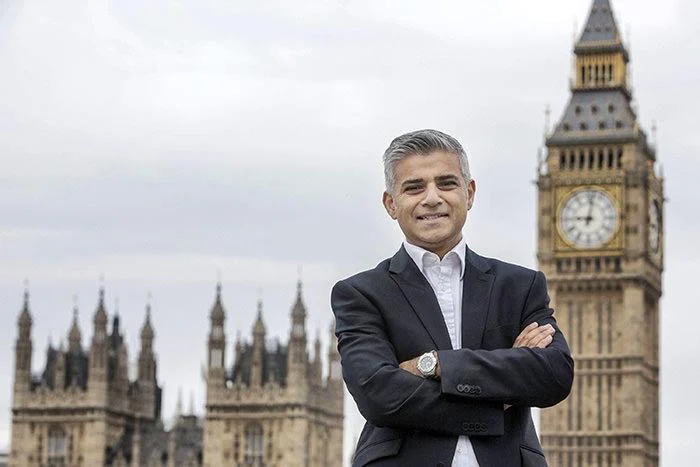
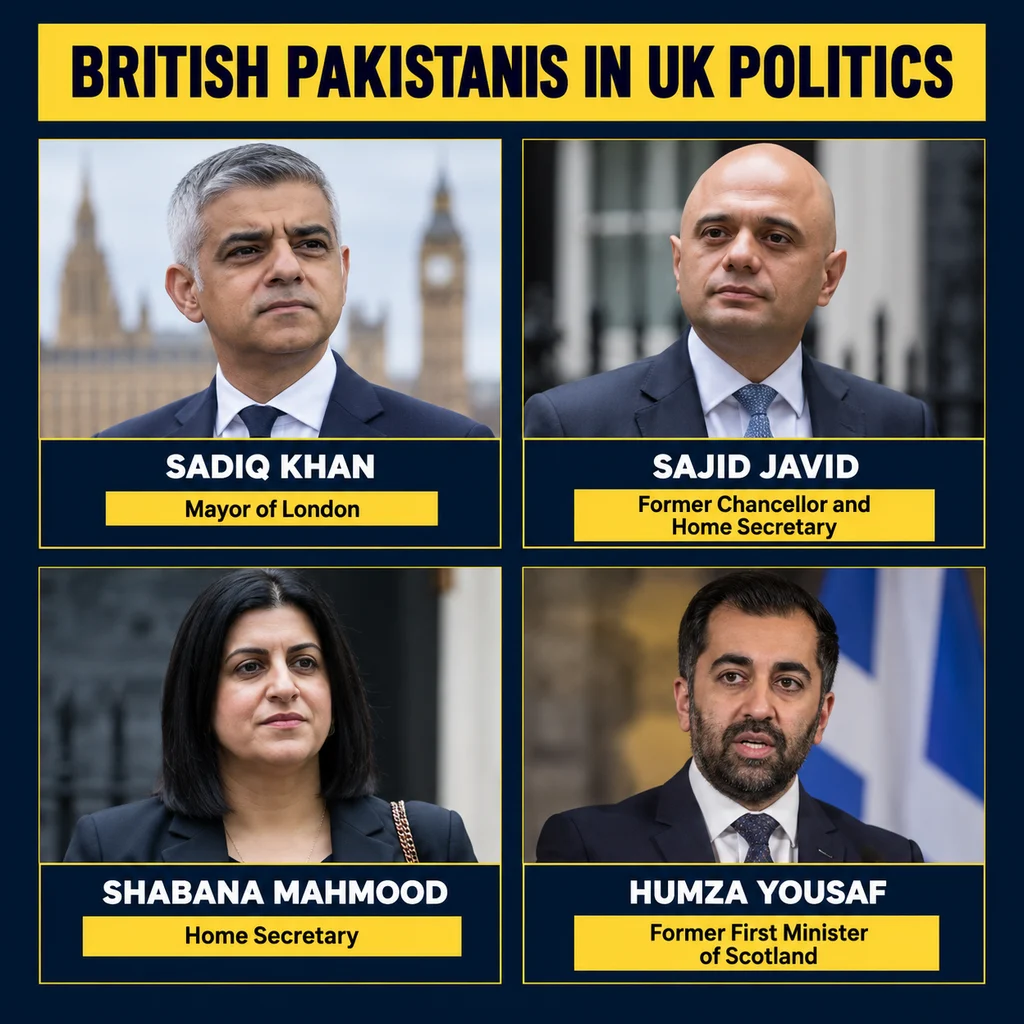
Sadiq Khan, the son of Pakistani immigrants, has been elected Mayor of London three times.
Sadiq Khan, the son of Pakistani immigrants, has been elected Mayor of London three times and is one of Britain’s most prominent Pakistani-origin politicians.
Sajid Javid, whose father worked as a bus driver after arriving from Pakistan, has served as Chancellor of the Exchequer, Home Secretary and Health Secretary.
Shabana Mahmood has reached one of the highest levels of the British government.
Humza Yousaf, the son of a Pakistani father, became First Minister of Scotland.
British Pakistanis have also become globally recognised in entertainment and sport. Riz Ahmed became an Oscar-winning actor, Zayn Malik became an international music star, Amir Khan became a world champion boxer and Olympic medallist, while Moeen Ali and Adil Rashid became major England cricketers.
The political difference between Britain and America is particularly striking because British Pakistanis are concentrated enough to influence constituencies and local authorities directly.
Bradford, Birmingham, Blackburn and parts of London contain Pakistani populations large enough to create significant electoral blocs, producing generations of councillors, MPs, mayors, ministers and political organisers.
Pakistani Americans are becoming increasingly politically active, but their smaller and more geographically dispersed population gives them a different form of political influence.
Britain Built A Dense Muslim Infrastructure
Bradford Central Mosque, reflecting the extensive religious infrastructure developed by British Muslim communities. Bradford’s large Pakistani population has helped establish a dense network of mosques, madrasas, halal businesses and community organisations.
Religion adds another dimension to the contrast.
British Pakistani settlement contributed heavily to the creation of one of the most developed Muslim infrastructures in the Western world. Mosques, madrasas, Islamic schools, halal butchers, charities, funeral services, Islamic finance businesses and halal restaurants became embedded in towns and cities with large Pakistani populations.
For someone living in Bradford, Birmingham, Blackburn or parts of London, it is entirely normal to have several mosques and numerous halal restaurants within a short distance.
Britain’s geography makes this particularly significant. Muslim populations are concentrated within a relatively small country, allowing commercial and religious infrastructure to develop around dense local demand.
America also has thousands of mosques and extensive halal networks, particularly in New York, New Jersey, Chicago, Houston, Dallas, Detroit and other major metropolitan centres.
However, the United States is geographically vast and its Muslim population is more dispersed.
The claim sometimes made in the online debate that Pakistani Americans simply “eat haram” cannot be supported as a general statement, and BPI News would not present it as fact. Individual Muslims follow different levels of religious observance, and there is no reliable dataset showing what proportion of Pakistani Americans consume non-halal meat.
What can be said more confidently is that British Pakistanis generally live within a much denser everyday halal ecosystem. In many heavily Pakistani areas, avoiding non-halal meat requires almost no additional effort because halal food is embedded into the local economy.
That is another way in which the British Pakistani experience differs substantially from the American one.
The Grooming-Gang Question Cannot Be Avoided
Rotherham became central to Britain’s debate over group-based child sexual exploitation after investigations exposed extensive abuse and serious institutional failures.
No serious examination of the stereotype can ignore the most damaging association attached to British Pakistani men.
Several of Britain’s most notorious group-based child sexual exploitation cases involved men of Pakistani heritage, including cases in Rotherham, Rochdale and other towns.
Those crimes were real, the victims were real and institutional failures allowed abuse to continue for far too long.
Baroness Casey’s 2025 national audit found evidence of significant Asian and Pakistani over-representation among suspects in some local group-based child sexual exploitation investigations. In Operation Stovewood, which investigated abuse in Rotherham, nearly two-thirds of 323 designated suspects were recorded as being of Pakistani ethnicity.
Those findings should not be minimised in order to protect a community’s reputation.
However, Casey’s review also made an equally important finding: Britain’s national ethnicity data remains too incomplete to establish a reliable national ethnic offending rate for grooming gangs.
The responsible position therefore lies between two politically convenient extremes. It is wrong to pretend ethnicity played no role in particular local offending networks where the evidence shows disproportionate Pakistani representation, but it is equally wrong to extrapolate the crimes of hundreds of offenders into a characteristic of roughly 1.6 million British Pakistanis.
Social media frequently makes precisely that leap.
A horrific collection of criminal cases becomes evidence about an entire diaspora, and “Mirpuri” becomes attached to offences committed by individuals as though regional ancestry itself explains criminal behaviour.
That is collective stereotyping rather than statistical analysis.
The Same Problem Exists With The Drug-Dealing Stereotype
Stock image illustrating drug dealing. British Pakistanis are frequently associated with drug crime in online stereotypes, despite the absence of a reliable Pakistani-specific crime rate that can be directly compared with Pakistani Americans.
British Pakistanis also encounter a persistent association with drug dealing and organised crime.
Pakistani-origin organised crime groups certainly exist in Britain, just as organised criminal networks exist among White British, Albanian, Turkish, Kurdish, Black British and numerous other populations.
What does not exist is a clean, nationally comparable dataset showing a Pakistani-specific offending rate in Britain against a Pakistani-American offending rate in the United States.
British criminal-justice statistics frequently aggregate Pakistanis into broader Asian categories, while American crime statistics do not publish a directly equivalent Pakistani-ancestry offending rate.
It is therefore impossible to produce the neat Britain-versus-America crime comparison often implied online without manufacturing statistical certainty that the available data does not support.
The British community is larger, denser and more visible. British Pakistani offenders consequently appear repeatedly in British national reporting, whereas Pakistani Americans form a much smaller proportion of a country containing more than 340 million people.
Headline visibility is not the same thing as a crime rate.
Why ‘Mirpuri’ Remains The Easy Punchline
The entrance to Mirpur in Azad Jammu and Kashmir. Mirpur and the wider Pahari-Pothwari region form the ancestral homeland of a large proportion of Britain’s Pakistani-origin population.
The online stereotype survives partly because it combines several layers of prejudice that reinforce each other.
There is class prejudice towards rural families. There is linguistic prejudice towards Pahari-Pothwari speakers. There is the cultural prestige attached to Urdu and urban Pakistani identity. There is British prejudice towards working-class northern towns. There are genuine social problems that can then be attached to the entire group, and there is the modern social-media tendency to reduce millions of people into a meme.
The result is that “Mirpuri” can be deployed against someone who may not even be from Mirpur.
In Britain it has increasingly become shorthand for a broad Pothwari-speaking cultural population, often encompassing people from Azad Kashmir and neighbouring northern Punjab whose accents, family structures and migration histories overlap.
Yet the very traits that are mocked also reveal something unusual about the diaspora.
These communities maintained family networks across continents, built mosques and businesses, bought homes, financed villages, entered politics and created a British-born generation whose opportunities bear little resemblance to those available to their grandparents.
The kothis scattered across the Pahari-Pothwari belt are perhaps the most visible monument to that story.
They are sometimes mocked as oversized diaspora houses or symbols of status competition, and some undoubtedly are.
But they also tell another story. Behind many of them was a man working nights in Birmingham, Bradford, Luton or Blackburn, sending money home month after month so that his family could live in circumstances he himself had never enjoyed growing up.
So Are American Pakistanis Better Than British Pakistanis?
The question ultimately asks us to compare two populations that were never socially equivalent in the first place.
Pakistani America was heavily shaped by selective professional migration.
Pakistani Britain was heavily shaped by rural and industrial working-class migration, particularly from the wider Pahari-Pothwari-speaking region.
One community arrived with a disproportionately high concentration of doctors, engineers and graduates.
A substantial part of the other arrived with comparatively little money, worked industrial jobs, endured Britain’s deindustrialisation and then created businesses, institutions and professional opportunities for the generations that followed.
Both produced remarkable achievements.
Both contain wealthy and poor families, highly educated and poorly educated people, deeply religious and secular people, criminals and public servants, successful businesses and struggling households.
The British Pakistani story simply began from a very different starting point.
For BPI News, that is the part of the argument most easily lost when “Mirpuri” is thrown around as an insult.
Within little more than a generation, families went from kachay makaans, basic mud-built or non-permanent homes, to kothis, large permanent villas and mansions. Men who arrived with few possessions created businesses, bought British homes, sent money to parents and siblings overseas and educated children who became doctors, lawyers, accountants, politicians, athletes and entrepreneurs.
That does not mean British Pakistanis should be romanticised or shielded from criticism. Serious social problems within sections of the community deserve serious reporting, whether they involve crime, deprivation, educational inequality, forced marriage, cousin marriage or sexual exploitation.
But criticism and contempt are not the same thing.
Calling every Pothwari-speaking British Pakistani “Mirpuri” and then using Mirpuri as shorthand for criminality, ignorance or backwardness does not explain the diaspora.
It obscures it.
The more revealing comparison is not between an imagined superior American Pakistani and an inferior British Pakistani.
It is between where the communities started and what they built from those starting points.
Seen that way, the Pahari-Pothwari British Pakistani story is not primarily one of people who failed to integrate or advance.
It is the story of a largely rural working-class migration that, in barely a few generations, built wealth, institutions, political influence and opportunities that many of the first migrants could scarcely have imagined when they arrived.